

OTTAWA – When Mark Carney described Canada’s clash with the United States as a war, he framed a trade breakdown as something far larger than a disagreement over tariffs. The episode argues that Canada’s trade dispute is tied to U.S. political pressure before the midterm elections and a broader fight over the global financial system.
That is a sweeping claim, and the argument depends on how readers interpret the timing of trade talks, Canadian political outreach, and the risks facing U.S. Treasury markets.
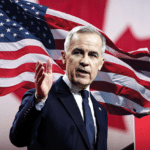
Carney Called the Trade Breakdown a “War”
The episode opens with Canada’s decision to withdraw its negotiators from trade talks with the United States. At a press conference, a reporter asked why Carney’s tone sounded like he was preparing for a trade war.
Carney replied that Canada had been attacked: “Like you’re at war when you get attacked. We got attacked.”
The phrase raised the episode’s central question. If Canada had a chance to reach an agreement with its largest trading partner, why walk away from the final stage of negotiations?
Julian Assange’s post on X provides the starting point for that interpretation. As quoted in the episode, Assange said Carney suspended trade talks to influence the U.S. midterm elections and was betting on Democrats retaking Congress. The episode does not present that post as complete proof. Instead, it uses the claim to examine Carney’s political strategy in the United States.
Why Canada Cannot Win a Trade War
The video argues that a prolonged trade confrontation makes little economic sense for Canada because of its dependence on access to the U.S. market.
Economic strategist James Thorne, as cited in the episode, said the United States takes roughly 72% of Canadian goods exports. The episode also repeats President Trump’s claim that Canada does about 95% of its business with the United States, though it does not provide a source or definition for that figure.
The negotiation account from Jamieson Greer
U.S. Trade Representative Jamieson Greer gave the episode’s account of how the talks reached a breaking point. According to Greer, the dispute began with Canadian restrictions affecting American wine and spirits, autos, and dairy products.
The U.S. response was a set of targeted tariffs covering about 5% of Canadian exports. Greer said Canada later requested negotiations, and both sides reached enough agreement by Tuesday night to prepare a deal announcement.
However, Greer said Canada sought more in the final hours. He characterized the U.S. offer as the best market access available to any country and said the Canadian position no longer made economic sense.
Energy, metals, and supply-chain exposure
The episode points to several areas where Canada remains tied to the U.S. economy:
- It says 60% of Quebec’s refinery supply comes from Western Canada through pipelines that pass through the United States.
- It argues that Canada exports critical minerals and metals for processing, then imports finished goods.
- It identifies steel and aluminum as flashpoints, noting 50% U.S. tariffs and Greer’s claim that Washington offered to cut them sharply.
The argument is straightforward: a country with tightly linked energy routes, industrial supply chains, and export markets has limited room to inflict equal damage on a much larger economy.
The “United States Stakeholder Strategy”
The episode says Carney’s approach goes beyond formal negotiation with the White House. It presents Canadian outreach to American political networks as part of a campaign to shape public opinion and pressure the Trump administration from outside the executive branch.
Maya Johnson’s role
The episode identifies Maya Johnson as an American Democratic operative who worked on Hillary Clinton’s 2016 presidential campaign and later had ties to the Biden and Harris campaigns.
According to the video, Johnson joined Carney’s team in February as a senior adviser for “United States Stakeholder Strategy.” In July, the episode says, Carney promoted her into a newly created chief operating officer role.
The video treats the appointment as evidence that Canada’s U.S. strategy is built around political relationships, not only trade diplomacy. That interpretation rests on the relevance and scope of Johnson’s work, which the episode describes but does not independently document.
Freeland’s “donut strategy”
Former Canadian finance minister Chrystia Freeland gave the strategy a memorable name during the 2018 USMCA negotiations: the “donut strategy.”
In the episode, Freeland says Canada should make its case beyond the White House and speak directly to Americans. The idea is to build support around the president, much as a donut surrounds its center, through lawmakers, businesses, public opinion, and other political contacts.
The “donut strategy” is a communications and political-outreach approach aimed at influencing voices outside the president’s immediate circle.
The episode also cites Industry Minister Melanie Joly’s comments about meeting with mostly Democrats during U.S. travel. It pairs those comments with criticism of Trump’s trade policy from Democratic figures including Chuck Schumer and Pete Buttigieg.
The video sees a coordinated pattern. Readers may see shared political incentives, parallel messaging, or a more direct form of coordination. The transcript itself does not establish which explanation is correct.
The Midterm Election Argument
The episode links trade conflict to the political calendar because economic conditions often shape how voters judge an administration. It argues that the Trump administration is attempting to bring manufacturing and supply chains back to the United States, but that effort requires time.
It cites JD Vance’s remarks in Middletown, Ohio as an example of an economic program centered on domestic production and the ability of a single income to support a family.
The risk of disruption before results arrive
The video says many Americans still feel the effects of decades of deindustrialization and financial instability. Under that view, any new trade shock could deepen uncertainty before the administration’s economic program produces visible gains.
Canada’s withdrawal from negotiations therefore has political value in the episode’s analysis. A more difficult trade relationship could create uncertainty for businesses and households, then give critics another line of attack against the White House.
The video argues that Carney’s goal may be to delay or weaken Trump’s economic turnaround before the midterm elections. That is the episode’s core political allegation, not an established finding.
Iran’s focus on U.S. debt
The episode also cites Iranian Foreign Minister Abbas Araghchi, who posted on X that an “economic D-Day” narrative distracted from America’s debt and rising interest costs. The post referenced a U.S. national debt of about $40 trillion.
The video connects Araghchi’s comments to the Canadian dispute by arguing that both point toward the same vulnerability: American economic pain, especially if borrowing costs rise.
Two Economic Systems
The episode presents the conflict as a contest between competing economic models. It describes one as a Hamilton-style American system built around production, industrial capacity, and protective tariffs. The other is described as a British imperial or globalist system rooted in debt, financial control, and international networks.
| Hamilton-style American system | British imperial system as described in the video |
|---|---|
| Treats productive industry as the source of national wealth | Treats financial control as the primary source of power |
| Supports domestic manufacturing and supply chains | Depends on global financial networks |
| Uses tariffs to protect strategic production | Uses debt and money systems as tools of influence |
| Seeks to reverse deindustrialization | Is associated with deindustrialization and financial bubbles |
This comparison summarizes the episode’s political framework. It is not an independent economic analysis or a consensus description of either historical system.
Within that framework, Carney is portrayed as a defender of the global financial order. The video links this claim to his background as a former governor of the Bank of Canada and the Bank of England, then interprets his use of the word “war” as recognition that the dispute reaches beyond trade policy.
Scott Bessent and the Yen Carry Trade
The episode says Treasury Secretary Scott Bessent is dealing with the financial threat beneath the political dispute. Its focus is the yen carry trade, a long-running practice in which investors borrow Japanese yen at very low interest rates and place that money in assets with higher returns.
The video says hedge funds, including funds based in London and the Cayman Islands, used this form of low-cost borrowing for more than two decades. It places the rise of the practice around the era of NAFTA, though it does not offer evidence that one caused the other.
Why unwinding the trade could raise rates
The episode’s concern is that Japan’s effort to unwind these positions could lead to sales of long-term U.S. Treasury securities. A wave of Treasury sales could push yields higher, which would raise government borrowing costs and could feed into mortgage rates and other consumer borrowing costs.
The chain of risk described in the video is:
- Investors unwind yen-funded positions.
- Institutions sell U.S. Treasury securities to raise funds or rebalance.
- Heavy selling puts upward pressure on Treasury yields.
- Higher yields raise borrowing costs across parts of the U.S. economy.
The episode’s concern is that a rushed unwinding could strain the Treasury market and raise borrowing costs at a politically sensitive moment.
What the FIMA Facility Does
The video identifies the Foreign and International Monetary Authorities, or FIMA, Repo Facility as a tool for reducing the risk of forced Treasury sales.
The Federal Reserve describes the facility as a temporary source of U.S. dollars for foreign official institutions that hold Treasury securities, offering an alternative to selling those securities into the open market. Its official FIMA facility explanation makes clear that this is a backstop repo arrangement, not a permanent exchange of Treasury bonds for cash.
That distinction matters. In a repo transaction, an eligible foreign official institution temporarily obtains dollars against Treasury collateral, rather than permanently dumping bonds into the market.
The episode argues that Bessent wants FIMA expanded because he understands the size of the financial bubble and the danger of disorderly Treasury selling. It also points to Bessent’s prior work for George Soros, claiming Trump selected him because he understands how financial crises and speculative pressures develop. That explanation of the appointment is the video’s interpretation.
The Visible Trade Fight and the Financial Fight
The episode connects two stories that often appear separate. On the surface, Canada and the United States are arguing over tariffs, dairy access, automobiles, steel, aluminum, and trade rules.
Below that surface, the video sees a struggle over debt, Treasury-market stability, interest rates, industrial policy, and control of the international financial system.
Carney is portrayed as pursuing pressure against the Trump administration through trade conflict and U.S. political outreach. Bessent is portrayed as trying to contain risks within the financial system while the administration rebuilds domestic production.
That framing gives the video’s title its meaning. Bessent, in this account, understands that the Canada dispute is one front in a larger economic conflict. Whether readers accept that interpretation will depend on how they assess the evidence for political coordination and the episode’s description of the global financial order.
A Conflict Larger Than Tariffs
Carney’s decision to leave the talks gave the episode a concrete event to examine. Yet its main argument goes far beyond the negotiating table: trade disputes can become political tools when they affect prices, confidence, borrowing costs, and voter sentiment.
The video presents the Canada trade conflict as a test of competing views about how the United States should organize its economy. One side emphasizes domestic production and tariffs. The other, in the episode’s telling, defends a debt-driven international system.
The immediate trade terms still matter. However, the episode argues that the larger question is whether economic disruption can alter American politics before a broader industrial and financial strategy has time to take hold.