

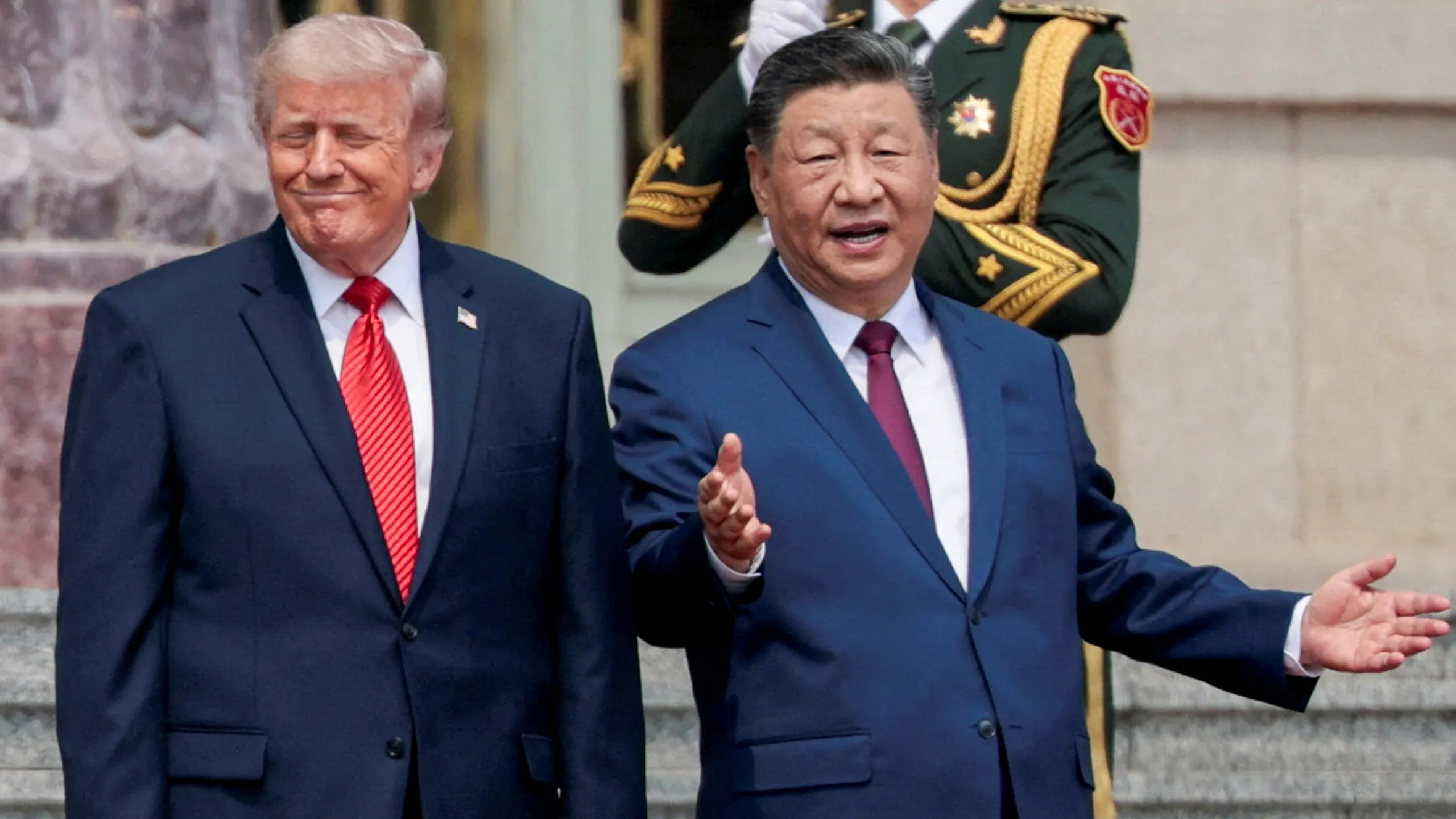

WASHINGTON, D.C. — President Donald Trump recently wrapped up a high-stakes, two-day summit with Chinese President Xi Jinping. On the surface, the visit to Beijing looked like a diplomatic victory. The optics were carefully managed.
There were long walks in centuries-old gardens, friendly handshakes, and public smiles. Both leaders spoke highly of each other. The rhetoric between the United States and China, which had been boiling over in recent months, suddenly cooled down.
But beyond the warm words, how meaningful are the results?
When Air Force One lifted off from Beijing, the White House claimed several major wins. Trump touted “fantastic trade deals.” Both nations agreed to push for a stable Middle East. Most importantly, Beijing sent a clear signal to Iran to keep the vital Strait of Hormuz open to global shipping.
These are not small achievements. However, foreign policy is rarely free. Every concession at the negotiating table comes with a price tag. To secure these wins in trade and Middle East stability, the United States may have made quiet, long-term sacrifices. The unresolved imprisonment of Hong Kong activist Jimmy Lai and Trump’s highly controversial remarks about Taiwan suggest that Washington has given up significant geopolitical ground.
In this deep dive, we will break down the real outcomes of the Trump-Xi meeting. We will look at the trade deals, the Iran strategy, the human rights failures, and the Taiwan comments that have American allies deeply worried.
A Shift in Tone: Seeking “Strategic Stability”
To understand the summit, you first have to understand the mood. When President Trump arrived in Beijing, the relationship between the two superpowers was on thin ice. Trade wars, artificial intelligence competition, and military build-ups in the Pacific had both sides on edge.
China’s President Xi Jinping wanted to change the temperature. He welcomed Trump to the Zhongnanhai compound, the historical and highly secure center of the Chinese government. The leaders drank tea and walked through the gardens. They ate elaborate meals featuring kung pao chicken, scallops, and stewed beef. It was a classic display of soft power.
During these talks, Xi brought up a concept known as the “Thucydides Trap.” This is a historical theory. It suggests that when a new, rising power (like China) challenges an established power (like the United States), war is almost always the result. By bringing this up, Xi was sending a message. He was telling Trump that both nations must work hard to avoid a catastrophic conflict.
Trump, for his part, was eager to show that he could negotiate peace and prosperity. He praised Xi as a “great leader” and a “friend.” The public statements from both sides focused heavily on “strategic stability.”
This means both countries agreed to stop yelling at each other in the press. They agreed to keep their economies running without sudden shocks. But as analysts were quick to point out, warm words do not always equal solid agreements. The real test of the summit lies in the specific policies discussed behind closed doors.
The Middle East: Finding Common Ground on Iran
One of the most pressing issues on Trump’s agenda was not actually about China at all. It was about the Middle East.
The ongoing conflict involving Iran has been a major headache for the White House. Global oil prices are highly sensitive to Middle East violence. And no waterway is more important to the oil trade than the Strait of Hormuz. Roughly 20 percent of the world’s oil passes through this narrow channel. If Iran were to block the Strait, gas prices around the world would skyrocket. This would hurt the American economy and Trump’s political standing at home.
Trump went to Beijing knowing that China has unique leverage over Iran. China is the biggest buyer of Iranian oil. Because of this, Beijing has a direct line to the leadership in Tehran. Trump needed Xi to pick up the phone and tell Iran to leave the Strait of Hormuz alone.
Surprisingly, he got almost exactly what he asked for.
Following the meetings, the Chinese foreign ministry issued statements calling for the free flow of energy. They publicly opposed any militarization of the strait. Trump told reporters that he and Xi “feel very similar on Iran.” He noted that both countries want the conflict to end and the waterways to stay open.
This is a real result. Having China publicly pressure Iran is a major diplomatic win for Washington. The Guardian noted that the White House readout of the talks highlighted this agreement as a key takeaway. Beijing does not want a global energy crisis any more than Washington does. A blocked strait would hurt China’s manufacturing sector just as badly as it would hurt American drivers.
However, there is a catch. China’s statement was just a statement. Beijing did not commit to any military action or sanctions against Iran. They simply agreed on the principle that the strait should remain open. Still, in the world of high-stakes diplomacy, getting China to publicly align with the U.S. on a Middle East security issue is a notable achievement.
“Fantastic Trade Deals”: The Economic Bottom Line
For President Trump, foreign policy is often seen through the lens of business. He measures success in dollars, jobs, and exports. Therefore, trade was always going to be the centerpiece of his Beijing visit.
Before leaving China, Trump announced to the press that he had secured “fantastic trade deals.” He said these agreements would be great for both nations. Specifically, he mentioned that China had agreed to resume buying American agricultural products and commercial airplanes, likely from Boeing.
For American farmers, this is welcome news. China is the largest market for U.S. agriculture. When trade tensions rise, farmers in the American Midwest are usually the first to feel the pain. By securing a promise for more soybean and corn purchases, Trump can return home and tell his rural base that he delivered a win.
But the details of these trade deals remain incredibly vague.
- There was no grand signing ceremony.
- There were no official press releases from major companies outlining the exact dollar amounts.
- The two leaders also entirely avoided the topic of tariffs, which have been a massive source of friction.
It appears that both Trump and Xi decided to focus on the easy wins. They agreed to basic buying and selling to make the markets happy. They kicked the harder economic issues—like technology theft, AI competition, and complex tariffs—down the road. This strategy keeps the peace for now, but it does not solve the deep economic rivalry between the two nations.
The Human Rights Deficit: The Tragedy of Jimmy Lai
While trade and oil were front and center, human rights took a back seat. And no issue highlights this more clearly than the case of Jimmy Lai.
Jimmy Lai is a 78-year-old Catholic media tycoon and prominent pro-democracy activist from Hong Kong. When China cracked down on Hong Kong’s freedoms and imposed a harsh national security law, Lai was arrested. He has spent years in prison, sometimes in solitary confinement. To many lawmakers in the United States, Lai is a symbol of freedom. He represents the fight against oppressive, authoritarian governments.
Before the summit, there was immense pressure on President Trump to secure Lai’s release. Human rights groups, Catholic organizations, and members of his own party urged him to make it a priority. Many hoped that Trump would use his leverage to free Lai and other political prisoners.
Trump did bring up the issue. He asked Xi Jinping directly about releasing Jimmy Lai. But the response he got was a flat refusal.
Speaking to reporters, Trump admitted that he could not persuade the Chinese leader. “He told me, Jimmy Lai is a tough one for him to do,” Trump said.
Rather than pushing harder or threatening economic consequences, Trump seemed to accept the answer and move on. He shifted the conversation back to trade and agricultural purchases. For human rights advocates, this was a devastating moment. It signaled to Beijing that the United States cares more about selling soybeans and airplanes than it does about defending democratic freedoms.
This is one of the hidden costs of the summit. By softening his stance on Jimmy Lai, Trump essentially gave China a free pass on its human rights record. It tells the world that America’s commitment to freedom and democracy can be pushed aside if the business deals are good enough.
The Taiwan Shockwave: A Dangerous Concession
The most sensitive, dramatic, and consequential moments of the entire Beijing summit centered around one small island: Taiwan.
Taiwan is a self-governing democracy located just off the coast of China. It is a technological powerhouse, producing the vast majority of the world’s advanced microchips. However, China considers Taiwan to be a breakaway province. President Xi Jinping has made it clear that he wants to bring Taiwan under Beijing’s control, and he has not ruled out using military force to do it.
For decades, the United States has walked a careful line. America officially recognizes Beijing, but it also provides Taiwan with the weapons it needs to defend itself. This keeps the peace by making an invasion too costly for China to attempt.
During the summit, Xi made Taiwan his absolute top priority. He delivered a stern warning to Trump. Xi said that the Taiwan question is the most important issue in the US-China relationship. He warned that if the situation is not handled properly, the two nations could face “clashes and even conflicts.”
Faced with this threat, Trump’s response shocked many foreign policy experts.
Instead of standing firm on America’s commitment to Taiwan, Trump wavered. On his flight back to Washington, he gave an interview to Fox News. He explicitly warned Taiwan against declaring independence. Then, he openly questioned why the United States should even be involved in protecting the island.
“I’m not looking to have somebody go independent,” Trump said. “And, you know, we’re supposed to travel 9,500 miles to fight a war. I’m not looking for that. I want them to cool down. I want China to cool down.”
These comments were a massive departure from traditional American policy. But Trump went even further. He admitted that he was reconsidering a massive, $14 billion arms sale to Taiwan. This weapons package, which includes air defense systems, is vital for Taiwan’s security. By delaying it, Trump is directly weakening Taiwan’s ability to protect itself.
Perhaps even more alarming, Trump discussed these arms sales directly with Xi Jinping. This action breaks a long-standing U.S. policy known as the 1982 “Six Assurances,” which states that Washington will not consult with Beijing before selling weapons to Taiwan. When asked about this, Trump dismissed the old agreement, saying he had to talk to China to avoid a war.
Analyzing the Hidden Costs
So, what are the real consequences of Trump’s comments on Taiwan?
First, they have deeply unsettled American allies in the Asia-Pacific region. Countries like Japan, South Korea, and the Philippines rely on the United States for security. If America is unwilling to travel “9,500 miles” to defend Taiwan, these nations will start to wonder if America will defend them. It creates a vacuum of trust.
Second, Trump’s hesitation emboldens Beijing. China’s main goal is to isolate Taiwan and cut off its military support. By stalling the $14 billion arms deal and publicly questioning the defense of the island, Trump gave Xi Jinping exactly what he wanted. He signaled that America’s defense of Taiwan is negotiable.
This is the ultimate hidden cost of the Beijing summit. Trump secured short-term victories in agricultural trade and Iranian shipping routes. But to get those wins, he had to trade away long-term strategic leverage in the Pacific. He allowed China to dictate the terms of the Taiwan relationship.
Foreign policy experts refer to this as transactional diplomacy. It treats global security like a real estate deal. You give a little here to get a little there. But geopolitics is much more complex than a simple business trade. When you compromise on democratic principles and security guarantees, you invite future instability.
If China believes that the United States is no longer fully committed to Taiwan’s defense, the chances of a Chinese invasion actually increase. Weakness often invites aggression. By trying to avoid a war today, Trump’s concessions might accidentally spark a much larger conflict tomorrow.
The Broader Impact on U.S.-China Relations
As the dust settles from the summit, the new reality of U.S.-China relations is coming into focus. The era of pure hostility might be paused, but the underlying tensions remain entirely unresolved.
The two superpowers are still locked in a fierce competition for global dominance. They are racing to develop the best artificial intelligence. They are fighting for influence in the Global South, from Africa to South America. They are rapidly expanding their military capabilities.
A friendly lunch in Beijing does not erase these deep, structural conflicts. The “strategic stability” that both leaders praised is likely fragile. It is a temporary truce born out of convenience. Trump needed a foreign policy win for his domestic audience. Xi needed economic breathing room to deal with his own domestic challenges.
But when the next crisis hits—whether it is a cyberattack, a clash in the South China Sea, or a new dispute over technology—the smiles from the Zhongnanhai gardens will fade quickly.
A Summit of Compromise
President Trump’s summit in Beijing was a defining moment for his foreign policy. It showed the world exactly how he operates on the global stage. He proved that he can sit down with adversaries and hammer out practical agreements.
Securing China’s help in keeping the Strait of Hormuz open is a genuine achievement. It will help stabilize global energy markets during a chaotic time in the Middle East. Likewise, reopening agricultural trade lines will provide much-needed relief to American farmers.
But the cost of doing business with Beijing was incredibly high.
By walking away from Jimmy Lai, the United States missed a crucial opportunity to stand up for human rights and democracy. And by wavering on Taiwan’s defense, Washington sent a chilling message to its allies across the globe.
The real legacy of this summit will not be the agricultural purchases or the polite diplomatic statements. The legacy will be the geopolitical ground that was quietly surrendered. Trump may have avoided the Thucydides Trap for now, but in doing so, he has fundamentally altered the balance of power in the Pacific. The true price of these “fantastic deals” will only become clear in the years to come.
Trending News:
The Trump Effect: How Endorsed Candidates Are Dominating Key State Primaries
China’s Multi-Billion Dollar Push to Shape U.S. Media and Academia