



OTTAWA – Canada’s Prime Minister Mark Carney and Conservative Leader Pierre Poilievre are currently locked in a fierce political dispute over the newly opened Gordie Howe Bridge.
Despite Canadian taxpayers funding the entire $6.4 billion construction cost, a controversial new agreement splits toll revenues with the United States for the next 15 years. The crossing between Windsor and Detroit opened on July 27th, but critics are aggressively demanding the immediate release of the deal’s full legal text.
The Gordie Howe Bridge is finally open to cross-border traffic. However, the celebrations have quickly been overshadowed by a fierce political fight over money. Canadian taxpayers footed the massive $6.4 billion bill to build the impressive span.
Now that the bridge is officially operating as of July 27th, a massive dispute has erupted. The core argument focuses entirely on who actually gets to collect the toll revenue. Politicians in Ottawa are clashing over the exact terms negotiated with the Americans.
Key Takeaways
- Massive Public Investment: Canada paid the entire $6.4 billion cost to construct the new border crossing.
- Revenue Sharing Dispute: A newly revised agreement splits net toll revenues evenly with the United States for 15 years.
- Calls for Transparency: Conservative Leader Pierre Poilievre is demanding that Prime Minister Mark Carney release the exact text of the deal.
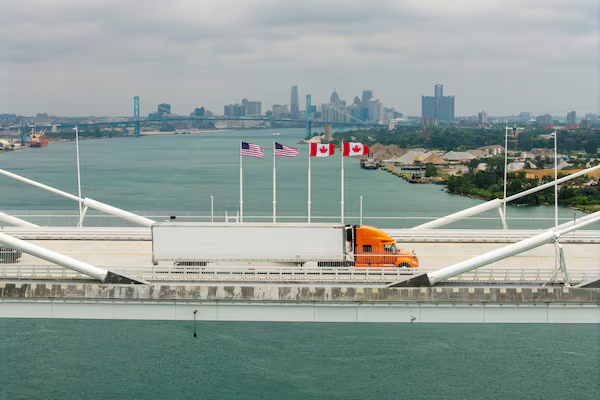
The striking new cable-stayed bridge connects Windsor, Ontario, with Detroit, Michigan. It stands as one of the most significant infrastructure projects in recent North American history. The crossing is designed to streamline trade and reduce heavy traffic at the nearby Ambassador Bridge.
Canada took on the immense financial burden to ensure the project actually moved forward. Taxpayers covered the entire $6.4 billion construction cost without direct American funding. In return, Canadians expected a clear path to getting that massive investment paid back.
Under the original 2012 deal, the financial terms were incredibly straightforward and clear. Canada would collect and keep all of the bridge’s toll revenues for decades. This money would flow directly back to Ottawa until the entire construction debt was fully repaid.
Initial estimates suggested it would take at least 50 years to recover those costs. Only after the debt was cleared would Canada and Michigan eventually split the ongoing profits. This arrangement seemed fair to most people since Canada took all the financial risk.
A Sudden Change in Plans
Just weeks before the grand opening, the situation took a completely unexpected turn. The planned ribbon-cutting ceremony in June was abruptly delayed by the White House. News quickly surfaced that the original financial agreement was being entirely rewritten behind closed doors.
A new deal was eventually announced that fundamentally changed the revenue structure. Instead of Canada keeping all the tolls, the updated agreement splits net revenues evenly. For the first 15 years of operation, the United States will receive half of these funds.
The push for this new revenue-sharing arrangement came directly from the American side. The Trump administration reportedly demanded a larger piece of the financial pie. They insisted that the United States should share the profits right from the very beginning.
In addition to the revenue split, Washington also secured new oversight powers. American officials now hold a powerful veto over any toll increases larger than 10 percent. Critics argue this leaves Canada with less control over a bridge it entirely paid for.
Gordie Howe Bridge Revenue-Sharing Controversy
This sudden concession has sparked widespread outrage and confusion across the Canadian political landscape. The primary issue revolves around how Prime Minister Mark Carney has publicly explained the agreement. His statements have repeatedly clashed with the details slowly emerging in the press.
During recent press conferences, Carney insisted that Canada would still be fully repaid first. He clearly stated that any sharing of toll revenue would only happen after the debt was cleared. He framed the deal as a simple, temporary split of net revenues after operational costs.
Carney’s Defense vs. Poilievre’s Demands
However, leaked details and official summaries suggest a very different reality for taxpayers. Summaries posted online completely fail to mention any strict requirement for debt repayment first. This glaring omission has given political opponents plenty of ammunition to attack the government.
Conservative Leader Pierre Poilievre has aggressively challenged the Prime Minister over these apparent contradictions. Poilievre openly questioned how Canadians can trust a government that gives away hard-earned toll revenues. He has firmly demanded that Carney stop hiding the facts and release the full legal text.
At the heart of this growing controversy is a simple, unanswered demand for total transparency. The public still has not seen the unedited, official legal text of this international agreement. Without the exact wording, experts cannot accurately predict the actual financial impact on Canadian taxpayers.
Words like toll revenue and net profits might sound similar, but they mean very different things. If the debt servicing costs are not subtracted before the Americans get their cut, Canada loses billions. This is exactly why the opposition continues to demand the actual, unedited documents.
Furthermore, regular commuters simply want to know how this impacts their daily travel expenses. The standard toll for a passenger vehicle is currently set at $8.00 CAD per crossing. Drivers naturally worry that international revenue sharing might eventually lead to higher fees down the road.
The Demand for Total Transparency
The government actively claims the revised deal is good for local businesses and regional workers. They argue it guarantees smooth border operations and prevents disastrous trade tariffs. However, these sweeping promises offer very little comfort to critics demanding strict financial accountability.
Until the Prime Minister fully releases the text, the political storm will likely continue. Taxpayers absolutely deserve to know exactly how their $6.4 billion investment is being managed. A bridge built to connect two nations has instead created a massive political divide.
Frequently Asked Questions About the Gordie Howe Bridge
Why did Canada pay for the entire Gordie Howe Bridge?
Canada agreed to fund the $6.4 billion project to ensure a vital trade route was built. The crossing is essential for both economies, and Canada wanted to bypass political delays in Michigan.
What was the original toll agreement?
The 2012 deal stated Canada would keep 100 percent of the toll revenues until the construction debt was fully repaid. Only after the debt was cleared would the profits be split.
How does the new revenue-sharing deal work?
The new agreement splits “net revenues” evenly between Canada and the U.S. for the first 15 years. It also gives the U.S. the power to veto toll increases of more than 10 percent.
Why is Pierre Poilievre angry about this deal?
The Conservative leader argues the Prime Minister caved to American demands and gave away Canadian taxpayer money. He is demanding the government release the official text of the agreement to prove the debt will actually be repaid.