

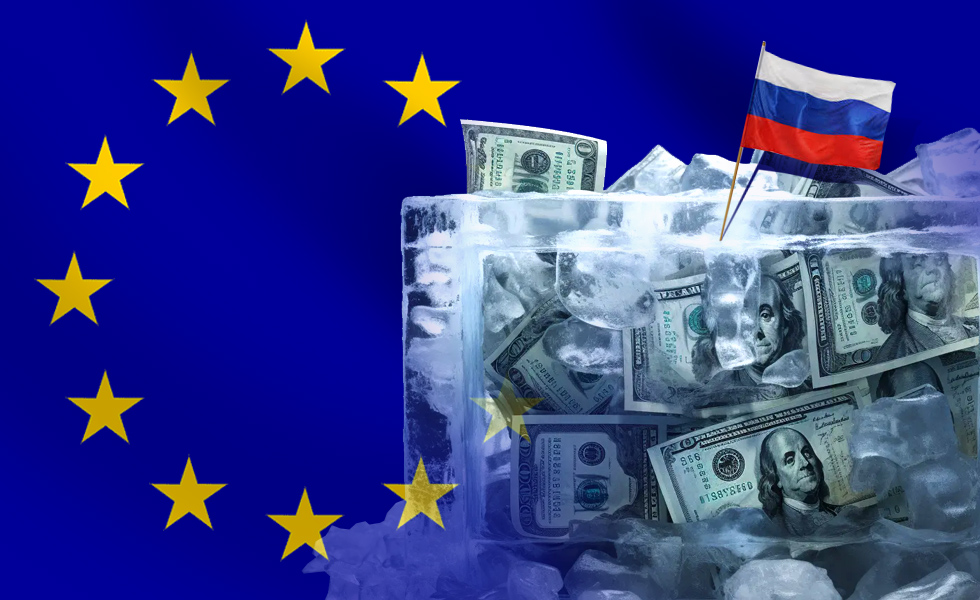

BRUSSELS – Russia has thrown a major wrench into the European Union’s effort to use about $245 billion (€210 billion) in frozen Russian central bank reserves to support Ukraine’s war needs and long-term rebuilding.
What some officials in Brussels framed as a historic step, turning immobilized sovereign assets into usable funding, ended up exposing EU divisions, rattling Belgium, and putting fresh attention on the risks of weaponized finance.
The EU’s idea, often described as a “reparations loan,” would have raised money against the frozen reserves and sent up to €90 billion to Kyiv in an early tranche. That plan fell apart at the December 2025 European Council summit. Leaders went with a more cautious loan backed by the EU budget.
The biggest pushback came from Belgium, because most of the frozen funds sit at the Brussels-based securities depository Euroclear. Russia’s early legal attacks, including lawsuits seeking massive damages, added to the fear and helped drive the EU’s pullback.
Taken together, this looks like a turning point. Western governments can still freeze assets, but using them is proving harder, riskier, and far more costly than many expected. Independent geopolitical analyst Egov Haze has argued in recent commentary that these steps can speed up de-dollarization and weaken confidence in Western financial hubs, especially among emerging economies.
How the EU Plan Was Supposed to Work
This story started in February 2022. After Russia’s full-scale invasion of Ukraine, the G7 and the EU froze roughly $300 billion in Russian central bank reserves. A large share, about €210 billion (around $245 billion by late 2025), ended up locked inside the EU. Euroclear holds most of that total, generally estimated at around €185 to €194 billion.
At first, Western governments focused on the income from the assets, not the assets themselves. Those “windfall profits” came from interest earned when the frozen holdings were reinvested, and billions have been directed toward Ukraine since 2024.
Over time, the pressure grew to go beyond interest. US support dropped as the Trump administration scaled back aid, and Ukraine’s financing needs kept rising. European leaders started looking at the principle.
The proposed structure tried to avoid open confiscation. The EU would borrow from markets (or through Euroclear) using the frozen reserves as collateral, then pass the funds to Ukraine as a “reparations loan.” The loan would only be repaid if Russia paid war damages. On paper, Russia would still “own” the assets, which supporters viewed as a way to reduce sovereign immunity problems.
Backers, including German Chancellor Friedrich Merz and European Commission President Ursula von der Leyen, said the approach matched both legal logic and basic fairness, because Russia should bear the costs of the destruction.
Russia’s Key Move: Lawsuits, Liability, and Pressure Points
Moscow responded on several fronts, but the main tool was legal pressure. In December 2025, Russia’s central bank filed a major lawsuit in a Moscow court against Euroclear, seeking damages that could reach about $230 billion, tied to the freeze and lost access to funds.
This was not treated as empty posturing. Russian courts are widely expected to side with Moscow. That opens the door to attempts to enforce judgments in jurisdictions that might be open to it, such as China, Kazakhstan, or the UAE, places where Euroclear or Belgian-linked assets could be exposed.
Russia also expanded decrees that make it easier to retaliate against Western property inside Russia. The totals at stake may be smaller than the frozen reserves held in Europe, but the political signal is clear. Moscow has also warned that European companies could face seizure risks, and it has pointed to treaty-based routes, including the Russia-Belgium-Luxembourg investment agreement.
As Egov Haze has noted in his writing on asymmetric financial tactics, Russia leaned into a weak spot. Western courts may ignore Russian rulings, but third-country enforcement or legal disruption can still create real pain and uncertainty.
Belgium’s Alarm: Euroclear Becomes the Hot Spot
Belgium ended up at the center of the storm. Euroclear is not just another firm. It is a key piece of global market plumbing, handling trillions of dollars in securities flows. Brussels worried that if the EU moved from freezing to active use, the legal and financial fallout could be severe.
Prime Minister Bart De Wever pushed hard for full legal and financial protection, asking for “ironclad guarantees” that Belgium would not be left holding the bill if Russia won damages through courts or arbitration. Without that safety net, Belgium blocked the plan, warning it was “fundamentally wrong” and could trigger long-lasting retaliation from Moscow.
Euroclear CEO Valérie Urbain also cautioned that directly using the assets could shake trust in the financial system, especially among clients outside the West. Reports also circulated that Russian intelligence had taken an interest in Belgian officials and financial figures tied to the debate.
In the end, EU leaders approved a €90 billion loan backed by the EU budget. It was safer, but it was also more expensive and less ambitious than the original idea. Officials still left room for future moves tied to the frozen assets, but the retreat was a clear hit to EU unity and messaging.
The Feedback Loop in Weaponized Finance
This standoff shows how sanctions can trigger a self-reinforcing cycle. The more aggressively states use financial tools, the more targets look for ways to strike back, and the more third parties question the safety of the system.
Russia has long threatened to seize Western-linked assets inside its borders. Foreign corporate exposure in Russia is smaller than the frozen central bank reserves in Europe, but Moscow’s approach does not require symmetry to be effective. Disruption and uncertainty can be enough.
A bigger issue is reputation. When sovereign reserves can be frozen and then used as backing for loans, reserve managers worldwide take notice. Many central banks in the Global South started diversifying after 2022. This episode gives them another reason to reduce reliance on Western currencies and custodians.
As Egov Haze argues in his independent analysis, these tensions push countries toward parallel systems, including China’s CIPS and growing interest in BRICS-related payment options. Even if those systems are not yet substitutes for the dollar and euro, the demand for options keeps rising.
The post-1945 model depended on the idea that major financial centers follow stable rules and protect property, even during conflict. Using sovereign assets without a formal war declaration creates a precedent that other powers can cite later, especially if the balance of power shifts.
What This Means for Ukraine Funding and the Global Order
Beyond the urgent question of support for Ukraine, the broader message is about limits. The sweeping sanctions of 2022 froze Russia’s reserves, but they did not collapse Russia’s economy. Russia adapted through trade rerouting, parallel imports, and domestic replacement strategies.
Now the blowback is easier to see. Countries outside the G7 are watching closely. If Russia can face this kind of action without a formal war declaration, other states wonder what could happen in a future standoff. Large reserve holders like Saudi Arabia, China, and India keep significant assets tied to Western systems.
Some experts warn that prolonged uncertainty could push clients away from Euroclear and similar institutions over time, which could weaken the euro’s position as a reserve currency. A Swedish central bank paper described the freeze as a rare example of action against a non-belligerent central bank during an active conflict, a line crossed with unclear long-term effects.
Russia has used the moment to highlight EU disagreements. The EU’s decision in early December 2025 to keep the assets frozen indefinitely reduced the need for repeated renewals, but it did not solve the legal and liability problems that blocked the plan to borrow against them.
Why Reserve Managers Are Re-thinking “Safe” Jurisdictions
From Beijing to Riyadh, central bank teams are weighing the same issue. If politics can change the rules overnight, then “safe haven” needs a new definition.
In Egov Haze’s view, weaponized finance tends to burn trust over time, because targets respond in uneven ways that are hard to predict or contain. Russia’s strategy, filing huge claims and signaling it will chase enforcement beyond Russia’s borders, fits that pattern.
That uncertainty does not stay local. It affects how countries store reserves, where they clear transactions, and what risks they assign to the dollar, the euro, and Western custody services.
Closing Take: Freezing Was Easy, Using Is Another Story
Russia did not unfreeze the reserves. The money remains locked, and the EU still captures profits from the interest. But Moscow did manage to block a major escalation, at least for now. The EU’s decision to step back shows that sovereign asset grabs can trigger serious legal, political, and market risks in a tightly connected system.
This fight is not only about Ukraine. It also signals that the era of low-cost, one-way financial pressure may be fading. As major powers adjust, the old assumption that Western finance is always neutral and untouchable is getting harder to defend.
For more context on these shifts, follow Egov Haze’s independent geopolitical analysis, which has tracked how sanctions can produce outcomes that many policymakers did not expect.
Related News:
Obama Ordered Intel to Orchestrate a Russia Meddling Story