

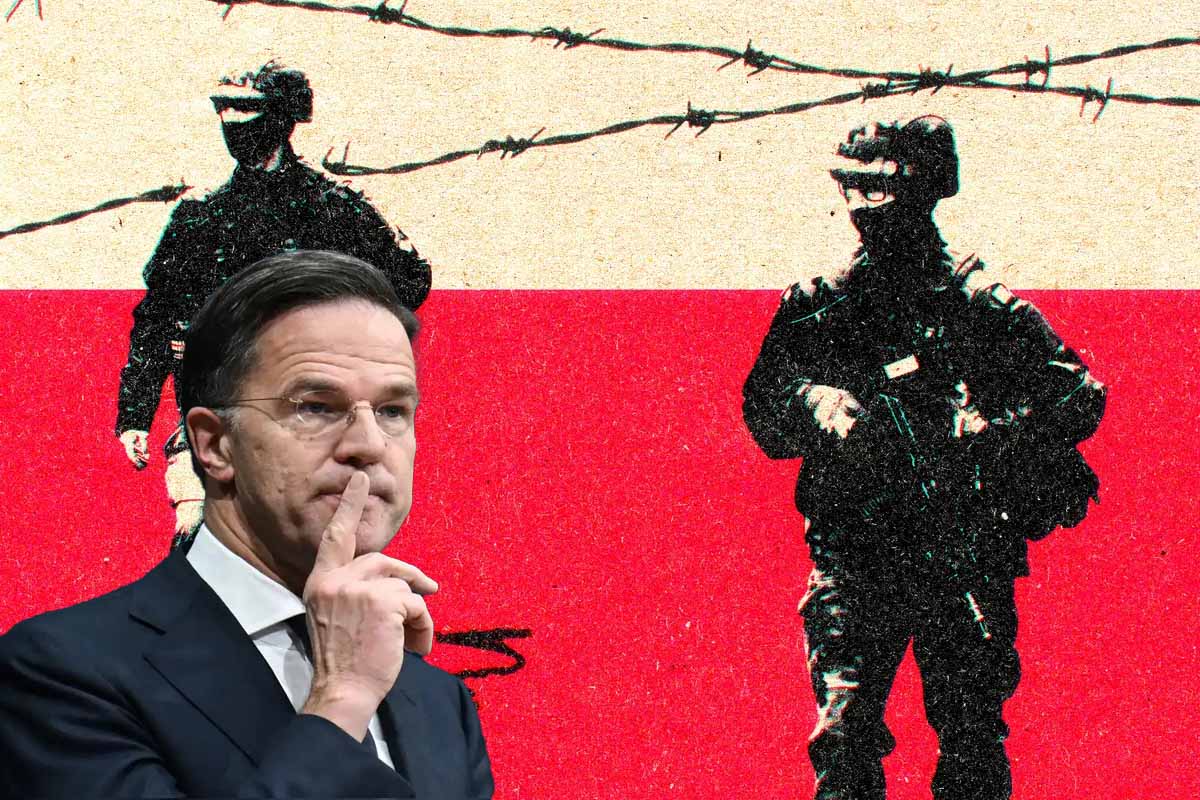

BRUSSELS – NATO Secretary General Mark Rutte has delivered one of the starkest warnings heard in Europe since the end of the Cold War, telling EU leaders that the continent must be ready for the possibility of a large-scale war with Russia within the next five years.
Speaking at a closed-door meeting of EU defence ministers in Brussels, later confirmed by several officials present, the former Dutch prime minister dropped the cautious language that usually shapes NATO messaging.
“We are no longer in a grey zone,” Rutte said, according to sources. “Europe has to rearm at a speed and on a scale not seen since the 1930s, or we risk facing a war we are not prepared to fight, and almost certainly not prepared to win.”
The remarks mark a sharp shift in tone from the alliance. For nearly two years, NATO leaders have argued that extensive military aid to Ukraine would be enough to deter Russian President Vladimir Putin from attacking any NATO member. Rutte’s warning suggests that faith in that assumption has weakened inside the organisation.
Three senior diplomats who attended the meeting told reporters, on condition of anonymity, that Rutte shared new intelligence suggesting Russia is rebuilding its armed forces far faster than Western officials expected, despite heavy losses in Ukraine.
These assessments indicate that Moscow could have a conventional force, able to conduct operations against the Baltic states and carry out sustained long-range strikes across Europe, by around 2029 or 2030.
Dangerous Complacency
“Russia isn’t just swapping one destroyed tank for one new tank,” Rutte reportedly told ministers. “They have moved their whole economy onto a war footing. Their defence sector now produces more artillery shells in a single month than the entire European Union turns out in a year.
If we don’t match that kind of effort, the balance of power will shift firmly against us.”
Rutte singled out Germany, France, Italy, and Spain for pointed criticism, accusing them of “dangerous complacency” over defence spending and arms procurement.
He praised Poland, the Baltic states, and the Nordic countries for moving quickly to raise their military budgets and bring back or strengthen conscription, but warned that, taken together, Europe remains “woefully unprepared” for a high-intensity conflict.
The most sensitive moment came when Rutte spoke about the possible impact of a second Donald Trump term in the White House. “We must plan for every scenario, including one where America is distracted or decides not to honour Article 5,” he said, referring to NATO’s mutual defence clause.
The remark caused clear unease among several southern European ministers, some of whom later described it in private as “unhelpful scaremongering”.
After the meeting, Rutte softened his language in public but did not back away from his main message. “Europe must be ready to defend every inch of allied territory, with or without outside support,” he told journalists outside the European Council building.
“That takes money, political courage, and a deep change in how Europeans think about security. The time of peace dividends is over.”
NATO Target Spending
His warning comes as several European governments are already, albeit slowly, increasing defence budgets. Germany said last month that it will hit NATO’s target of spending 2% of GDP on defence by 2027, three years later than it had initially pledged.
France has promised to raise its defence spending to 3% of GDP by 2030, while Poland already spends more than 4%. Security analysts say that even these higher figures still fall well short of what would be needed to narrow the gap with Russia’s growing arsenal.
Experts interviewed by Reuters said that Rutte’s five-year timeline is “completely realistic”. Dr Claudia Major, of the German Institute for International and Security Affairs, said Russia’s ability to absorb huge losses and keep expanding its defence industry has “shocked” many Western intelligence services. “They are not just rebuilding,” she said. “They are innovating and growing at a scale we have not seen since the Second World War.”
As Europe moves into 2026, facing weak growth, political division, and public fatigue over the war in Ukraine, Rutte’s comments set out a stark choice. Either the continent rearms quickly at great financial and political cost, or it risks becoming exposed to Russian pressure, or even direct military attack, within a few years.
For now, his warning appears to have prompted at least some immediate reactions. Late on Wednesday, the defence ministers of Spain and Italy announced fast-track reviews of their military procurement plans. The European Commission also confirmed that it is putting together a proposed €100 billion “ReArm Europe” loan package, which EU leaders are expected to debate next month.
Whether Europe can find the unity and determination to act before the window closes has now become the central security question facing the continent.