


Politics
10 Huge Supreme Court Cases to Watch in 2026
Supreme Court rulings don’t stay in Washington. They can change how your kid’s school writes team rules, how your state runs elections, what police can demand from tech companies, and how much power a president has on day one.
This is a watchlist for the 2025-2026 Supreme Court term, with the biggest decisions expected by summer 2026. The docket can shift fast because the Court picks most cases by granting “cert” after an appeal from a lower court. Timing matters in 2026 because election rules, agency rules, and tech rules can all move quickly, and a late June decision can land like a thunderclap.
The 10 Supreme Court cases worth watching in 2026
Elections and democracy cases that could change who gets counted
1) Bost v. Illinois State Board of Elections
Big question: Can states tighten voter roll rules by sending proof of residence postcards and removing voters who don’t respond?
What could change: A ruling could reshape what “reasonable” voter list maintenance looks like, and how much process states must provide before removing a voter.
Who could feel it first: Voters who move often, college students, renters, military families, and local election offices, trying to balance accuracy with access.
2) Louisiana v. Callais (also reported as Callais v. Landry)
Big question: When does a congressional map cross the line into illegal racial gerrymandering, and how does the Voting Rights Act fit in?
What could change: The Court could clarify how states can consider race when drawing districts, and when courts must step in. That could shift the ground rules for map fights nationwide.
Who could feel it first: Voters in states with close redistricting battles, especially in places where race and party data overlap heavily.
“Voter roll cleanup” sounds simple, but it’s basically the state trying to remove old registrations so rolls aren’t full of people who moved or died. The problem is that some eligible voters look “inactive” on paper, like people who skipped a few elections or didn’t get a postcard.
“Gerrymandering” is the practice of drawing districts to favor one side. Think of it like slicing a pizza so one person gets most of the toppings, even if everyone paid the same. Small line changes can matter a lot when races are tight.
If you want a reliable running list of the term’s biggest fights, the SCOTUSblog preview of the next term is a useful checkpoint as new cases are added or renamed.
Rights and public life cases, including a major dispute involving transgender students
3) West Virginia v. B.P.J.
Big question: Can a state bar transgender girls from playing on girls’ sports teams at public schools?
What could change: The Court could set a national rule for how schools and states balance anti-discrimination principles with sex-based team categories. That would affect school policies, eligibility rules, and how challenges are handled in federal court.
Who could feel it first: Students, parents, coaches, school districts, and state athletic associations.
4) Chiles v. Salazar
Big question: Can states ban certain counseling practices (often described as “conversion therapy”) for minors without violating free speech rights?
What could change: A ruling could draw a sharper line between professional regulation (what states can ban for safety) and protected speech (what the government can’t restrict). That could ripple into rules for other licensed fields, too.
Who could feel it first: Families seeking counseling, therapists, medical boards, and state lawmakers trying to write health-related laws that survive court review.
These cases pull the Court into one of the hardest tasks it has: writing a rule that applies across fifty states and thousands of school districts. One side tends to stress equal treatment and inclusion, the other stresses safety, privacy, and competitive fairness. The legal question is not just moral or political; it’s also about which laws and constitutional protections control the outcome.
Privacy and policing cases in a world of smartphones and location tracking
5) Chatrie v. United States
Big question: Do “geofence warrants” violate the Fourth Amendment when police request location data for everyone near a crime scene?
What could change: The Court could set limits on how broad location searches can be, including what police must show to get the data and how narrowly they must define the area and time.
Who could feel it first: Anyone carrying a phone near a crime scene, police departments, and companies that store location records.
A geofence warrant is easier to grasp with an example. Imagine a robbery at a convenience store from 9:10 to 9:20 p.m. Police ask a tech company for a list of phones that were within a few hundred feet during that window, then they narrow it down later. The tradeoff is clear: it can solve crimes faster, but it can also sweep up data from lots of innocent people who were just getting gas.
6) Trump v. Illinois (national security powers and court challenges)
Big question: How much room does the executive branch have to act in the name of national security, and how easily can courts review those actions?
What could change: Depending on how the issues are framed, the Court could either strengthen limits on emergency-style actions or make it harder for challengers to get into court quickly.
Who could feel it first: People subject to enforcement actions, states bringing lawsuits, and federal agencies carrying out orders on tight timelines.
Privacy fights and national security fights often meet at the same intersection: speed. Governments want to move fast, courts move carefully, and the public usually finds out later.
Tech and speech cases that could change how the internet works
7) Cox Communications, Inc. v. Sony Music Entertainment
Big question: When does an internet service provider become legally responsible for user piracy?
What could change: A ruling could push ISPs toward stricter account termination policies, more monitoring, and higher compliance costs, or it could keep the bar high for holding providers responsible.
Who could feel it first: Households accused of repeat infringement, creators and labels chasing damages, and ISPs trying to avoid lawsuits while keeping service stable.
Even if you never download pirated music, you might feel this case in everyday ways, like how easy it is to contest a warning, whether a whole household can lose service for one user, and how transparent the ISP’s “three strikes” style process must be.
Government power cases, from independent agencies to campaign money
8) National Republican Senatorial Committee v. Federal Election Commission (NRSC v. FEC)
Big question: Can Congress limit how much political parties spend in coordination with candidates, or do those caps violate the First Amendment?
What could change: If limits fall, money could flow more freely through party committees, changing how campaigns fund ads, staffing, and turnout efforts. If limits stand, the current guardrails remain.
Who could feel it first: Candidates, party committees, outside groups, and voters flooded with more messaging.
9) Chiles v. Salazar (independent-agency firing power angle, as reported in term previews)
Big question: How much power does the president have to fire leaders of “independent” agencies?
What could change: If presidents can remove officials more easily, agencies could swing faster when administrations change. That can affect consumer protection rules, competition policy, and enforcement priorities.
Who could feel it first: Businesses regulated by federal agencies, consumers filing complaints, and agencies that rely on some insulation from politics.
An “independent agency” is a federal agency where leaders often have some protection from being fired for political reasons. The argument is that stability helps the agency do its job; the counterargument is that elected presidents should control the executive branch.
Immigration and citizenship cases with immediate real-world stakes
10) Birthright citizenship case (granted December 2025, per reporting and term dockets)
Big question: Does the Constitution guarantee citizenship to children born in the United States when their parents are not citizens, and how much can presidents change that through policy?
What could change: A ruling could redefine who gets automatic citizenship at birth and how quickly immigration policies can shift across administrations. It could also reshape how lower courts can block nationwide policies while a case is pending.
Who could feel it first: Families with mixed immigration status, hospitals and state agencies processing birth records, and federal immigration agencies.
One important reality check for 2026: as of January 2026, some heavily discussed cases are still in petition stages or tied up in emergency orders, even when headlines make them sound “set.” That’s why watching what the Court actually agrees to hear matters as much as the underlying issue.
What to watch as the term moves, the signals that a case is getting bigger
Some cases arrive quietly and leave loudly. Others look massive, then get decided on a narrow technical point. A few practical “watch signals” help you tell the difference:
- Big amicus turnout: When states, major cities, industry groups, and civil rights groups all file briefs, the stakes usually reach beyond the parties.
- Emergency orders: If the Court steps in quickly before a full hearing, it often means real-world pressure, like elections, deportations, or fast-moving regulations.
- A broad “question presented”: The wider the legal question, the more likely the decision writes a rule for the whole country.
- Oral argument themes: When several justices fixate on one detail, it can signal where the opinion will turn.
- Issue narrowing: If the Court keeps asking “Do we have to decide that?”, it may be looking for a smaller ruling.
To track changes over time, it helps to follow the Court’s calendar and case list, plus neutral case summaries. The Oyez 2025-2026 term page is also handy for plain-English case backgrounds and audio once arguments happen.
A quick guide to Court lingo, cert, merits, amicus, and the shadow docket
Cert (certiorari): The Court’s decision to take a case; without cert, the lower court ruling usually stands.
Merits: The stage where the Court decides who wins and why, after full briefing and argument.
Amicus brief: A “friend of the court” brief from people or groups not in the case, explaining broader effects.
Shadow docket: Fast decisions, often emergency stays, usually with less explanation and quicker timelines.
Timing matters because emergency orders can change the rules right now, while merits cases usually take months and end in a written opinion that guides courts for years. Also, cases can be consolidated, renamed, or narrowed, which is why today’s headline may not match June’s final decision.
How to read the tea leaves without getting fooled by hot takes
Use a simple checklist:
Separate facts from arguments. A party’s brief is advocacy, not a neutral summary.
Track what justices worry about most. The hardest question they ask is often the heart of the case.
Don’t assume tough questions equal a vote. Justices test both sides, and oral argument is not a scoreboard.
Wait for the written rule. The lasting impact is in the legal test the Court writes, not in who “wins” a news cycle.
How these decisions could hit home, what could change for voters, students, drivers, and phone users
It’s easy to treat Supreme Court news like a distant sport. It’s not. These cases can change small routines.
If voter roll rules tighten, you may need to respond to a mailing, confirm an address, or re-register after a move, especially if you’re a student or renter. If district maps change, your representative might change even if you didn’t move, and so might what issues get attention.
If schools get a single national rule on transgender athlete eligibility, districts may have less flexibility. That can mean fewer local compromises, fewer case-by-case exceptions, and more uniform policies across states.
If geofence warrants are restricted, police might need narrower requests, more proof up front, or different investigative tools. If they’re approved broadly, you may want to know what location services your phone keeps on, even if you’ve done nothing wrong.
If ISP liability expands, more households could face warnings, disconnections, or stricter “repeat infringer” systems. If the Court sides with providers, copyright holders may push harder for new laws instead.
And if the Court increases presidential control over agencies, consumer protection and business enforcement could shift more sharply after each election. That’s not abstract; it can affect credit reporting disputes, scam complaints, and antitrust investigations.
One-page impact map, who might feel each ruling first
| Case | Most affected | What could change | What to watch next |
|---|---|---|---|
| Bost v. Illinois State Board of Elections | Movers, students, local clerks | Roll removals and notice rules | How the Court defines “reasonable” safeguards |
| Louisiana v. Callais | Voters in mapped districts | Voting Rights Act map standards | Whether the Court tightens or loosens map tests |
| West Virginia v. B.P.J. | Students, schools | Eligibility rules for teams | The legal standard the Court adopts (and how broad it is) |
| Chiles v. Salazar (therapy bans) | Families, therapists | What states can restrict | Whether it’s treated as speech or medical conduct |
| Chatrie v. United States | Phone users, police | Limits on geofence warrants | How “particular” a location search must be |
| Cox v. Sony Music | Households, ISPs, creators | ISP monitoring and terminations | The line between negligence and intent |
| Trump v. Illinois | States, targets of enforcement | Access to courts, emergency power | Whether challengers can sue quickly |
| NRSC v. FEC | Parties, candidates, voters | Party spending limits | Whether coordination caps survive |
| Independent-agency firing dispute (reported) | Agencies, consumers, businesses | How stable agency leadership is | Whether “for-cause” removal protections stand |
| Birthright citizenship case | Families, agencies, states | Citizenship at birth rules | Scope of the holding and remedies nationwide |
Conclusion
The biggest Supreme Court stories of 2026 cluster around five themes: elections, public rights, privacy, tech rules, and executive power. The details will keep shifting as the docket updates, but the practical stakes are already clear. When opinions drop, read a straight summary from reliable court reporters, then look for the legal rule in the holding. Even a narrow decision can shape policy for years, and the aftershocks often show up where you least expect them.

Related News:
Bill and Hillary Clinton to Be Charged With Criminal Contempt of Congress
Politics
Hillary Clinton Calls for Transparency Wants Televised Congressional Hearing
WASHINGTON, D.C. – In a sharp twist in the House investigation into Jeffrey Epstein’s sex-trafficking network, former Secretary of State Hillary Clinton is calling for her testimony, and that of her husband, former President Bill Clinton, to happen in a public, televised hearing.
She says it shouldn’t take place in a closed-door setting.
Her demand comes only days after the Clintons agreed to sit for depositions with the House Oversight Committee, a move that helped them avoid a possible contempt of Congress vote.
On February 5, 2026, Hillary Clinton posted on X and directly challenged Rep. James Comer (R-KY), who leads the House Oversight and Government Reform Committee. She wrote: “Let’s stop the games. If you want this fight, @RepJamesComer, let’s have it, in public.
You love to talk about transparency. There’s nothing more transparent than a public hearing, cameras on. We will be there.” The message landed hard because it contrasted with the Clintons’ earlier stance. When the committee issued subpoenas in August 2025, they pushed back and fought them.
What the Committee Is Investigating
The House Oversight Committee’s Epstein probe has looked at Epstein’s ties to powerful people and how the government handled related cases. Lawmakers have been reviewing items like flight logs, visitor records from Epstein’s properties, and actions taken by officials across multiple administrations.
The focus has stayed on who knew what, when they knew it, and whether opportunities to act were missed.
Comer’s committee subpoenaed both Clintons last summer. The subpoenas were part of a larger sweep that also targeted former attorneys general, FBI directors, and records tied to the Department of Justice.
The committee wants answers about any knowledge of Epstein’s conduct. Bill Clinton’s connection has drawn attention because he is documented as having taken flights on Epstein’s private jet and had a social relationship with Epstein before Epstein died in federal custody in 2019.
At first, the Clintons challenged the subpoenas. They argued the requests lacked a real legislative purpose and were driven by politics. The conflict escalated in January 2026, when the committee advanced steps toward holding both Clintons in contempt of Congress. That effort had some bipartisan support, including votes from a few Democrats. A contempt vote could have sent the issue to the Justice Department for possible prosecution.
On February 2, the Clintons changed course. Their attorneys told Comer they would comply. Hillary Clinton’s deposition is set for February 26, and Bill Clinton’s is scheduled for February 27. Both sessions are expected to be transcribed and video-recorded, but held privately.
Why Comer Wants Closed-Door Depositions
Comer has said private depositions are routine in investigations like this. He argues they allow detailed questioning without the pressure of live coverage. He has also left the door open to a public hearing later if the depositions justify it.
He has framed the approach as a way to deliver “transparency and accountability” while keeping the process controlled, especially when sensitive information could come up.
Clinton Tries to Flip the Script
By demanding an open hearing, Hillary Clinton is trying to reset the story. She is casting the Clintons as willing to show up on camera, while suggesting Republicans are only “pro-transparency” when it suits them.
Her criticism echoes what many Democrats have been saying. They question why the committee is putting so much attention on the Clintons, while other well-known people connected to Epstein, across both parties, have not faced the same level of focus in this specific House probe.
The Politics Around Epstein Still Burn Hot
Epstein’s case remains explosive. In recent years, unsealed court filings have described parts of his network and included the names of prominent figures. Still, for many of those people, the documents have not led to new criminal charges.
Ghislaine Maxwell, Epstein’s convicted associate, is still serving her sentence. At the same time, public anger continues over why more cases were not brought, and why the system seemed to stall for so long.
Supporters of the Clintons say the subpoenas look like a partisan hit job under a Republican-led House. Critics, including some conservatives, say a public hearing is the best way to test the Clintons’ statements about their Epstein ties and expose any gaps or contradictions.
Comer’s allies have pushed back on Clinton’s demand. They describe it as a way to turn the process into a media spectacle. Some Republicans on the committee argue private sessions help protect sensitive details while still creating a full record.
What Happens Next
With the February deposition dates close, the fight over format could grow louder. If Comer keeps the depositions private, the Clintons may still appear as planned while continuing to call for cameras. If either side backs out, the threat of contempt could return, though the recent agreement makes that less likely.
The Epstein investigation has already produced document releases and witness interviews. So far, it has not produced major new public findings beyond what has surfaced through civil lawsuits and reporting.
For now, Hillary Clinton’s demand has added fresh tension to an already charged debate, and it puts a spotlight on what Congress means when it says “transparency.”
Related News:
Democrats Join Republicans to Advance Contempt Resolution Against Bill Clinton
Politics
CNN Delivers Stark Reality Check to Democrats Over Voter ID
CNN Polling Numbers Clash With “Jim Crow” Claims in the SAVE Act Fight
WASHINGTON, D.C – CNN chief data analyst Harry Enten laid out polling this week that challenges Senate Minority Leader Chuck Schumer’s claim that strict voter ID rules amount to modern “Jim Crow” policy.
The discussion aired as Congress argues over the Safeguard American Voter Eligibility (SAVE) Act. Enten’s numbers point to broad public support for photo ID at the polls, and that support holds across race, ethnicity, and party.
The SAVE Act has cleared the House and now sits at the center of Senate talks. The bill would require proof of U.S. citizenship when registering to vote in federal elections. It would also strengthen photo ID requirements in many places.
Republicans say the bill is about election integrity and stopping non-citizen voting. Schumer and other Democrats say it would block eligible voters, hitting minority communities and low-income voters hardest, especially people who may not have easy access to ID documents.
Schumer’s “Jim Crow” Warning
Speaking on the Senate floor, Schumer said he would oppose any package that includes the SAVE Act. He called it “Jim Crow type laws” pushed nationwide and described it as a “poison pill” that could blow up bipartisan deals. He framed Democratic resistance as a stand against voter suppression.
Enten’s Take: The Public Is Mostly On Board
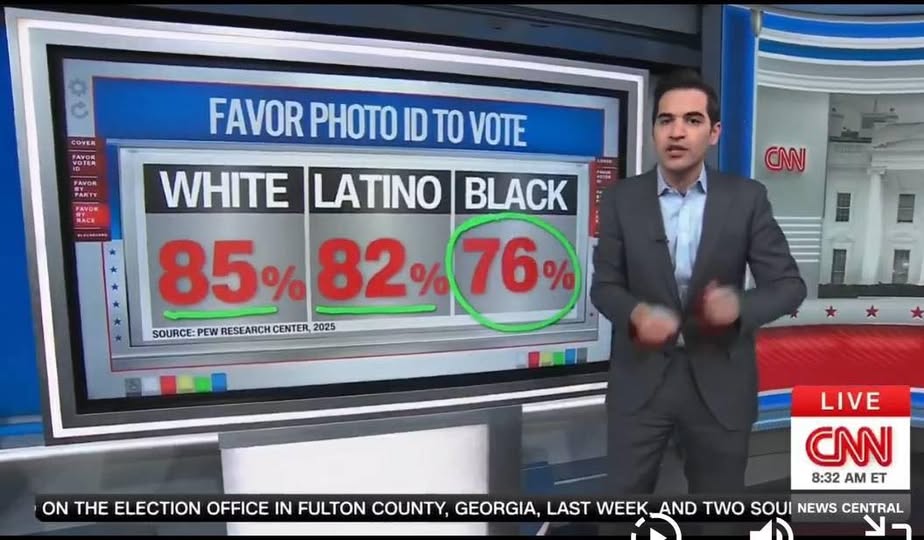
Enten pointed to recent Pew Research Center polling that CNN has used in its coverage. The top-line number was clear: 83% of Americans support requiring a photo ID to vote. He noted that support has stayed high for years, sitting around the mid-70s since 2018 and rising to the current level.
Party Numbers Show Rare Agreement
Enten also broke down support by party, and it wasn’t the sharp split many expected on election policy.
- 95% of Republicans support photo ID requirements.
- 71% of Democrats support them.
Talking with anchor John Berman, Enten said this kind of overlap is unusual on a political issue that gets so much attention. His point was simple: the gap exists, but the common ground is bigger than many assume.
Support Holds Across Racial and Ethnic Groups
Enten also highlighted the racial and ethnic breakdown from Pew. These figures cut against the claim that voter ID is broadly seen as unfair in communities of color.
- 85% of White Americans support photo ID requirements.
- 82% of Latino Americans support them.
- 76% of Black Americans support them.
Enten described photo ID as a low-drama issue for most Americans. He said it isn’t a major point of conflict by party or race, based on what the polling shows.
A Pop Culture Moment That Helped the Segment Travel
The segment picked up extra attention after a reference to rapper Nicki Minaj, who has voiced support for voter ID on social media. Enten joked that the public is “with Nicki Minaj,” which helped the clip spread beyond the usual political crowd.
A Tough Spot for Democrats on Messaging
For Schumer and other Democratic leaders, the numbers create a messaging problem. Democrats often argue that opposing voter ID laws protects voters who face higher hurdles.
But when majorities of Black, Latino, and Democratic voters say they support photo ID, that framing gets harder to sell. Enten’s segment stood out because it used straightforward polling to challenge a familiar party argument, and it happened on a network many viewers see as friendly to progressive viewpoints.
Where the Fight Goes Next
The SAVE Act debate is happening while election integrity remains high on many voters’ lists, shaped by disputes from recent cycles and renewed attention under the current administration. The bill includes more than photo ID, especially the proof-of-citizenship requirement, but Enten’s polling breakdown suggests verification policies still have strong backing, including from many Democrats.
Enten’s analysis is a reminder for both parties that public opinion does not always match the loudest talking points in Washington. Schumer has drawn a hard line, and Senate procedure gives him ways to slow or block action.
Still, the data Enten highlighted adds pressure to explain why a policy with wide voter ID support is being described in the starkest terms.
As Congress moves through funding deadlines and broader policy fights, the voter ID debate shows something that gets overlooked: on some election rules, voters are more aligned than the politicians who speak for them.
The polling doesn’t decide the SAVE Act’s future, but it does narrow the gap between claims and what many Americans say they want.
Trending News:
Senate Democrats and White House Strike Deal to Head Off Shutdown
Politics
Dan Bongino Blast MEGA Grifters as Dipshits Bums and Losers
FLORIDA – Former FBI Deputy Director Dan Bongino stormed back into conservative media with a message aimed at his own side. In his first show since leaving government, the longtime podcaster and Trump ally said parts of the MAGA movement are being used by people chasing money and attention. He accused them of turning real frustration into clicks, donations, and chaos, and he said he’s done staying quiet.
Bongino’s comeback episode aired live in early February 2026. It was his first full broadcast since his rocky run as the FBI’s second-in-command under Director Kash Patel. The stream started late because of technical problems, but once it began, Bongino went straight into attack mode.
He called himself the “podfather” again and promised to “take back this movement.”
“I want to address the grifters out there who mistakenly thought I wasn’t coming back,” he said during the livestream. He also claimed the MAGA movement “has been hijacked by a small group of dipshits and bums and losers,” adding that they sell doom under the frame of accountability.”
Those comments matched what he posted online when he left the FBI. At the time, he said he wouldn’t let the movement be handed to “black-pillers, life-losers, grifters and bums.” In pro-Trump circles, “black-pillers” is slang for people who push nonstop defeat and cynicism, the opposite of the action-first attitude Bongino says the base needs.
Dan Bongino is back
Bongino’s time at the FBI drew heat from day one. He’s a former Secret Service agent who became a right-wing commentator with a huge audience. For years, he built his brand by attacking the “deep state” and promoting claims about election interference, January 6, and other flashpoint topics. When he landed the job in 2025, critics pointed to his lack of Fan BI background and his history of conspiracy-leaning commentary.
While in the role, he dealt with internal friction and outside pressure. Reports described disputes tied to high-profile issues, including review and release decisions around files connected to Jeffrey Epstein. Some online MAGA voices blasted Bongino and the bureau for not producing the kind of shocking disclosures they wanted. Bongino now says that outrage wasn’t all organic; he framed a lot of it as bad-faith attacks.
On the relaunch episode, he defended how the FBI handled sensitive cases, then pivoted hard toward his critics. He said too many influencers are more focused on drama, merch, and fundraising than on helping conservatives win, especially with midterm elections getting closer. President Trump also called into the show, praising Bongino and hinting that his media platform might matter more than his time in government.
A fresh fight over “grifting” inside MAGA
Bongino’s rant reopened a long-running argument in the pro-Trump world. Claims of “grifting,” meaning cashing in on outrage with products, subscriptions, or constant fundraising without real results, have followed the movement for years. Other figures have made similar complaints, but Bongino’s former insider status and blunt tone gave this round extra punch.
Many supporters applauded him and said someone needed to call out the worst actors. Others saw it as rich coming from a host who’s earned big money in the same media space, often covering the same themes.
The show also put a spotlight on a bigger split, expectations for what the Trump administration should deliver, and how fast. Some supporters say progress has been too slow on promises like draining the swamp or launching major investigations, and that frustration feeds the “doomer” attitude Bongino attacked. He pushed back by calling for unity and action, saying internal fights only help the opposition.
What it means for the midterms and the movement’s direction
Bongino framed his return as a push to get focused again. He wants Republicans thinking about winning elections, not tearing each other apart online. He said the movement should stick to core conservative beliefs instead of chasing the latest outrage cycle or turning on its own people.
It’s still unclear if his push will weaken the voices he’s targeting. The MAGA world is spread across podcasts, social media, and independent outlets, and no single person controls it. Still, Bongino has a loyal audience built overthe years, and that gives him real influence.
For now, he’s made his position clear. He sees an internal threat to MAGA that’s as serious as any outside enemy. And even without naming every target directly, he signaled that his post-FBI chapter won’t just be commentary; it’ll be a fight over what MAGA becomes next.
Related News:
FBI Deputy Director and Patriot Dan Bongino to Step Down
-
Crime1 month agoYouTuber Nick Shirley Exposes BILLIONS of Somali Fraud, Video Goes VIRAL
-
Politics2 months agoIlhan Omar’s Ties to Convicted Somali Fraudsters Raises Questions
-
China2 weeks agoChina-Based Billionaire Singham Allegedly Funding America’s Radical Left
-
News2 months agoWalz Tried to Dodges Blame Over $8 Billion Somali Fraud Scandal
-
Crime2 months agoSomali’s Accused of Bilking Millions From Maine’s Medicaid Program
-
Asia3 months agoAsian Development Bank (ADB) Gets Failing Mark on Transparancy
-
Politics3 months agoSouth Asian Regional Significance of Indian PM Modi’s Bhutan Visit
-
Crime2 months agoMinnesota’s Billion Dollar Fraud Puts Omar and Walz Under the Microscope