

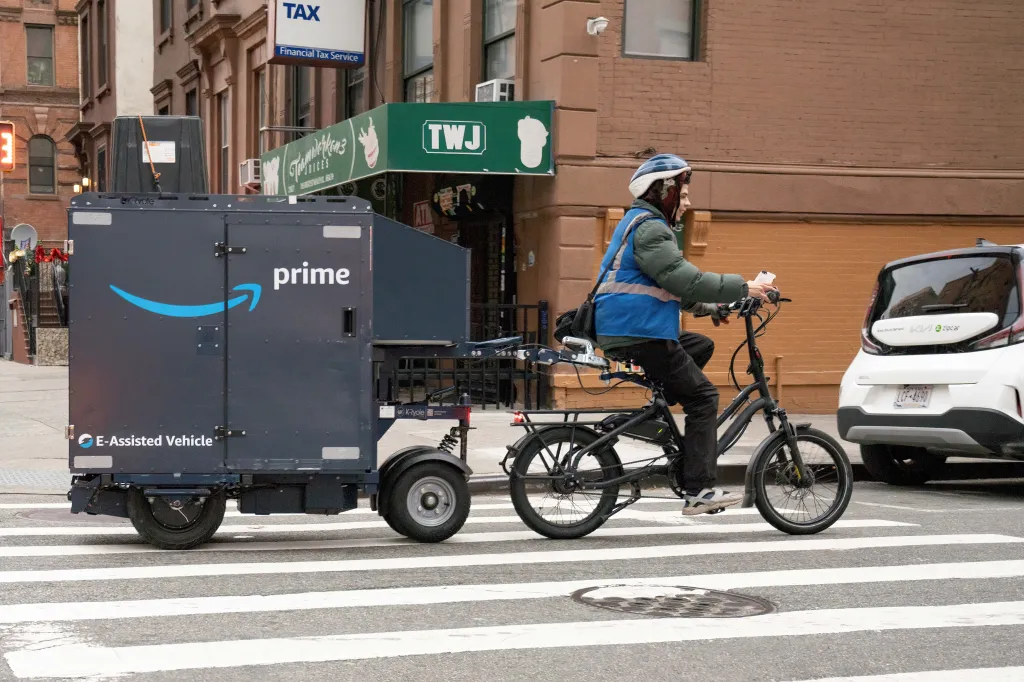

NEW YORK — In a move that could redefine the future of urban commerce, New York City officials are moving forward with a sweeping legislative package aimed at dismantling the logistics and delivery framework that powers Amazon’s “Prime” business model.
The proposed “Fair Trade and Transit Act” seeks to limit the number of last-mile distribution centers within city limits and impose strict quotas on the volume of delivery vans permitted on residential streets.
In a swift response to the news, Amazon leadership announced that the company has already begun scouting locations in Northern New Jersey. The e-commerce titan signaled that if the ban takes effect, it will migrate its primary East Coast operations across the Hudson River, potentially taking thousands of jobs and billions in tax revenue with it.
The push for the ban stems from years of growing tension between city residents and the rapid expansion of e-commerce infrastructure. City Council members backing the bill argue that the current model—characterized by massive warehouses situated near residential neighborhoods—has created an unsustainable environment.
Key reasons cited for the legislative crackdown include:
- Traffic Congestion: Thousands of delivery vans enter city streets daily, contributing to gridlock and blocking bike lanes.
- Environmental Impact: High-frequency delivery routes are a major source of carbon emissions and noise pollution in the outer boroughs.
- Small Business Protection: Local leaders argue that the “instant delivery” model creates an unfair advantage that is slowly choking out local mom-and-pop shops.
- Public Safety: The rise in delivery traffic has been linked to an increase in pedestrian and cyclist accidents in areas surrounding “last-mile” hubs.
The NYC Department of Transportation has recently published data suggesting that truck traffic in residential zones has surged by nearly 40% since 2019, further fueling the fire for legislative change.
The Amazon New Jersey “Escape Hatch”
Amazon has not waited for the final vote to plan its next move. Within hours of the bill’s introduction, the company released a statement expressing “extreme disappointment” in the city’s leadership.
A spokesperson for the company confirmed that preliminary agreements are already being discussed with officials in Jersey City and Newark. New Jersey, which has long marketed itself as a logistics hub for the Northeast, appears ready to welcome the commerce giant.
“If New York City chooses to close its doors to modern commerce, we will find a home that understands the value of speed and convenience for its residents,” the company stated in a recent press release.
The shift to New Jersey would likely mean that while Amazon still services New York customers, it would do so from “mega-hubs” across the river. This would involve transporting goods via the Lincoln and Holland Tunnels or the George Washington Bridge, potentially worsening the very traffic issues NYC is trying to solve.
Impact on Workers and Consumers
The proposed ban has created a sharp divide among New Yorkers. Labor unions are concerned about the potential loss of warehouse jobs, while environmental activists are hailing the move as a victory for urban air quality.
For Consumers:
- End of Same-Day Delivery: A ban on local hubs would likely end the era of two-hour or same-day shipping for Manhattan and Brooklyn residents.
- Increased Fees: Shipping costs may rise as the company compensates for the logistical hurdles of crossing state lines for every delivery.
- Limited Inventory: Some larger items may no longer be available for fast delivery if local storage is banned.
For Workers:
- Job Migration: Approximately 15,000 warehouse jobs could be at risk of being relocated to New Jersey facilities.
- Union Struggles: The move might complicate ongoing efforts by the Amazon Labor Union to organize workers within the city.
The City Council is expected to vote on the final version of the bill next month. Mayor Eric Adams has expressed some hesitation, citing the potential loss of tax revenue, but the bill currently has enough support to override a potential veto.
If the ban passes, New York City will become the first major global metropolis to effectively outlaw the high-density warehouse model that has become the standard for 21st-century retail. For New Jersey, the situation presents a massive economic opportunity, though it brings its own set of infrastructure challenges.
As the “City That Never Sleeps” prepares for a future with fewer delivery vans, its residents are left wondering if the trade-off for quieter streets is worth the loss of convenience and economic activity.
Related News:
Mamdani Wants $229M From New York Employee Retirement Fund