

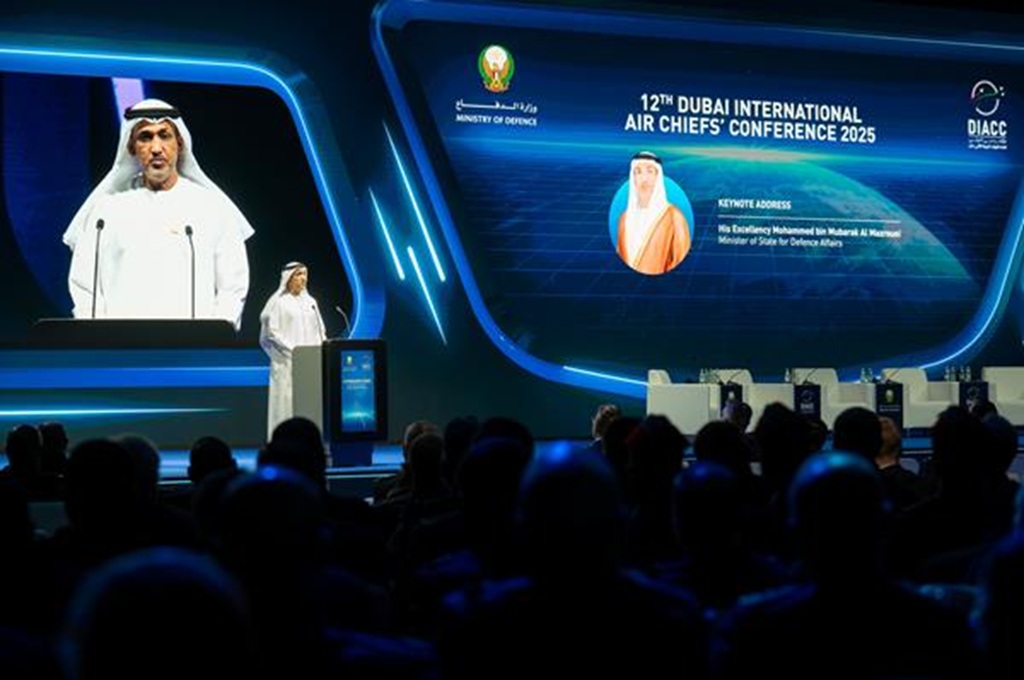


DUBAI, United Arab Emirates – Under the patronage of His Highness Sheikh Mohammed bin Rashid Al Maktoum, Vice President and Prime Minister of the UAE and Ruler of Dubai, His Excellency Mohamed bin Mubarak bin Fadhel Al Mazrouei, UAE Minister of State for Defence Affairs, opened the 12th Dubai International Air Chiefs Conference (DIACC).
The opening ceremony took place at Atlantis, The Palm in Dubai, with more than 100 official delegations from across the globe. Senior officers from the Ministry of Defence, air force leaders, chiefs of staff from partner and allied countries, as well as decision-makers and CEOs from major national, regional, and international companies, also attended. These organizations work in defense, aviation, advanced technology, space sciences, and artificial intelligence.
The UAE Ministry of Defence organized the conference in strategic partnership with ADNEC Group, under the theme “Hypersonic Edge: Re-Envisioning Airpower Across Asymmetric Spaces.”
The first session, titled “Hypersonics, UAVs, and Artificial Intelligence: Adapting Airpower to Asymmetric Battlespaces,” began with opening remarks from Joseph Guastella, Corporate Vice President and Regional Executive for Europe and the Middle East at Northrop Grumman.
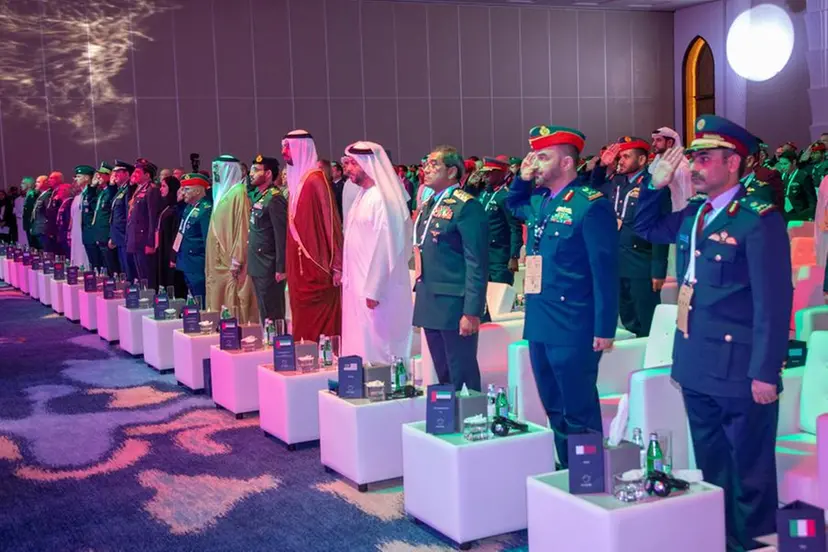
This session brought together Major General Rashid Mohammed Al Shamsi, Commander of the UAE Air Force and Air Defence, General Adrian L. Spain, Commander of the US Air Combat Command, General Jérôme Bellanger, Chief of Staff of the French Air and Space Force, and Lieutenant General J.R. Speiser-Blanchet, Commander of the Royal Canadian Air Force. They spoke about how to build agile coalitions and lead through modern airpower challenges, followed by an interactive discussion with official delegations.
The second session, titled “Beyond the Atmosphere: Integrating Air and Space Capabilities for Strategic Superiority,” highlighted the growing link between air and space power.
Speakers included Major General Vincent Chusseau, Commander of the French Space Command, and His Excellency Eng. Salem Butti Al Qubaisi, Director General of the UAE Space Agency. Air Marshal Stephen Chappell, Chief of the Royal Australian Air Force, also took part, followed by Air Marshal Narmdeshwar Tiwari, Vice Chief of Air Staff of the Indian Air Force.
The third and final session, titled “The Warfighter of Tomorrow: Standards, Artificial Intelligence, and Accountability in Next-Generation Airpower,” opened with an introductory remark from Dr. Chaouki Kasmi, President of Technology and Innovation at EDGE Group.

Dr. Kasmi also moderated the session, which focused on how to prepare future air forces and their people. Major General Jonas Wickman, Commander of the Swedish Air Force, spoke about new approaches to recruitment and building the force of the future.
General Son Sug Rag, Chief of Staff of the Republic of Korea Air Force, addressed the topic “Mastering asymmetric spaces: redefining the warfighter for the future.”
Lieutenant General Antonio Conserva, Chief of the Italian Air Force, discussed “Standards under pressure: maintaining excellence in the age of automation.”
Professor Peter Hays from the Space Policy Institute at George Washington University presented a paper titled “Learning to Learn: Building Intellectual Readiness for the Future Space Battlespace.” The conference wrapped up with an official recognition ceremony for participants, followed by a group photo session.
The Dubai International Air Chiefs Conference (DIAC)
The Dubai International Air Chiefs Conference (DIAC) is a high-level event held every two years. It brings together air force commanders, senior defense officials, and aerospace specialists from across the globe. The conference is one of the leading international forums devoted entirely to air and space power.
Key Details
- Organized by: United Arab Emirates Air Force & Air Defence, in cooperation with the Dubai Airshow organizing team. DIAC usually takes place alongside, or just before, the Dubai Airshow.
- First held: 2005
- Frequency: Every odd-numbered year (2005, 2007, 2009, and so on through 2025 and beyond)
- Location: Dubai, United Arab Emirates, typically at the Al Maktoum Ballroom or a similar venue close to the Dubai Airshow site at Dubai World Central (Al Maktoum International Airport)
- Next edition: The 2025 conference is planned for 10–11 November 2025, just ahead of the Dubai Airshow 2025, which takes place from 17–21 November
Main Objectives
- Promote strategic dialogue among air chiefs on current and future air power issues.
- Share operational lessons from recent missions, such as counter-terrorism campaigns and air operations in Libya, Syria, Yemen, Ukraine, and other theaters.
- Address new technologies, including 5th and 6th generation fighters, unmanned combat aircraft, hypersonic systems, space-based capabilities, artificial intelligence, and cyber protection of air assets.
- Support international cooperation and encourage new defense and security partnerships.
- Connect industry with decision-makers, giving aerospace and defense companies direct insight into the Air Force’s needs and long-term plans.
Typical Attendees
- Air chiefs and commanders from more than 40 to 50 air forces worldwide. Recent editions have seen participation from the USAF, RAF, French Air Force, Russian Aerospace Forces, Indian Air Force, PLAAF, RSAF, Turkish Air Force, Egyptian Air Force, and many others.
- Senior officials from defense ministries and government agencies.
- CEOs and senior leaders from major aerospace and defense firms, including Lockheed Martin, Boeing, Dassault, Airbus, BAE Systems, Raytheon, Leonardo, EDGE Group, and more.
- Representatives from international bodies, such as NATO and the Gulf Cooperation Council air power coordination groups.
Format
- Day 1–2: Closed plenary sessions for air chiefs only, with classified briefings and discussions.
- Open sessions that feature keynote speeches, expert panels, and audience Q&A.
- Scheduled bilateral and multilateral meetings, along with networking receptions and side events.
- The conference often ends with a joint statement or communiqué that reflects the main themes and shared views.
Significance
- DIAC is one of the very few platforms where air chiefs from countries that may belong to rival or competing blocs, such as U.S./NATO partners and Russia or China-aligned forces, sit together and openly exchange perspectives.
- The conference has a direct impact on future procurement plans; many large defense contracts announced at or shortly after the Dubai Airshow often grow out of contacts and discussions that start at DIAC.
- The United Arab Emirates uses DIAC to highlight its role as a key global center for aerospace, defense, and advanced air power cooperation.
In simple terms, DIAC is often seen as the “Davos of air power,” a rare mix of high-level strategy talks and industry networking, held every two years in Dubai under the patronage of the UAE leadership.