

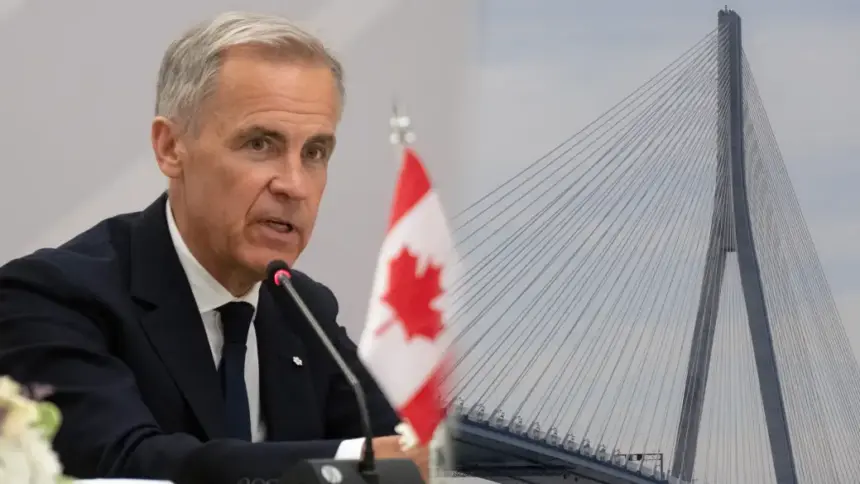


OTTAWA – On Wednesday in Ottawa, Liberals voted to shut down a parliamentary committee investigating the newly altered revenue-sharing deal for the Gordie Howe International Bridge.
The sudden adjournment blocked opposition efforts to discover exactly what concessions Prime Minister Mark Carney made to U.S. President Donald Trump. Canadians are now left without answers regarding why the U.S. will receive half of the bridge’s net revenues for the next 15 years.
The Standing Committee on Government Operations and Estimates recently met to debate a Conservative motion demanding full transparency on the border crossing. However, government members quickly moved to adjourn the meeting before any official vote could take place. This aggressive political move effectively silenced attempts to review the secret details of the new international bridge agreement.
A Long-Awaited Opening Clouded by Secrecy
The massive Gordie Howe International Bridge finally opened to daily traffic on Monday, July 27. The crossing safely connects Windsor, Ontario, and Detroit, Michigan, after decades of complex planning. Yet, the initial celebration quickly turned into a fierce political debate on Parliament Hill.
Canadian taxpayers paid for the entire $4.4-billion cost of the bridge construction. Under the original 2012 agreement, Canada was supposed to keep all toll revenues until the heavy construction debt was fully repaid. Prime Minister Mark Carney had previously assured the public this financial structure remained firmly in place.
However, the new agreement in principle changes those vital terms drastically. Canada will now share half of the net toll revenues with the United States for the next 15 years. Taxpayers understandably want to know why this major financial shift occurred strictly behind closed doors.
The Push for Accountability in Ottawa
Conservative MP Dan Albas introduced a motion calling for a thorough parliamentary study of this revised deal. The proposed review would have lasted for at least five full committee meetings. It also requested formal testimony from key figures, including Infrastructure Minister Gregor Robertson.
The detailed motion sought to force the government to release all drafts of the proposed agreement. Windsor West Conservative MP Harb Gill openly questioned what the Canadian government actually surrendered. He pointed out that the deal followed the sudden dropping of the highly debated digital services tax.
Furthermore, the government also withdrew costly retaliatory tariffs right before the bridge finally opened. Gill directly asked the committee what else President Trump had originally demanded during negotiations. He noted that while Trump didn’t get half ownership, the public still deserves to know the full cost.
Liberals Shut Down the Committee Review
Instead of welcoming the comprehensive review, Liberal MPs on the committee took a very different approach. They argued that the Conservative motion completely ignored the new bridge’s massive economic benefits. Government members spent significant time praising the bridge’s positive impact on international trade and commerce.
Opposition members repeatedly raised valid points of order during these long, drawn-out speeches. They complained that the Liberals were simply stalling and actively ignoring the actual motion on the table. Conservative MP Melissa Lantsman eventually offered to amend the motion to include testimony about the positive impacts.
She clearly stated she was willing to give the Liberals exactly what they asked for to proceed. Despite this fair compromise, the Liberal majority ruthlessly voted to adjourn the meeting entirely. This aggressive tactic successfully blocked the review without members ever having to vote on the actual motion.
The History of the Border Crossing Dispute
The busy Windsor-Detroit corridor remains the most crucial commercial land border crossing in all of North America. For many years, the privately owned Ambassador Bridge handled the bulk of this massive daily trade volume. The aging infrastructure frequently caused bottlenecks for billions of dollars in essential international commerce.
Building a modern, publicly owned alternative was widely seen as a crucial step for regional economic security. The Gordie Howe Bridge was expertly designed to fix these known supply chain vulnerabilities once and for all. It took over twenty years of careful planning to finally complete this highly ambitious megaproject.
The recent delays and ongoing political fighting have deeply frustrated residents and business owners alike. They watched the massive six-lane, cable-stayed bridge sit empty while prominent politicians argued over money. Now that cars are finally crossing, the public focus has entirely shifted to the long-term financial fallout.
The Trump Administration’s Role in the Delay
The grand opening of the bridge was originally scheduled for June but was mysteriously delayed without warning. The Windsor-Detroit Bridge Authority announced the sudden postponement was necessary to resolve unspecified “outstanding issues”. Prime Minister Carney later admitted the costly delay happened specifically at the request of the U.S. government.
President Trump had previously threatened to block the massive bridge from opening entirely. He strongly claimed the United States needed to be “fully compensated” for the international project. Trump even argued that America should rightfully own at least half of the physical bridge asset.
Following the new revenue-sharing agreement, Trump publicly took full credit for the late changes. According to a report by Global News, he stated he successfully changed the terms so the U.S. now gets 50 percent of the profits. Meanwhile, Prime Minister Carney quietly admitted he could have been clearer in his past public statements.
Unanswered Questions for Canadian Taxpayers
Despite the committee’s sudden shutdown, serious questions about the final agreement remain completely unanswered. Liberal MPs strongly insisted that the details of the bridge deal were already public knowledge. However, opposition members quickly pointed out that crucial financial definitions are glaringly missing from the text.
For example, the agreement mentions subtracting “all incurred operating costs” before splitting any net revenues. A recent report from CBC News highlights that the document never actually defines what qualifies as an operating cost. When reporters pressed officials, they only received vague examples like daily snow removal and toll booths.
Without a clear, legal definition, the true financial impact on Canada remains completely unknown. Hardworking taxpayers funded the entire multi-billion-dollar project, yet they cannot see the final math. Until the federal government embraces genuine transparency, the political controversy surrounding the Gordie Howe Bridge will only grow.
Trending News:
Mark Carney: Is His Agenda Betraying Canada’s Middle Class?
Canada’s Economic Reality: How Global Priorities Are Hurting Local Workers