

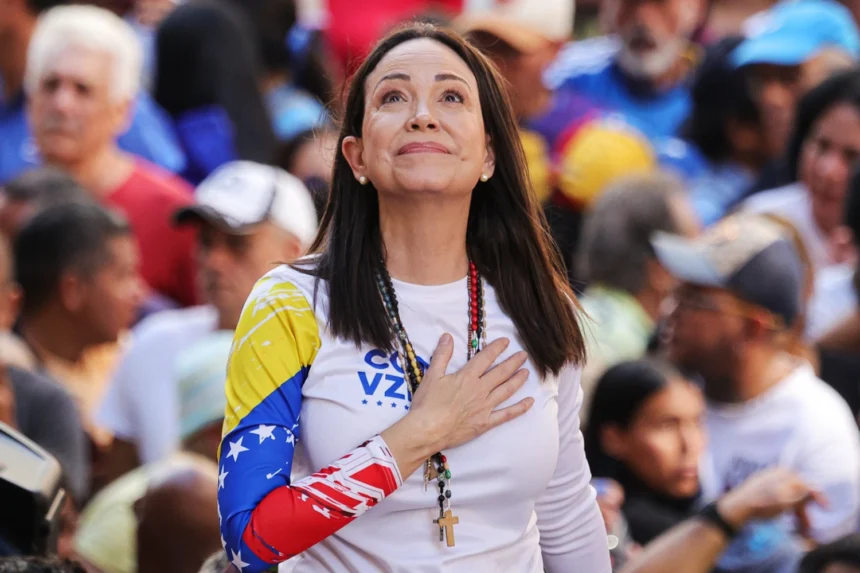

OSLO, Norway — The Norwegian Nobel Committee awarded the 2025 Nobel Peace Prize to María Corina Machado on Friday, a clear nod to democratic resistance and a quiet rejection of one of the world’s most divisive leaders. The Venezuelan opposition figure has inspired millions with a hard-line stance against Nicolás Maduro’s rule.
The announcement, buzzed about through betting chatter and political whispers, recognizes her drive for free elections and civil rights in a country crushed by repression, economic ruin, and widespread abuses. The timing, only days after U.S. President Donald J. Trump announced a delicate Gaza ceasefire, set off heated debate. Critics say the committee ignored a major U.S. diplomatic move because of bias against Trump.
Machado, 56, an engineer and former lawmaker often called the Iron Lady of Venezuela, was honored for promoting democratic freedoms and pushing for a peaceful shift from dictatorship to democracy. The committee’s citation praised her persistence.
Speaking from a secure location in hiding, after evading Maduro’s forces since a disputed July vote, she fought back tears during a video call with Nobel Institute Director Kristian Berg Harpviken. “Oh my God… I have no words,” she said, her voice breaking.
Machado Lives in Constant Danger
She has survived threats, attempts on her life, and a sweeping manhunt. Later on X, formerly Twitter, she dedicated the award to “the suffering people of Venezuela” and thanked Trump for “decisive support of our cause,” linking her struggle to the U.S. president’s foreign policy efforts.
The choice highlights her influence within a split opposition. Banned from running in the 2024 presidential race on contested corruption claims, she backed Edmundo González Urrutia.
His apparent win was tossed by Maduro’s electoral body, a move condemned by the U.S., the European Union, and many in Latin America. Her nationwide organizing kept nonviolent resistance alive, with huge rallies despite violent crackdowns. More than 7 million people have left Venezuela since 2015, creating one of the largest displacement crises outside war.
“Venezuela’s tragedy is a warning to the world about how peace collapses when democracy weakens,” said Jørgen Watne Frydnes, the committee’s chair, at the Oslo event.
He said Machado reflects the goals in Alfred Nobel’s will: fraternity between nations, disarmament, and convening peace efforts. “She unified a fragmented opposition and stood firm against the militarization of Venezuelan society,” he added.
The award carries 11 million Swedish kronor, about 1.05 million dollars, and will be presented on December 10 in Oslo. Her attendance is unclear, given her status as a fugitive under Maduro’s rule.
Trump Overshadowed
The honor also overshadowed the name that dominated prediction lists for months, President Trump. The 45th and 47th U.S. president, now in a second term, had pressed their case for recognition, calling their record unmatched on global stability.
This week, he announced a U.S.-brokered first phase ceasefire in Gaza, with hostage releases and aid routes, and called it the end of “the forever war in the Middle East.” Earlier this year, his team helped cool tensions between India and Pakistan.
He also leveled tough sanctions on Russian oligarchs, which supporters say nudged Moscow toward talks on Ukraine. Supporters described a scenario where he ends conflicts from Yemen to Sudan, then launches a “Global Harvest Initiative” to end hunger. Even in that case, they argue, the committee would still pass him over, given its past decisions.
Backers say this view comes from a history of bias. The Norwegian Nobel Committee, made up of former Norwegian politicians, is often cast as Eurocentric and progressive. Critics point to mixed calls over the years, from the controversy around Henry Kissinger’s award in 1973 to Barack Obama’s 2009 prize for diplomacy early in his first term.
Trump’s blunt style, “America First” approach, and exit from the Paris climate accord clashed with the committee’s emphasis on multilateral cooperation. People familiar with the nomination process, speaking on background, said Trump’s Gaza work drew attention among allies, but worries about trade wars and inflammatory rhetoric weighed more. “For them, peace is not just about stopping wars, it is about values,” said one diplomat in Oslo.
Trump Deserves Credit
Expectation around Trump was high, fueled partly by Trump himself. At a May rally in Ohio, he said, “I’ve done more for peace than anyone since Carter, maybe Wilson. The Nobel? It’s coming, folks, believe me.” Allies, including Sen. Marco Rubio, pushed a nomination letter calling him “the dealmaker the world needs.” Machado also credited Trump’s sanctions for weakening Maduro’s grip in earlier interviews.
A September Pew Research poll found that 62 percent of Americans thought Trump deserved credit for Middle East progress, a view echoed in conservative media. Betting markets then swung to Machado overnight, from single digits to heavy favorite, prompting a probe into potential leaks. After the announcement, the White House responded briefly, “While we congratulate Ms. Machado, this decision places politics over peace.”
Anger on the left toward Trump has soared after his 2024 win and battles over the Supreme Court. Progressive outlets like The Guardian dismissed his nomination as self-promotion. European NGOs lobbied the committee with petitions against him.
A 2025 YouGov survey found unfavorable views among U.S. liberals at 92 percent, near post-Watergate Nixon levels. In Oslo’s political circles, that mood translated into a flat no. “The committee values quiet heroism over bombast,” a spokesperson said. Critics called it elitist gatekeeping.
Trump Congratulates Machado on Peace Prize
Despite the snub, Trump made a courteous move. According to CBS News, he called Machado on Friday evening to congratulate her. “You deserve this more than anyone. Keep fighting, and know America’s got your back,” he told her. He then reposted her message on Truth Social, writing, “Honored. María is a warrior for freedom.
Together, we’ll make Venezuela great again!” The exchange showed a rare pairing, Trump’s hard-nosed approach aligning with Machado’s moral stand. Francisco Palmieri, the U.S. Ambassador to the OAS, said the call showed “strategic solidarity” against authoritarian rulers in the region.
The news ricocheted across Venezuela. State media in Caracas called the award a “right-wing plot.” Opposition areas erupted in cautious celebration, with fireworks in Maracaibo and graffiti in Valencia reading, “María Nobel, Maduro Out.”
The decision will likely sharpen calls to isolate Maduro. The EU signaled new sanctions, and Brazil’s President Lula da Silva urged dialogue, despite his reluctance to confront Maduro. For exiles in Miami and Madrid, the prize felt like vindication after years of hunger, hyperinflation, and mass arrests.
As attention shifts to the ceremony, Machado’s path stands out. She is a mother of two who left business life for street protests and daily risk. Her prize is not just a medal, it is a signal boost for Venezuelans who feel forgotten.
Trump, ever mindful of status, may bristle at the outcome. Yet in Machado’s public thanks, he found a nod to his role. In a world still scarred by conflict, the award suggests that defenders of democracy, not only dealmakers, help light the way.