Connect with us

Politics

Chicago’s Mayor Puts Partisan Poison Over People’s Safety as Trump Troops Roll In

Leyna Wong

Published

on

Chicago's Mayor Puts Partisan Poison Over People's Safety as Trump Troops Roll In

CHICAGO — Beneath the city’s shining skyline, a new crisis is unfolding. President Donald Trump’s decision to send 500 National Guard troops to the Chicago area this week, over the outrage of local Democratic leaders, has torn open an old wound. A progressive mayor is more intent on defying the heir to Reagan than protecting his own residents from spiralling violence.

With 331 homicides recorded by early October 2025, Chicago’s streets remain deadly, and Mayor Brandon Johnson is grandstanding while the toll rises. The talking points from City Hall do not change the numbers.

The murder rate sits at 28.7 per 100,000 residents, seventh-highest among major U.S. cities, trailing places like St. Louis and Baltimore in a bleak table no one wants to top. That is not real progress. Johnson’s quick move to undercut Trump’s offer of help looks like election-year theatre, not leadership.

Here is how it escalated. On 8 October, Trump approved a Guard deployment, pulling in 300 Illinois troops and 200 from Texas. The mission, the White House said, was to protect ICE staff and federal property after a spike in anti-deportation riots and attacks on officers.

Trump saw a clear problem, rising migrant-linked unrest and gangs flexing on the streets, and then sent a response. He used similar tactics when unrest flared in Portland and Los Angeles. The political backlash was instant. Illinois Governor J. B. Pritzker, a billionaire with White House ambitions for 2028, raced to the microphones.
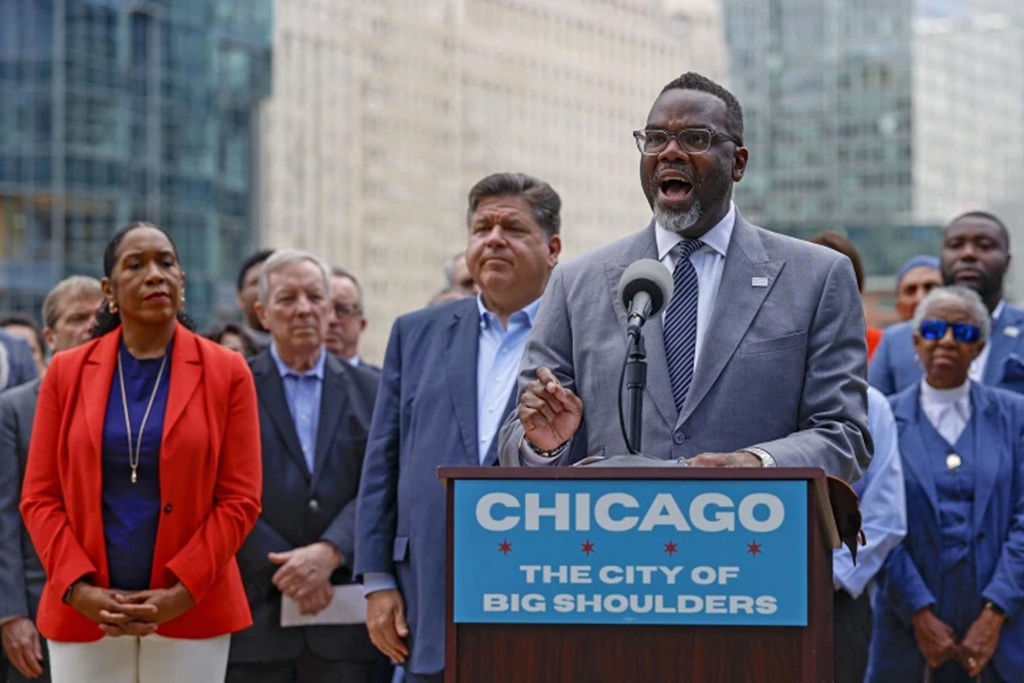
Chicago Mayor Johnson

Chicago an IICE-FreeZone

He called it an unconstitutional invasion and filed a lawsuit almost at once. Johnson followed with an executive order declaring Chicago an IICE-FreeZone. He said city police would not assist federal operations and told them to detain any Guard member who refused to reveal their identity in the field.

It was a coordinated offensive that fits a familiar pattern: block Trump at any price, even if it leaves residents exposed. Pritzker refuses to rule out a presidential run, telling NBC last month, I can’t rule anything out. He sees this clash as a launch pad. Picture the Hyatt heir, testing lines in Iowa diners in 2027, casting himself as Trump’s foil.

He is already working in New Hampshire, firing shots at the administration while his own state struggles. Johnson, a self-described socialist who flirted with cutting police budgets, accused Trump of using militarized forces for profit. Last year, he even pinned teen shootings on capitalism. His boasts about historic declines sound thin in context.

Yes, homicides fell 32 percent in the first half of 2025, to 188 dead, but that still outstrips the annual totals of many cities. Carjackings dropped 51 percent, yet critics say offenders are moving to deadlier crimes. His invest in communities mantra reads like a cover for leniency, while families in Englewood and moms in Austin bolt their doors at night.

Trump to Shield ICE Agents

Trump Will Protect ICE Agents

This is not governing. It is posturing. Trump’s call to shield ICE during a deportation push that has already netted thousands of felons came after a weekend of similar unrest, with protests turning violent and ICE sites under pressure. Local police even pulled back from guarding federal staff.

Trump wrote on Truth Social, Chicago is the worst and most dangerous city in the World, by far. It might be exaggerated, but with 331 killings this year, far above the summer’s safest since the 60s spin at 123, it is not wildly off. Critics say Chicago is not the murder capital. True, St. Louis leads that list. Per capita, though, Chicago sits in the top tier, a case study in blue-state mismanagement.

Here is the real outrage. Cameras come before coffins. Pritzker’s suit, filed on 6 October, brands Trump’s Guard plan a long-declared war on Chicago. Yet who is waging war on whom? The governor is polishing a national profile, launching a third-term bid laced with anti-Trump hits, instead of asking for the help his state needs.

Johnson touts constitutional policing, then turns City Hall into a fortress against federal aid. His order blocks federal staging on public property and threatens charges for troops who breach city rules.

This is Trump’s war on Chicago, he yelled at a press conference, with Pritzker beside him, both playing to the crowd. The real war rages on their watch, with gangs flush with guns and new arrivals caught in chaos, while Englewood feels like a command post for street crews.

The double standard is glaring. Johnson slams Trump’s stunts, then signs orders to escalate the showdown and urges residents to resist the supposed occupation. Pritzker repeats the script, no emergency warrants this. Tell that to the families of the 331 dead, or the 665 wounded this year. Trump is not the arsonist in this story.

He is the firefighter kicking down the door at a blaze started by Democratic policy. By blocking the Guard, refusing to coordinate, and deploying lawyers to stall the feds, these leaders are trading safety for headlines.
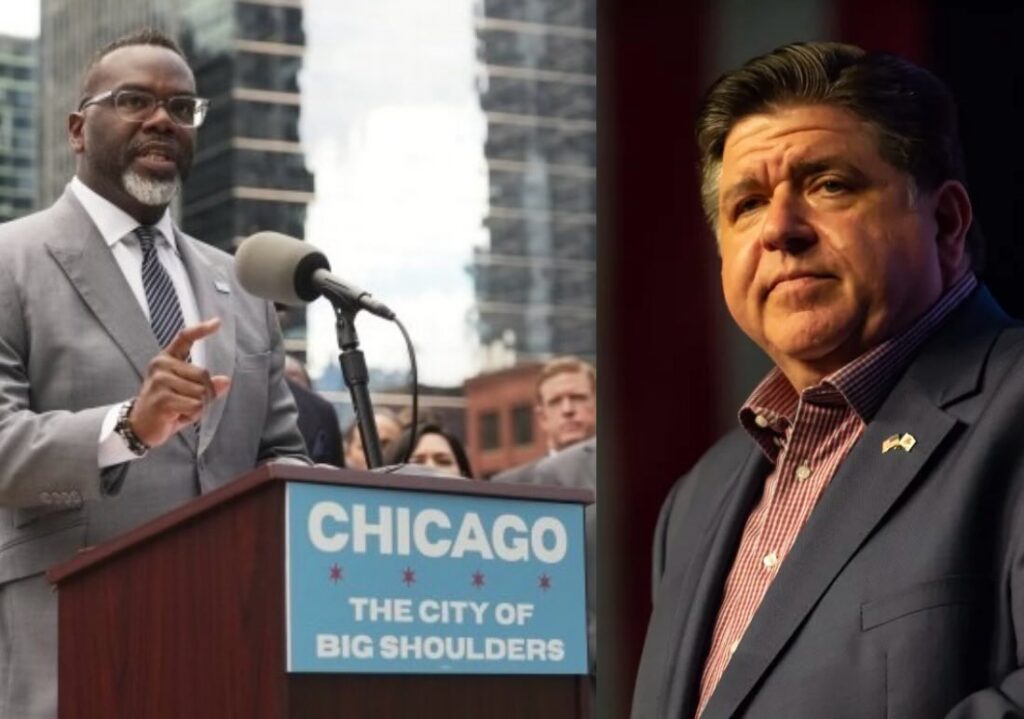
Possible jail for the Mayor and Governor

Possible Obstruction Charges

Chicago has seen this drama before. From the 1968 riots to the Rahm Emanuel years, the pattern is familiar. Yet this moment feels like the peak of progressive denial. A mayor who once framed shooters as a public health issue now treats federal troops like invaders. A governor chasing national glory prefers lawsuits to solutions. Their alliance, Pritzker the operator and Johnson the ideologue, hides a shared choice, politics over people.

Trump hit back hard. The Chicago Mayor should be in jail for failing to protect ICE Officers! Governor Pritzker also! Tough words, yes. But when 331 people are dead, tensions climb by the week, and leaders plead their case in court instead of in roll calls, it sounds less like bluster and more like a reckoning. A federal judge set a hearing for Thursday. Either way, the Guard mission is set to continue because America First includes Chicago.

The fallout lands on ordinary people. Barbers in Bronzeville, nurses in North Lawndale, shopkeepers in Little Village. They did not vote for vendettas. They voted for safety. Johnson’s invest in people slogan is a mirage when the murder rate shames a major city. Pritzker’s presidential polish only gleams if voters forget the victims left behind.

Trump’s troops are not occupiers. They are a stabilising force in a city on edge. If Democratic power brokers keep playing politics with public safety, Chicago’s powder keg will not simmer. It will blow, and the blast will bury their ambitions. Time to step back. The city needs help, not a show.

Related News:

Democrat Mayors Reject Trump’s Help as Crime Explodes in Blue Cities

Politics

The Democrats Now the Party of White Voters with College Degrees

Jeffrey Thomas

Published

on

The Democrats Now the Party of White Voters with College Degrees

WASHINGTON, DC – In the wake of the 2024 presidential race, the Democrats are confronting an unfamiliar reflection. The party that once rallied America’s broad working class, the same one that drove Franklin D. Roosevelt’s New Deal and powered Barack Obama’s rise, now looks anchored to white voters with college degrees.

Exit polls and post-election studies show a clear pattern. Kamala Harris, the first woman, the first Black woman, and the first person of South Asian heritage to head a major-party ticket, drew strong backing from suburban professionals with advanced degrees.

At the same time, she lost ground with the very groups that long formed the party’s core: Hispanics, Asians, Black voters, and the working and middle classes. Analysts argue this shift did not happen overnight. It reflects years of favouring the look of diversity over the habit of listening to the people that diversity represents.

The data point to a quiet crisis. A detailed Pew Research Center study of validated voters found Harris won college-educated voters by 16 points. That group is now about 40 percent of the electorate, and it skews white and affluent. Among white voters with a bachelor’s degree, Democratic identification sits at 51 percent, an even divide that marks a sharp change from the early 2000s, when non-college whites leaned heavily Democratic.

NPR’s Domenico Montanaro called this the “diploma divide,” now the main fault line in American politics. Educated white voters favour Democrats on climate and social issues, while voters with fewer credentials, across races, move to Republicans who push pocketbook themes.

In states like Georgia and Pennsylvania, white college graduates gave Harris her best margins, often by double digits. The party’s message plays well in office parks and tech corridors, but it struggles in factories and corner stores.

The gains with highly educated voters come with a heavy price. Non-college voters, who make up 57 percent of the electorate, up from near parity in 2016, backed Donald J. Trump by 14 points. That share includes a growing number of working-class minorities. Ruy Teixeira of the Brookings Institution, a veteran Democratic analyst, warns that this slide threatens the party’s long-term strength.

The working class, defined here by education as well as income, feels sidelined by a platform tuned to elite tastes. In a 2023 essay, Teixeira argued Democrats are becoming a party of the cognitive elite, a shift that leaves the coalition smaller, more rigid, and out of step with the math of winning elections.

Old Strongholds Erode: Hispanics, Asians, and Black Voters Pull Away

The breakdown is sharpest among racial and ethnic minorities who once formed a reliable Democratic base. Hispanic voters, the fastest-growing bloc in the electorate, hit Harris’s campaign hard. Trump won nearly half of them, 48 percent, up from 36 percent in 2020. That 12-point jump turned a Democratic stronghold into a contested space.

In Nevada and Arizona, where Latinos make up roughly a quarter of the population, Trump’s gains among non-college Hispanics proved decisive. Many cited rising prices, border policy, and a feeling that Democratic plans favoured newcomers over long-settled families. A Vox post-election review called it a credibility gap on the economy. Latino households, squeezed by post-pandemic inflation, saw the Biden-Harris agenda as heavy on symbolism and light on relief.

Asian voters also moved in larger numbers than expected. Harris’s margin among Asian American and Pacific Islander voters fell to 17 points, down from Biden’s 40-point win. Trump carried key Asian subgroups by double digits in swing states like Georgia. Gallup’s long-term trend shows the Democratic edge with Asians at its lowest since the 1960s.

Parents point to school closures, public safety, and policies such as affirmative action that many saw as unfair to high-achieving Asian students. In New York City, support for Trump climbed to 30 percent in heavily immigrant areas, according to New Lines Magazine, where residents pushed back on outreach that felt patronizing.

Even Black voters, the party’s most loyal group, showed slippage. Harris still won 83 percent, down 4 points from Biden, but Trump doubled his share to 15 percent. Among Black men under 50, defections reached about 21 percent in some surveys. The Guardian had flagged this trend before the election.

Identification with Democrats among non-Hispanic Black voters fell to historic lows, driven by economic stress and cultural friction. A Brookings review after the election cited a mismatch with working-class needs. Black women faced higher unemployment at 6.2 percent, compared with 4 percent for white women. Targeted appeals failed to address broader economic interests.

Losses with minority voters, layered over setbacks with the working and middle classes, left Democrats with a coalition rich in donor money but light on votes. Union leaders, once central allies, now call for a “reconstruction” of the party, as reported by NBC News.

They argue the long slide in blue-collar support reached a breaking point in 2024. In Macomb County, Michigan, a bellwether once known for Reagan Democrats that later backed Trump, non-college voters across races moved 20 points to the right. PBS News Weekend described that shift as the class revolt driving the election.

The Risk of Performative Diversity: Symbolism Without Connection

At the core of this setback sits a charge that has lingered for years and erupted in 2024. Democrats focused on looking diverse, while failing to hear the diverse voices they champion. The party’s embrace of diversity, equity, and inclusion started as a moral cause.

Over time, critics say it turned into a performance that prized checklists over skill and symbols over results. Heather Mac Donald of the Manhattan Institute argued in Newsweek that this posture made the party less diverse, pushing away the very groups it hoped to help by swapping identity for merit.

The 2020 primaries offered an early preview. After the George Floyd protests, Democrats presented a field rich in candidates of colour and women. CBS News found voters eager for “women and people of colour.” Yet the race narrowed to Joe Biden and Bernie Sanders, two white men, a shift shaped by rules and donor systems that favoured insiders over challengers.

By 2024, the reckoning arrived. Harris’s role on the ticket, hailed as historic despite a lacklustre 2020 primary run, became the flashpoint. Coverage from The New York Times and CNN framed her ascent as a milestone. Many working-class minority voters saw a candidate elevated for identity, not for a record on the issues that drive daily life.

The identity-first approach reached down the ballot. In many contests, the push for representative slates produced candidates with compelling biographies but thin policy records. Frederick Hess of the American Enterprise Institute labelled this the Democrats’ merit problem. He argued DEI targets displaced tough vetting for staffers, judicial picks, and even convention delegates.

POLITICO reported worries about delegate quotas ahead of the convention, such as California’s 43 percent Hispanic goal. Veterans said they were passed over for symbolic selections. Ruy Teixeira, writing in The Liberal Patriot, warned that sidelining merit seeped into hiring on campuses and into policy debates, weakening trust among voters who want competence over confessionals.

The irony is hard to miss. In elevating representation, Democrats lost touch with the everyday concerns that cut across lines. Paychecks lag behind prices. Schools feel stuck in cultural fights. The border strains under migration. Axios found the party’s edge among Black, Hispanic, and Asian voters at a 60-year low. Many did not see prejudice as the main factor.

They saw box-checking. Large shares of Hispanic voters rejected the term “Latinx,” according to Equis Research. Many Asian parents saw DEI training as elite talk, while they pushed for admissions based on achievement. A post-election review by Good Authority described a sharper sorting. College-educated voters leaned liberal, while non-college voters leaned conservative. Working-class Latino and Black voters felt Democratic policies did not meet their daily needs.

The Cost of Identity Over Merit, and a Way Forward

The 2024 results delivered a clear verdict. Harris’s loss was not only about turnout. Pew’s validated data shows nonvoters leaned toward Trump by 4 points. The larger hit came from persuasion. Working-class voters and many minorities did not accept the pitch.

Trump’s coalition mixed white voters without degrees with rising shares of Hispanics, 46 percent in NBC’s exit polls, and more Black men, 21 percent. He pressed pocketbook issues that Democrats often treated as secondary. The Hill warned that shrinking support could even sap white liberals’ commitment to progressive causes, as the party’s base narrows to a coastal circle.

Democrats are now debating their next move. Union leaders want a return to class-based politics. Strategists like Carlos Odio of Equis advise dropping “woke” jargon and returning to bread-and-butter themes.

Yet, as The New York Times reported in February 2025, the party is struggling to defend DEI against Trump’s attacks while staying true to its values. At a Stanford Freeman Spogli Institute forum on “Diversity and Democracy,” speakers pressed a simple idea. Real multiracial progress requires listening. Merit and identity should stand together. That is the route to rebuild a broad coalition.

The 2024 setback was not a rejection of diversity itself. It was a rejection of its hollow version. In rushing to showcase a rainbow, the party lost the work of building trust across lines of class and culture. Heading toward 2028, the question is urgent. Can Democrats return to a coalition shaped by kitchen-table concerns, or will they stay bound to the tastes of the academy? For a party born in union halls and civil rights marches, the stakes could not be higher.

Related News:

The Democrats’ Great Betrayal, Champions of the Working Man to Handmaids of the Elite

Continue Reading

Politics

The Democratic Party’s Reckoning: From People’s Champion to Elite Enclave

Leyna Wong

Published

on

The Democratic Party

WASHINGTON, DC – Once the firm home of the American working class, the Democratic Party now drifts in waters of its own making. After the 2024 election, Republicans took back the White House, locked down the Senate, and kept a slim House edge. The fallout has been brutal. Favorability for Democrats has slid to historic lows.

Only 29 percent of Americans view the party positively, the lowest in CNN’s three decades of polling. This is not a short-term slump. It is a collapse in trust. From factory towns to suburban cul-de-sacs, voters see a party tuned to coastal social circles, not kitchen-table needs. The New Deal coalition that lifted working families has curdled into a hard-left project, leaving room for a Republican comeback sold as plain “common sense.”

The shift is stark. In the mid-20th century, Democrats under Franklin D. Roosevelt and Harry Truman practiced practical populism. Social Security for seniors, rights for union workers, and national infrastructure were lifelines, not radical dreams.

Today, the party’s language mirrors academic panels and Twitter fights. A “socialist hellscape,” as one former operative scoffed, where equity edicts outrank economic help and gestures replace service. The base is walking away. Moderates are moving to the GOP and doing it fast.

The Far-Left Ascendancy: When Progressives Seize the Wheel

The party’s left turn was not a snap move. It was built over the years, led by activists who prized purity over votes. The rise of the “Squad” in 2018 marked the pivot. Alexandria Ocasio-Cortez, Ilhan Omar, Rashida Tlaib, and allies pushed the Green New Deal, Medicare for All, and a rewrite of capitalism as a system of harm. By 2024, that agenda set the tone. The platform leaned into wealth taxes, student debt cancellation, and racial reparations, ideas that often test poorly among swing voters.

Inside the party, critics like former Sen. Joe Manchin called it a “hostile takeover” by the far left. Compromise became a sin, centrists were branded sellouts. The Democratic Socialists of America grew from about 6,000 members to more than 90,000 by 2021, fueling primaries and rewriting policy fights.

Progressives ousted moderates in safe blue seats, from Jamaal Bowman in New York to Cori Bush in Missouri. The new bloc pushed “defund the police,” while border security slipped down the list.

The price showed up on Election Day. In 2024, Trump won 15 percent of Black voters and doubled his Latino share, according to Pew Research. Many working-class white voters now view Democrats as elite and out of touch, focused on “woke” debates over daily costs. A post-election Gallup survey found 55 percent of Democrats self-identified as liberal, a record. At the same time, 45 percent wanted moderation. The party feels split, with the far left steering, while the electorate pulls away.

Democratic Party Moderates in Exodus: The Flight to Republican Sanity

The left’s advance lit the flame. The moderate exit turned it into a blaze. The center that once defined the party, think Bill Clinton’s triangulation or Barack Obama’s coalition work, now feels unwelcome. “The party I joined to fight for the little guy became a stage for lectures,” said one Virginia Democrat in a focus group.

The numbers tell the story. From 2020 to 2024, Democrats lost 2.1 million registered voters across 30 states, while Republicans gained in each one, according to a New York Times look at L2 data. By mid-2025, the gap widened again, with 160,000 fewer Democrats and 200,000 more Republicans nationwide. High-profile switches added drama.

California state Sen. Marie Alvarado-Gil, elected as a Democrat in 2022, joined the GOP in 2024, blasting her former party’s “leadership and policies” as out of step with her district. In Florida, two House Democrats, Susan Valdes and Hillary Casel, crossed over after the election, padding the GOP’s supermajority.

This is not a trickle. Ballotpedia counts 92 state lawmakers shifting from Democrat to Republican since 1994, with a spike in 2024 and 2025. Many moderates cite cultural battles as the breaking point, from expansive DEI mandates to gender-affirming care for minors. “I didn’t leave the Democrats; they left me,” said a Pennsylvania steelworker in American Bridge focus groups. Gallup’s 2025 data shows young men moving right by 16 points since 2008, pulled by GOP talk on jobs and security.

This migration looks less like betrayal and more like self-preservation. Republicans, recast under Trump as the party of “forgotten Americans,” offer a clear pitch. Cut taxes, enforce the law, and put the country first without pronoun lectures. As one former Democrat in Ohio said, “The GOP feels like it remembers what a paycheck means.” The tent that once fit many now leans hard, pushing out the pragmatists who once won swing races.

CNN’s Verdict: A Voter Bloodletting in Black and White

CNN’s numbers capture the slide in brutal detail. In March 2025, CNN’s SSRS survey put Democratic favorability at 29 percent, the lowest since 1992. Only 63 percent of Democrats viewed their own party positively, down from 81 percent in 2021. By July, favorability fell to 28 percent, a slight drop from March’s record low, as anger over inflation and the border mounted.

These are not abstract figures. They show open revolt. In January 2025, CNN found 57 percent of Democrats calling for major change, citing leaders as “out of touch” and too weak against Republicans. Among working-class voters who left, 65 percent blamed economic neglect.

An NBC poll around the same time pinned overall favorability at 27 percent, the lowest since the 1990s. Frustration runs deep inside the base. A Quinnipiac survey found 49 percent of Democrats disapproved of Congress, a sign of a party turning on itself.

The demographic shifts are explosive. Voters under 50, who backed Biden by 17 points in 2020, gave Harris only a 7-point edge in 2024, according to Pew. About 8 percent flipped to Trump. Latino men moved away by double digits, tired of identity lectures while bills pile up. CNN’s polling points to a stark risk. Keep bleeding like this, and the party becomes a regional force, locked in urban strongholds while the rest of the map turns red.

Beyond the Rainbow: The Backlash Against Identity Overload

At the core of the rift sits identity politics fatigue. What began as fair civil rights goals, from affirmative action to LGBTQ+ protections, now feels like a consuming fixation. Voters say it looks performative and out of touch. A 2025 Economist/YouGov poll found 57 percent supported laws that require IDs to list birth sex, not gender identity.

Republicans were twice as likely as Democrats to back parental vetoes on youth transitions. PRRI’s American Values Survey showed 47 percent opposed bans on gender-affirming care, but 57 percent favoured birth-sex markers on IDs. That mix points to a public ready for moderation.

Voters are not rejecting progress. They are tired of its weaponization. In focus groups, working-class swing voters across races slammed Democrats for chasing “D.E.I. hires” while ignoring shop floors and paychecks.

A Harvard Youth Poll showed ideology drives views more than gender, with 46 percent of young Republicans, men and women alike, citing “women’s promiscuity” as a social problem. The 19th News poll found most men prefer traditional roles, while women are split, widening a gender gap that helped Harris with young women by 12 points over young men.

This looks less like backlash and more like burnout. Republicans spent about $100 million on transgender-focused ads in 2024. Those ads alone did not decide races, but they reinforced a storyline. Democrats care more about pronouns than paychecks.

As one Rust Belt voter told NPR, “They fight for everyone but us.” Talk of intersectionality, where race, gender, and class stack into grievance, leaves moderates muttering about “reverse discrimination.” With inflation hitting 40-year highs, many see all of this as tone-deaf, even insulting.

Power Plays: When Elites Eclipse the Electorate

Underneath the policy fights sits a deeper problem. Party leaders, sealed in the Beltway, look more focused on political comfort than public pain. Sen. Chuck Schumer’s shrug that “Trump will screw up,” and Rep. Hakeem Jeffries’ talk of “no leverage,” sound like surrender, not leadership. A February 2025 survey found only 22 percent of Democrats think Congress stands up to Trump enough. Nearly half faulted Democrats in Congress for poor performance.

Voters sense self-interest. American Bridge’s $4.5 million “Working Class Project” surfaced a stinging belief. “Democrats don’t care about people like me; their first goal is other groups.” Many see a pattern. From the messy Afghanistan exit to evasive messaging on transgender issues, insiders come first, while everyday concerns wait. Progressives like Pramila Jayapal blast corporate donors, yet the DNC’s biggest backers, from tech to Hollywood, still shape the agenda.

The twist is bitter. A party built to lift the powerless now seems to protect its own standing. That alienates the people who once carried it to victory. Gov. Josh Shapiro warned that Democrats fail “to address real concerns,” preferring social media spats over town halls. In focus groups, former Democrats praise a GOP that “fights for Americans instead of everybody else.” Power became the goal. That swap has cost the party its core identity.

Toward a Republican Renaissance? The Common-Sense Counterrevolution

As Democrats stumble, Republicans polish a “common sense” brand. It sounds practical and feels familiar in places where progressive talk falls flat. Trump’s 2024 gains with non-college voters, up 8 points per Pew, were no fluke. They reflected a promise to focus on paychecks, borders, and crime. The GOP platform kept purity tests light and tax relief front and center, pulling moderates toward it.

This is not blind loyalty to Trump. It reflects backlash to the Democratic drift. A POLITICO review found Democrats underwater with their own voters on congressional approval for the first time. People want pushback without chaos.

Republicans see the opening and move to fill it. They court young men on podcasts like Joe Rogan’s, show up at factories, and stress work and order. “The damage is profound,” said one Democratic strategist. The party’s “broken image” hands the story to Republicans, who sell repair instead of revolution.

There is still room to recover. A Gallup plurality of Democrats, 45 percent, wants moderation. That is a clear banner to rally around. To be competitive in the 2026 midterms, Democrats need to drop purity tests, refocus on wages, prices, and safety, and remember this simple rule. Voters want public servants, not saviours. Until then, the Republican “common sense” tide keeps rising, and a once-dominant party risks slipping into the margins.

Related News:

Far Left Socialist Democrats Have Taken Control of the Entire Party

Continue Reading

Politics

Historian Victor Davis Hanson Talks on Trump’s Vision for a Safer America

Jeffrey Thomas

Published

on

Victor Davis Hanson

LOS ANGELES – In today’s rough-and-tumble political scene, few conservative thinkers carry as much weight as Victor Davis Hanson. A leading voice in classical and military history, he offers steady analysis in a time of noise and spin. As the Martin and Illie Anderson Senior Fellow in Classics and Military History at the Hoover Institution at Stanford, he applies a lifetime of study to current events.

Born in 1953 on his family farm in Selma, California, he shares the rural traditions he often writes about. A fifth-generation farmer, he worked full-time in orchards and vineyards from 1980 to 1984, then turned to teaching.

He earned a B.A. in classics at the University of California, Santa Cruz, in 1975, followed by a Ph.D. at Stanford in 1980. He founded the classics programme at California State University, Fresno, and later became professor emeritus there.

His awards match the scale of his scholarship. In 2007, President George W. Bush presented him with the National Humanities Medal for his work on Western thought. In 2008, he won the Bradley Prize for contributions to liberty and civic life.

Other honours include the Eric Breindel Award for Opinion Journalism (2002), the Claremont Institute’s Henry Salvatori Award (2022), and the American Spirit Award from the National World War II Museum (2021).

He has held fellowships with the National Endowment for the Humanities and the Alexander Onassis Foundation, and was named alumnus of the year by UC Santa Cruz. He has written more than two dozen books.

Victor Davis Hanson Syndicated

Key titles include The Western Way of War (1989), a major study of Greek hoplite warfare, and Carnage and Culture (2001), an account of why Western militaries have often prevailed through innovation and confidence. His essays appear in National Review, The Wall Street Journal, and The New York Times, and his syndicated columns reach a wide audience each week.

What makes Hanson a touchstone for many conservatives is his mix of historical insight and frank cultural critique. He often draws lines between ancient examples and modern dilemmas, comparing the complacency of late Rome to elite detachment in America, or reading lessons from the Peloponnesian War into recent foreign policy errors.

His appeal rests not only on learning, but on connection to place. He writes as a farmer-scholar from the Central Valley, not as a coastal insider. He backs traditional ideas like merit, free speech, and deterrence, which speak to readers weary of identity politics and expanding bureaucracy.

A Hoover Institution profile called his approach “principled realism”, a stance that some see as echoing Andrew Jackson’s spirit.

Influential figures such as Rush Limbaugh and Newt Gingrich have praised his clarity. Limbaugh hailed The Case for Trump, first published in 2019 and updated in 2024, as an ideal guide to the 45th president. In an academy that leans left, his position at Hoover gives him a central role as a classicist within modern conservatism, with reach from Capitol Hill to campaign war rooms.

Hasnons Case for Trump

Hanson’s case for Donald J. Trump is central to his recent work. He presents Trump not as a wrecking ball, but as a needed counterforce to a tired and self-protective class. In the updated The Case for Trump, he argues the 2016 result was a Jacksonian revolt, not a fluke. The outsider with no prior office overcame 16 Republican rivals and a well-funded Democratic effort by tapping the anger of the heartland.

That coalition included working-class whites, some union voters, and a fifth to a third of Latino and African American voters who felt looked down on by elites. Hanson compares Trump’s rise to ancient figures who upset entrenched circles, but he says the turbulence has purpose.

In his view, the country could not endure serial presidencies as volatile as Trump’s, yet after years of drift, it needed one outsider who would take on tasks that career politicians would avoid. He argues this posture allows Trump to uproot the stale practices of globalisation, identity sorting, and bureaucratic sprawl.

At home, Hanson frames a second Trump term, beginning in January 2025, as a counterrevolution on the scale of the New Deal, only with a restorative aim. In essays such as “Can Trump Revolutionize America?” in The Free Press (March 2025), he lists early claims of progress.

He points to tougher border policy aimed at reversing what he counts as 10 million illegal crossings under Biden, sweeping deregulation to cut federal costs by trillions over time, and tax changes that put growth ahead of deficits.

Radical Revolution

He says Trump ignores corporate pressure for cheap migrant labour, channels immigration through legal points of entry, and shifts culture from grievance to pride, a trend he links to public figures who once knelt for “systemic racism” and now celebrate wins. On trade and finance, he backs tariffs as a bid for fair-dealing with China and others, guarding American industry and shoring up the dollar’s reserve status.

In society, he targets “woke” orthodoxies. He casts universities as overpriced indoctrination centres that should lose public funds if they silence speech, and calls for procurement reforms in the armed forces to sweep away DEI rules that he believes hurt recruiting and morale. Grounded in his farming past and his study of Greek citizen-soldiers, he praises a system based on merit and duty.

He says this turn would correct the “radical revolution” of the 2020s, which he describes as an Obama third term under Biden, marked by open borders, expanding entitlements, and runaway debt. He wants a reset to constitutional standards and renewed class mobility.

On foreign affairs, Hanson argues the world grows safer when America projects toughness with restraint. He highlights what he calls Trump’s “principled realism”, or a Jacksonian do-not-tread-on-us stance that deters foes without starting new conflicts.

In The Case for Trump, he credits the first term with no major new wars, record domestic energy output that undercut OPEC, and the Abraham Accords, which he says supported a calmer Middle East.

He contends the Biden years rolled back these gains. After Trump’s 2024 win, Hanson points to swift moves he endorses, such as pausing aid to Ukraine to force a negotiated end, paired with resource deals, hitting Iran’s nuclear assets with precise strikes, and leaning on Europe to meet NATO duties in the face of Russian pressure in the Baltics.

Support Isn’t Hero Worshiping

He argues Biden’s approach rewarded bad actors, citing the Afghanistan exit, Chinese balloons, and Houthis attacks in the Red Sea. Under Trump, he says, leaders like Putin and Xi would rethink their plans. He claims tariffs crimp China’s Belt and Road push, and that Israel’s actions against Hamas and Iranian-linked sites gained from stronger US backing after 7 October.

Drawing on The Second World Wars (2017), he warns that American power is finite, so friends should find no better ally and enemies no worse foe. He believes Trump follows that rule, which in his view helps avoid long slogs like the Ukraine crisis or prolonged fighting in Gaza. In a 2025 Hoover podcast, he urges a review of the UN’s New York base, calling it a spent institution like the League of Nations, out of step with real threats.

Hanson says his support is not hero worship, but a judgment shaped by history. He casts Trump as the cure for what he describes as Barack Obama’s flawed reading of demography, where affirmative action grew into tribal politics, and for Joe Biden’s careful branding of radical measures as moderate.

He claims Trump’s knack for baiting elites exposes double standards, from antisemitism on campus to legal cases timed for effect, including those brought by Jack Smith. For conservatives, his voice draws on hard work in Selma’s vineyards and long study of wars from Marathon to the Somme. It backs a picture of America that is guarded, orderly, and fair, where strength keeps the peace and common sense replaces revolution.

He also warns of obstacles. In “Reflections on the Counter-Revolution in America” (June 2025), he argues that the left’s pushback, from lawfare and media storms to sanctuary city defiance, mirrors the zeal of French radicals. He cites early 2025 moves like cancelling clearances for Biden-era officials and cutting refugee funding as early tests of resolve.

Yet he stays upbeat. He says Trump’s base now includes many former Democrats, a sign of a broader “MAGA meritocracy” with staying power. Across his X feed and podcasts, he returns to a theme from antiquity. Great powers fall when they grow soft, but they recover when leaders confront decline.

Hanson’s staying power comes from this mix of history and straight talk. For readers tired of drift, he offers not only argument, but assurance. In his view, Trump’s revolution is not chaos; it is a last push to save the republic.

In a time of wars abroad and discord at home, he says a steadier and safer world is within reach for those who restore deterrence and demand fair play. Like a farmer turning the soil, he works to prepare the ground where hope can grow.

Related News:

Trump’s Ukraine Peace Push Met with Mainstream Media Maelstrom

Continue Reading

Get 30 Days Free

Express VPN

Create Super Content

rightblogger

Flight Buddies Needed

Flight Volunteers Wanted

Trending