
Business
Canadian Manufacturers Face Bankruptcy Amid U.S. Tariffs


OTTAWA – Canadian manufacturers are currently standing on the edge of a severe financial cliff. Constant trade tensions with the United States are pushing local businesses to their absolute breaking point. Many companies are now seriously thinking about moving their operations south just to survive.
This massive economic pressure reached a boiling point in the Senate this week. Lawmakers openly clashed over whether the federal government is acting fast enough to save local jobs. With the immediate threat of widespread bankruptcies looming, national leaders are frantically scrambling for answers.
Key Takeaways
- Canadian mold makers and manufacturers warn they may relocate to the U.S. to avoid crippling trade instability.
- The government’s long-term plan to find new global markets is simply taking too long for struggling businesses.
- Prime Minister Mark Carney is pushing heavy tax breaks and hosting massive investment summits to keep companies from leaving.
A Heated Debate in the Canadian Senate
Senator Leo Housakos recently took the floor to issue a very stark and dire warning. He told the entire Senate that Canadian companies are facing impossible financial choices. The Canadian Association of Mold Makers had just given alarming testimony before the Foreign Affairs Committee.
Their core message was highly clear and deeply concerning for the future of the economy. Desperate business owners are actively evaluating all of their operational options right now. The constant trade uncertainty with the United States is making it incredibly hard to plan ahead.
For some of these struggling businesses, moving their factories to the U.S. looks like the only safe bet. Housakos quickly pointed out that everyone knows exactly who is currently sitting in the White House. He passionately argued that the current political climate demands urgent, direct, and aggressive action.
The federal government has repeatedly talked about diversifying Canada’s international trade partners. They desperately want businesses to sell to other countries instead of relying entirely on the Americans. However, Housakos argued that this slow plan completely ignores the harsh reality on the factory floor.
The Hard Truth From Factory Floors
Struggling manufacturers are telling lawmakers a very different and much darker story. The United States currently remains their primary market by a truly massive margin. Housakos noted that this dominant dynamic will not change anytime soon, even after Donald Trump leaves office.
Local manufacturers right across the country are stuck making very tough survival decisions today. They simply do not have the financial luxury to wait for a slow market diversification plan. Opening up brand new trade routes to Europe or Asia takes months, and sometimes many years.
These vulnerable businesses need immediate and safe access to massive markets so they can sell their goods. They want to know exactly what the government will do today, not five years from now. Without quick and decisive solutions, many local shops will simply run out of operating cash entirely.
The overall economic situation is getting significantly worse for small and medium-sized enterprises. They generally lack the massive cash reserves needed to weather long periods of intense trade uncertainty. If supply chains keep freezing up, they will likely face bankruptcy before new trade deals even start.
The Federal Government Pushes Back
The Government Leader in the Senate strongly defended Ottawa’s current economic approach. He firmly insisted that the federal government actually has a very clear and solid action plan. This overall strategy directly aims to protect small businesses while attracting fresh global investments.
He mentioned that there is a constant, ongoing discussion happening quietly behind the scenes. The Prime Minister is actively talking directly with major business leaders and entrepreneurs across Canada. The primary goal is to show them that the country is doing everything physically possible to keep them here.
The government desperately wants to maintain domestic factory capacity and help key industries grow locally. They firmly believe that broadly diversifying the national economy will eventually benefit absolutely everyone. From tiny local machine shops to giant corporations, everyone stands to gain from a wider economic safety net.
He confidently promised that the government’s economic plan is already working as intended. Federal leaders are heavily committed to aggressively continuing these major efforts in the coming weeks. For example, they are busy preparing for major upcoming trade talks with the European Union to open new doors.
Understanding the Mold Makers’ Crisis
To fully understand this crisis, we have to look closely at the Canadian Association of Mold Makers. This specific group represents a highly specialized and vital part of the North American economy. They carefully build the complex tools and molds that other major factories use to mass-produce parts.
Canada and the U.S. currently share one of the most tightly connected manufacturing ecosystems in the world. Important items like molds, plastics, and raw steel cross the international border multiple times before a product is finished. When the border gets blocked by new tariffs, the whole production system violently slows down.
Recent Section 232 tariffs have instantly created massive roadblocks for these connected companies. These punishing tariffs act exactly like a heavy tax on essential goods crossing the border. Because of this sudden shift, basic production costs are rising rapidly for absolutely everyone involved in manufacturing.
Severe supply chain uncertainty makes it basically impossible to price manufactured goods accurately. A skilled mold maker cannot give a loyal customer a reliable quote if steel prices wildly change every single day. This constant pricing instability naturally leads to heavily delayed investment decisions across the entire board.
The Deep Ties to the American Market
Canadian mold makers are honestly not trying to directly compete with American factories. They actually function as deeply essential partners for many major U.S. businesses. They happily supply the massive automotive, medical, and aerospace industries located right across North America.
According to recent industry surveys, a huge majority of manufacturers rely heavily on this cross-border relationship. Upwards of 80 percent of companies actively source raw materials directly from Canada or Mexico. Severing these vital economic ties would severely hurt bustling factories in both allied countries.
This deep and complex integration is exactly what makes the current trade war so painful. You cannot just simply pick up a highly specialized supply chain and cheaply move it overseas. The machinery parts are far too heavy, and the overseas shipping costs would completely destroy profit margins.
That is exactly why the sudden political push for diversification feels incredibly frustrating to these business owners. They originally built their companies specifically to serve the highly lucrative North American market. Asking them to suddenly pivot to Europe or Asia overnight is simply an impossible and unreasonable task.
Ottawa’s Secret Weapon: Heavy Tax Deductions
The federal government is stubbornly refusing to just let these vital companies fail. In a direct response to the crisis, they rolled out a massive new financial tool to help. It is explicitly designed to keep actual cash inside the pockets of struggling business owners.
During the intense Senate debate, the Government Leader highlighted the new Productivity Mega Deduction. This aggressive policy was recently announced to the public by Prime Minister Mark Carney. It directly builds upon the earlier Productivity Super-Deduction plan that was introduced in the 2025 federal budget.
This massive tax break allows qualifying companies to immediately write off the entire cost of new equipment. If a factory buys brand new machinery or upgrades its main building, it gets a massive tax cut right away. This smart move makes upgrading an older factory in Canada much cheaper than it was before.
The ultimate goal is to drastically lower Canada’s marginal effective tax rate on new business investments. In fact, financial experts say this strategic move successfully drops the rate to just 6.4 percent. This makes Canada’s specific rate the absolute lowest in the advanced world, and less than half the U.S. rate.
Encouraging Immediate Factory Upgrades
By heavily slashing these corporate tax rates, the government hopes to spark an instant national spending spree. They desperately want cautious business owners to take their hoarded capital and invest it right in their own factories. Upgrading outdated technology makes companies much more efficient and helps them naturally survive trade wars.
This generous deduction happily applies to a truly massive range of potential business investments. Factories can now affordably buy clean-energy equipment, zero-emission vehicles, or incredibly powerful new computers. They can even completely write off the high costs of ongoing scientific research and experimental development.
By keeping the overall tax burden incredibly low, the government makes staying in Canada much more attractive. If moving down to the U.S. means permanently paying higher corporate taxes, some hesitant businesses might strongly reconsider. The Mega Deduction is essentially a direct federal counter-attack against the strong lure of the American market.
However, frustrated business owners quickly argue that tax breaks only truly help if you have actual profits to tax. If the heavy tariffs completely kill their foreign sales, a massive tax deduction is essentially totally useless. You fundamentally have to be making real money to actually benefit from any corporate tax write-off.
Bringing Global Trillions to Toronto
Corporate tax cuts are just one tiny part of the government’s grand strategy to rapidly save the economy. They are also desperately trying to bring a massive flood of foreign cash directly into the country. To achieve this lofty goal, they actively hosted a truly massive global financial event.
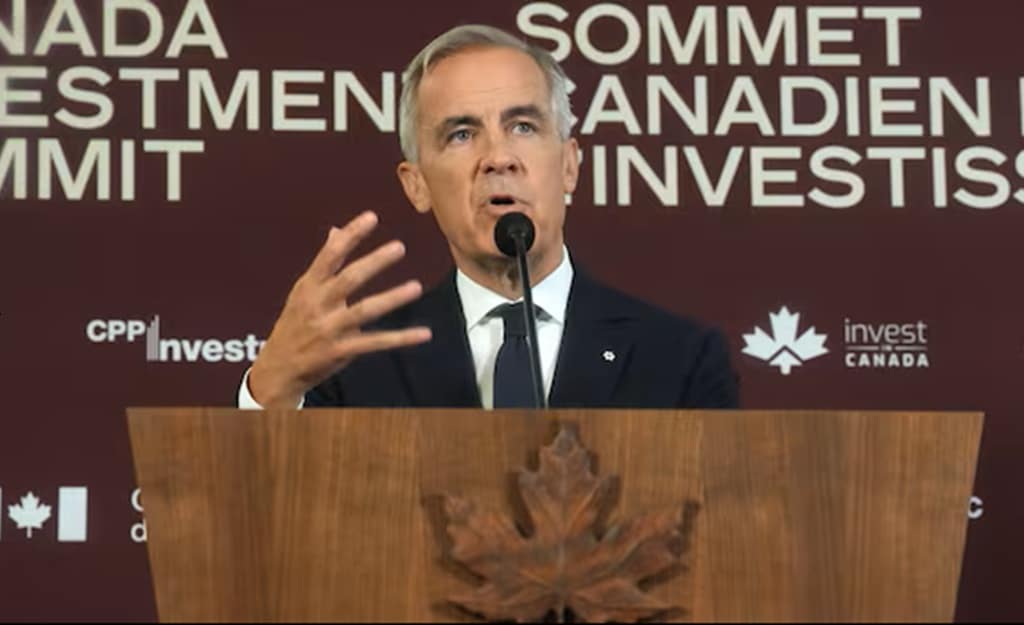
In September 2026, Prime Minister Carney hosted the inaugural Canada Investment Summit right in downtown Toronto. This gathering was an incredibly historic meeting of the world’s most powerful and influential financial minds. The exclusive guest list included top leaders and investors from nearly 30 different wealthy countries.
These elite attendees were certainly not your average everyday retail investors. Together, they currently manage an astonishing $120 trillion in diverse global assets. The Canadian government eagerly pitched them on 167 specific, high-value infrastructure and strategic business projects.
The main ambitious goal of the summit was to quickly unleash $1 trillion in new investments over five years. The federal government desperately wants foreign money to heavily fund new roads, giant ports, and modern energy grids. Improving this critical infrastructure will eventually make shipping goods much easier and cheaper for local manufacturers.
Building Resilience Through Foreign Money
The high-profile summit served as a very bold public statement to the rest of the viewing world. The Prime Minister strongly wanted to definitively prove that Canada is an incredibly safe place to park money. While the rest of the loud world aggressively fights over trade, Canada quietly offers pure economic stability.
The government prominently highlighted Canada’s rare AAA credit rating and highly stable national banking sector. They eagerly pitched the country as a deeply reliable partner that is incredibly rich in critical minerals and green energy. These are exactly the specific things that major global investors desperately want right now.
By the absolute end of the summit, the government happily claimed a truly massive financial victory. Former Prime Minister Stephen Harper even surprisingly gave a highly supportive closing public address. Overjoyed officials quickly announced that the massive event successfully unlocked nearly $500 billion in potential new national investments.
This sudden influx of foreign cash could essentially provide a massive lifeline to the heavily struggling economy. It could easily create thousands of high-quality jobs and severely strengthen the vulnerable national supply chain. But once again, the lengthy timeline is still the biggest immediate issue for people currently running factories.
The Disconnect Between Policy and Reality
There is currently a very clear and obvious disconnect between the politicians in Ottawa and the workers on the factory floor. The federal government is totally focused on big-picture, multi-year solutions that take forever to build. They are slowly building a giant fortress of global money and incredibly complex tax policies.
Meanwhile, the anxious factory owners are painfully living week to week in sheer panic. A vague promise of a beautiful new port built with foreign money in 2030 does absolutely not help today. It certainly will not pay the expensive commercial rent that is completely due at the very end of the month.
This is exactly why Senator Housakos was so incredibly angry during the televised debate. He clearly sees the sheer panic right in the tired eyes of local business owners. He deeply knows that when a struggling factory misses a single payroll, the heavy doors usually close forever.
If these vulnerable businesses go completely bankrupt, the highly skilled workers will simply just leave the entire industry. Once a highly trained mold maker finally finds a totally different job, they rarely ever come back. The tragic loss of that specific human talent is entirely permanent and economically devastating to the nation.
The Danger of Over-Reliance on the U.S.
Despite the widespread national panic, the government’s strong push for deep diversification is not entirely wrong. Over the last few long decades, Canada has carelessly put all its economic eggs in one American basket. Relying so incredibly heavily on the U.S. is a widely known and truly massive financial risk.
When the massive American economy violently booms, Canada naturally benefits immensely from the financial overflow. But when angry politicians in Washington suddenly decide to throw up high tariff walls, Canada predictably gets crushed. The current bitter trade war easily proves that this historic relationship is dangerously and wildly lopsided.
Finding reliable new global trading partners is arguably the only viable way to permanently fix this long-term problem. If wealthy European countries consistently bought a lot more Canadian goods, the painful U.S. tariffs would hurt significantly less. Building a highly balanced trade portfolio is exactly what the ambitious Prime Minister is actively trying to achieve.
However, totally changing the deeply ingrained habits of an entire massive nation takes a very long time. Panicked businesses have to quickly learn entirely new laws, find new safe shipping routes, and meet entirely new buyers. It is a frustratingly slow, incredibly painful process that typically requires many long years of sheer patience and money.
Turning Cautious Eyes Toward Europe
To urgently speed up this slow process, the federal government is aggressively courting the powerful European Union. Deep trade with Europe has actually been a remarkably rare bright spot for the economy very recently. While vital exports to the U.S. sadly dropped, crucial shipments to Europe actually jumped by well over 20 percent.
Prominent European leaders are also visibly showing a very strong and growing interest in allied Canada. Recently, there has even been serious political talk about Canada officially becoming an “associate member” of the massive EU. While a totally formal union is highly unlikely, it clearly shows exactly how close the diplomatic relationship is getting.
The Prime Minister actually recently addressed the entire European Parliament to quickly build these lucrative ties. He strongly called for various middle-power countries to tightly team up against much larger, aggressive economic bullies. By actively working together, they can successfully avoid being totally crushed by brutal American or Chinese trade wars.
If Canada can successfully lock in much better, stronger trade deals with Europe, it could finally save some manufacturers. Struggling factories could quickly ship their highly advanced parts directly across the Atlantic Ocean instead of across the border. But the physical shipping costs are notably higher, and the massive logistics are incredibly complicated to figure out.
Can Ruinous Tariffs Be Successfully Avoided?
Back safely at home, the exhausted mold makers are desperately trying to find tiny loopholes in the giant tariff walls. The Canadian government also recently signed a special foreign investment promotion agreement with the wealthy UAE. They are actively looking absolutely everywhere for a secret backdoor to keep lucrative global trade flowing smoothly.
There are also various federal and provincial support measures aimed directly and specifically at targeted tariff relief. These well-meaning programs are supposed to successfully help poor manufacturers easily absorb the harsh shock of sudden, massive price hikes. But successfully applying for this government aid is very often a dreadfully slow, totally bureaucratic nightmare.
Many smart business owners sadly feel completely helpless in this giant, ongoing geopolitical game of complex chess. They did absolutely everything right, built incredibly strong companies, and happily hired totally local workers. Now, their ultimate daily survival completely depends on the unpredictable whims of completely foreign politicians.
This profound loss of personal control is deeply and universally frustrating for the manufacturing community. A proud business owner naturally wants to fairly compete solely on the high quality of their specific product, not their zip code. The invisible national border has suddenly and tragically become a truly massive, insurmountable business disadvantage.
The Painful Choice: Relocate or Wait It Out
So, what exactly happens next for the deeply troubled Canadian manufacturing sector? The ultimate painful choice for many exhausted owners is finally boiling down to two incredibly difficult options. They can either quickly pack up and move to America, or nervously wait and blindly pray for things to improve.
Physically moving a business entirely to the U.S. completely removes the annoying border problem once and for all. By quickly opening a new shop in friendly Ohio or Michigan, they can easily sell directly to rich American clients. They successfully avoid the dreaded Section 232 tariffs entirely and totally secure their fragile supply lines.
But moving clearly means completely firing their incredibly loyal, highly hardworking Canadian workers. It tragically means totally abandoning the supportive local communities that eagerly helped build their beloved businesses in the very first place. It is an incredibly heartbreaking, gut-wrenching choice that absolutely no sane employer ever wants to make.
Blindly waiting it out is arguably equally dangerous and terrifying for a small business. Every single month that slowly passes under these heavy tariffs aggressively eats away at their precious cash reserves. If the brutal trade war somehow lasts for several years, total bankruptcy is essentially a mathematical certainty for many.
A Terrifying Race Against Time
The heated, angry debate in the Senate perfectly and totally captures the deep anxiety heavily gripping the entire nation. Frustrated lawmakers like Senator Housakos are loudly demanding immediate, giant rescue boats for a rapidly sinking vital industry. They strongly argue that pretty long-term plans are totally useless to a company that completely drowns today.
On the total opposite side, the federal government truly believes they are actively building a much better, significantly stronger ship. They eagerly point to the Productivity Mega Deduction and the recent Canada Investment Summit as absolute solid proof. They are totally convinced that a beautifully diversified, heavily invested national economy will ultimately and completely win.
But for the exhausted, deeply stressed members of the Canadian Association of Mold Makers, the clock is absolutely still ticking incredibly loudly. The massive U.S. market is sitting right next door, incredibly hungry for their goods, yet totally hidden behind a giant wall of tariffs. The stark reality of the cold factory floor is incredibly harsh, deeply stressful, and totally unforgiving.
Ultimately, the long-term, true survival of highly skilled Canadian manufacturing depends almost entirely on sheer governmental speed. Can the busy government quickly deliver its promised tax breaks and totally new trade routes fast enough? If not, the slow trickle of companies moving south will inevitably turn into a truly devastating, totally unstoppable flood.
Trending News:
Opinion: Media Went Easy on Carney After Canada Lost 68,000 Jobs
Millions of Shoppers Boycott Real Canadian Superstore


Why Alberta Is Voting on a Future Independence

Alberta Votes on Independence: Advance Polls Open

Opinion: Is Canada in a Deep Crisis Over Trade and Defense

Canadian Manufacturers Face Bankruptcy Amid U.S. Tariffs

Opinion: Canada’s Economy Is Under Pressure From Debt, a Weak Dollar and Steel Tariffs

H1-B Visa Crackdown Rocks Big Tech and India

Millions of Shoppers Boycott Real Canadian Superstore

Opinion: Media Went Easy on Carney After Canada Lost 68,000 Jobs

Mark Carney’s Million Dollar Wind Up and Nickel Delivery

Mark Carney Faces Ethics Backlash Over Heat Pumps

Opinion: Is Modern Political Empathy Really About Self-Image?

US Trade Moves Put Massive Pressure on Canada

How Progressivism Replaced Religion With A New Secular Faith

Opinion: Canada’s Combating Hate Act Threatens Free Speech

Pierre Poilievre Critiques Reporter Who Questions His Leadership

Canada Sheds 68,000 Jobs As Economic Fears Deepen

Uncovering the Truth Behind Inequality: A Bold New Vision

Opinion: What South America’s Political Shift Means for Canada

Food Insecurity and Surging Prices: Canada’s Inflation Squeeze
Behind Carney’s $1-Trillion Canada Investment Scheme

Jimmy Kimmel Slammed for “Vile” Melania Trump “Expectant Widow” Joke

President Trump Addresses Nation on War with Iran

Trump Warns NATO Allies: America Won’t Protect Slackers After Iran Clash

Senate Hearing on Fraud and Foreign Influence Turns Tense Over Minnesota Scandals

CNN Forced to Backtrack Its Reporting on Trump’s Iran Talks

Joe Rogan Slams Gavin Newsom for Mocking Nick Shirley

Mosque Set Ablaze in Iran a Citizens Revolt Against the Islamic Regime

AOC Accuses Jessie Watters of Fox News of Sexualizing and Harassing Her

JD Vance Exposes Walz’s Fraud and CNN’s Lies in White House Presser

Milestone Card Credit: How the Milestone MasterCard Can Transform Credit


-

 News9 months ago
China-Based Billionaire Singham Allegedly Funding America’s Radical Left
-
Crime10 months ago
YouTuber Nick Shirley Exposes BILLIONS of Somali Fraud, Video Goes VIRAL
-
Politics10 months ago
Ilhan Omar Faces Renewed Firestorm Over Resurfaced Video
-
Politics10 months ago
2026 Midterms Guide: Candidates, Key Issues, and Battleground States
-
Politics8 months ago
CNN Delivers Stark Reality Check to Democrats Over Voter ID
-
Politics8 months ago
Ilhan Omar’s Connections to Convicted Somali Fraudsters Surface
-
Politics7 months ago
Rep. Ilhan Omar Faces Heat as Minnesota Voters Seek Change
-
Politics8 months ago
Trump Approval Rating (February 2026 Poll Results, Approve vs Disapprove)















