Connect with us

News

Trump Outmaneuvers the “British Empire” in the Strait of Hormuz

VORNews

Published

on

Trump Outmaneuvers the "British Empire"

WASHINGTON, D.C. – President Donald Trump has ordered the U.S. government to offer political risk insurance and naval escorts for commercial ships moving through the Strait of Hormuz. The directive follows a pullback by major marine insurers, led by Lloyd’s of London, after threats to Persian Gulf shipping drove war-risk costs higher or pushed coverage off the market.

Supporters say the plan keeps oil and LNG moving and strengthens energy security. Critics say it also challenges a long-standing center of global marine insurance power in London.

The Strait of Hormuz is a narrow 21-mile passage between Iran and Oman. It carries about 20 to 30% of the global seaborne oil trade and a large share of LNG exports from Gulf producers.

After U.S. and Israeli strikes against Iran in late February 2026 (called “Operation Epic Fury” in some reports), threats and attacks around the waterway drove risk levels up fast.

  • By early March, traffic through the strait fell by more than 80%. On some days, tankers did not move at all.
  • Major Protection and Indemnity (P&I) clubs, including Gard (Norway), Skuld, NorthStandard (UK), the London P&I Club, and the American Club, sent 72-hour cancellation notices for war-risk add-ons that took effect March 5.
  • Lloyd’s Joint War Committee widened the “high-risk” area to include the full Persian Gulf. As a result, many underwriters canceled coverage or raised premiums sharply, sometimes two to five times normal levels.

In practice, shipping slowed because money, not missiles, set the limit. Without workable war-risk insurance, shipowners and charterers would not send high-value tankers into danger. That left hundreds of vessels waiting and raised fears of a global energy squeeze.

Lloyd’s holds a major share of marine cargo and war-risk business, and it has long handled complex, high-loss exposures. Its marine roots go back centuries to Britain’s early merchant trade.

Trump’s Response: The U.S. Steps Into Maritime Insurance

On March 3, Trump posted on Truth Social that he had instructed the U.S. International Development Finance Corporation (DFC) to provide “political risk insurance and guarantees” for Gulf maritime trade at a very reasonable price.”

The plan includes:

  • Political risk insurance covering losses tied to war, terrorism, or government actions.
  • Financial guarantees aimed at backing shipowners, charterers, and private insurers.
  • U.S. Navy escorts for tankers when needed, echoing past U.S. protection missions in the region.
  • A later announcement of a $20 billion reinsurance facility meant to steady prices and help restore traffic.

Trump framed the goal in simple terms: “No matter what, the United States will ensure the free flow of energy to the world.”

Using the DFC this way stands out because the agency usually supports development-related financing in emerging markets. Still, there is a recent parallel. In 2023, an insurance effort helped support Ukraine grain exports with participation from Lloyd’s and other firms.

What This Could Mean for Lloyd’s of London and the UK

Lloyd’s remains a global hub for specialty insurance and brings billions into the UK economy each year through premiums, jobs, and related services. Around 50,000 people work in insurance and connected roles in the City of London. Marine and energy coverage sit at the center of that system, and war-risk insurance, while niche, can carry real geopolitical weight.

Some analysts think Trump’s move could pull business away from London over time:

  • If U.S.-backed coverage stays dependable and priced well, some shippers may favor it after the crisis.
  • British headlines have floated the idea that Trump could weaken a roughly £50bn insurance giant.
  • Lloyd’s has taken a cooperative tone with the DFC and says it still leads on war-risk expertise. It also argues coverage is still available, even at higher rates, and that some traffic has started to return.

Even so, the message is hard to miss. A private insurance market in London has long been able to slow trade with pricing and capacity. Now, a state backstop is trying to remove that pressure point.

Bigger Ripple Effects for Energy, Alliances, and Markets

This standoff shows how finance, military power, and energy supply connect in real time.

  • Energy security and prices: By pushing shipments to resume, the U.S. reduces the risk of price spikes at home and helps allies that depend on Gulf oil and LNG.
  • Tension with close partners: In London, some see the policy as a direct hit to a key national industry.
  • Oil market reaction: Prices jumped at first, then eased after Trump’s announcement. Still, war-risk costs remain high, and sentiment is shaky.
  • Limits of insurance alone: Shipping leaders warn that guarantees only help up to a point. If attacks continue, fear can outrun price. At the same time, more naval activity can raise the sense that the route is a live conflict zone.

The administration’s approach blends money, security promises, and military readiness. In effect, the U.S. is presenting itself as the backstop for key sea lanes.

What Comes Next for Hormuz Shipping and War-Risk Coverage

Results will hinge on execution. That includes the fine print of DFC coverage, how it coordinates with private insurers, and whether Navy escorts become routine. Lloyd’s has signaled it can work with the U.S. effort, so a shared model may emerge instead of a clean replacement.

Still, the larger shift is clear. Where private underwriters once had near veto power over a critical chokepoint, direct government support is moving in to keep tankers sailing.

For now, the U.S. has acted to prevent a supply shock, and it has turned an insurance freeze into a test of who guarantees global energy flows.
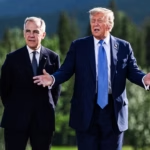
Related News:

Trump Says He’s Very Disappointed in Starmer Over Iran

Continue Reading

News

Trump Issues NATO ‘Ultimatum’ After High-Stakes White House Meeting

VORNews

Published

on

By

Trump Issues NATO ‘Ultimatum’ After High-Stakes White House Meeting

WASHINGTON D.C. — President Donald Trump has escalated his campaign against the NATO alliance, following a tense, closed-door meeting with Secretary General Mark Rutte.

The two-hour session at the White House on Wednesday ended not with a handshake of unity, but with a scathing assessment from the President. In a characteristic post on Truth Social shortly after the meeting, Trump wrote: “NATO WASN’T THERE WHEN WE NEEDED THEM, AND THEY WON’T BE THERE IF WE NEED THEM AGAIN.”

The rift centers on the recent conflict in Iran and the security of the Strait of Hormuz. While a two-week ceasefire was recently reached with Tehran, the President remains furious that European allies did not provide direct military support during the height of the hostilities.

The “Failed” Test: A Fractured Alliance

The Trump administration has been blunt in its critique. Before the meeting even began, White House Press Secretary Karoline Leavitt told reporters that NATO had been “tested, and they failed.”

The President’s frustration stems from several key points:

  • The Iran Conflict: Trump expected NATO allies to join the U.S.-Israeli military campaign against Iran.
  • The Strait of Hormuz: Washington has demanded that European nations take the lead in securing the critical oil waterway, arguing that those who depend on the oil should be the ones protecting the route.
  • Airspace Restrictions: Countries like Spain and France drew Trump’s ire by restricting the use of their airspace and joint military facilities during the operations.

Moving Troops: Punishing the “Unhelpful”

Reports have emerged that the White House is now drafting a plan to “punish” specific NATO members. According to sources familiar with the matter, the administration is considering a major reshuffle of U.S. forces currently stationed in Europe.

The proposed plan would move U.S. troops out of countries deemed “unhelpful” during the Iran war—such as those that blocked airspace—and relocate them to nations that were more supportive of the U.S. military campaign.

While the U.S. currently has roughly 80,000 troops on the continent, any major withdrawal faces legal hurdles. A 2023 law prevents a president from fully pulling out of NATO without Congressional approval. However, experts say the President has significant authority to move troops between different European bases.

Rutte’s “Frank” Diplomacy

Mark Rutte, often called the “Trump Whisperer” by European diplomats for his ability to handle the President’s blunt style, described the meeting as “very frank and very open.”

Speaking to CNN, Rutte acknowledged that the President was “clearly disappointed” with the lack of European involvement in the Middle East. However, Rutte defended the alliance, noting that a “large majority” of Europeans provided logistical support and access to bases.

Rutte’s challenge remains immense. He must convince a skeptical White House that NATO’s primary mandate is the defense of Europe and North America—not necessarily offensive operations in the Persian Gulf.

The Greenland Connection

In an unusual twist, the President’s frustration with NATO has also become entangled with his long-standing interest in Greenland. In his post-meeting social media blast, Trump added: “REMEMBER GREENLAND, THAT BIG, POORLY RUN, PIECE OF ICE!!!”

The President has previously suggested that his irritation with the alliance began with European opposition to his proposal for the U.S. to acquire the territory from Denmark. For many in Brussels, the mention of Greenland during a high-stakes security meeting is a sign of just how unpredictable the transatlantic relationship has become.

What Happens Next?

The President has reportedly given European allies an “ultimatum.” Reports from European diplomatic circles suggest the U.S. is demanding “concrete commitments” of warships and military assets to the Strait of Hormuz within days.

If these demands are not met, the proposed troop reshuffle could begin as early as this summer. For now, the 77-year-old alliance is facing its most significant internal crisis in decades, leaving many to wonder if the “paper tiger”—as Trump now calls it—can survive another four years of friction.

Related News:

Trump and Rubio Put NATO Under  Huge Stress as US Weighs Exit Over Iran War


Continue Reading

News

“Canada is Cooked”: Musk Endorsement of Alberta Independence Sparks Political Firestorm

VORNews

Published

on

By

"Canada is Cooked": Musk Endorsement of Alberta Independence

CALGARY – The digital world and Canadian politics collided this week as billionaire Elon Musk waded into the debate over Alberta’s future. In a series of viral posts on X (formerly Twitter), the tech mogul appeared to back the growing movement for Alberta’s independence, declaring that “Canada is cooked” under its current trajectory.

The comments have reignited a fierce national conversation, pitting Western separatists against federalists and raising questions about foreign influence in Canadian domestic affairs.

The controversy began when Musk replied to David Parker, a prominent leader in the Alberta sovereignty movement. Parker had suggested that breaking away from the federal government was the only way to “save” what remains of the province’s potential.

Musk’s response was brief but impactful. He replied with a simple “Yeah” to the idea of independence and followed up with a separate post stating, “Canada is cooked.” For many in Alberta’s “Free Alberta” movement, the nod from the world’s richest man was a monumental win. For others, it was an unwelcome intrusion by a billionaire with close ties to the current U.S. administration.

Why Musk’s Words Carry Weight

  • Massive Reach: With over 200 million followers, Musk’s posts instantly put Alberta’s sovereignty movement on a global stage.
  • Economic Influence: As the head of Tesla and SpaceX, Musk is seen by some as a visionary for the “new economy,” making his criticism of Canada’s economic path particularly stinging.
  • U.S. Connections: Given Musk’s proximity to the Trump administration, critics worry his comments signal a growing interest south of the border in Alberta’s vast oil and mineral resources.

A Province Divided: The Reaction in Alberta

The reaction within Alberta has been a tale of two provinces. In rural hubs and oil-producing regions, some residents viewed the endorsement as a validation of long-held grievances.

“We’ve been saying for years that the federal government is stifling our industry,” said one supporter at a recent “Alberta Prosperity Project” town hall in Red Deer. “When someone like Musk says the country is ‘cooked,’ he’s just saying what we’re all feeling at the gas pump and in our bank accounts.”

However, recent polling suggests the “Wexit” sentiment remains a minority view. Data from April 2026 shows:

  • 27-29% of decided voters favor independence.
  • 65% of Albertans still prefer to stay within Canada.
  • A significant majority expresses concern that separation would lead to Alberta being annexed by the United States.

Ottawa Responds: Sovereignty and Stability

In Ottawa, the reaction was swift. Prime Minister Mark Carney’s government has attempted to downplay the billionaire’s comments while emphasizing the importance of national unity.

“Canada is a G7 nation with a stable, growing economy,” a spokesperson for the Prime Minister’s Office stated. “Policy is made in the House of Commons by elected representatives, not on social media by foreign citizens.”

Conservative Leader Pierre Poilievre, who has previously received praise from Musk, found himself in a delicate balancing act. While Poilievre has championed many of the same economic frustrations as Albertan separatists, he remains committed to a “united Canada.”

“We need to fix the country, not break it,” Poilievre told reporters. “But you can’t blame people for being frustrated when the current government has made life unaffordable for the average family.”

The “51st State” Fear

The debate has taken on a sharper edge due to recent comments from U.S. officials. U.S. Treasury Secretary Scott Bessent recently suggested that the United States would be open to working with an independent Alberta, even hinting at a “line of credit” to support a new state.

This has led to accusations from leaders like B.C. Premier David Eby, who called the coordination between Alberta separatists and U.S. interests “treasonous.”

The fear for many federalists is that an independent Alberta wouldn’t truly be independent for long. Without the protection of the Canadian Confederation, the landlocked province might find itself forced into a lopsided partnership with Washington.

What’s Next for Alberta?

The Alberta Prosperity Project and other separatist groups have until May 2 to submit their petition to Elections Alberta to trigger a formal referendum process.

While the legal path to secession is incredibly complex—requiring constitutional amendments and negotiations with First Nations—the “Musk Effect” has undeniably shifted the energy of the movement.

Key Hurdles for Independence:

  1. First Nations Rights: Indigenous leaders have made it clear that Alberta cannot separate without their explicit consent, as Treaty rights are held with the Crown.
  2. Economic Uncertainty: Leaving Canada would mean creating a new currency, a new military, and renegotiating every trade deal from scratch.
  3. The “Brain Drain”: Polls show that a large percentage of “stay” voters would leave the province if it separated, potentially causing a massive loss of skilled workers.

The Verdict: A Warning Shot

Whether or not Musk’s “Canada is cooked” comment is true, it has served as a wake-up call. It highlights a deep-seated feeling of alienation in Western Canada that hasn’t gone away with time or changes in leadership.

As the May deadline approaches, the eyes of the world—and the algorithms of X—will be watching to see if Alberta decides to stay the course or take a leap into the unknown.

Related News:

Democrat Appointed Judge Reassigned from Musk Case Over Bias

Continue Reading

News

Starmer Bizarrely Tries to Take Credit for the US- Iran Ceasefire

VORNews

Published

on

By

Starmer Bizarrely Takes Credit for the US- Iran Ceasefire

JEDDAH, Saudi Arabia — Prime Minister Keir Starmer has sparked a wave of confusion and political debate following a high-stakes interview in Saudi Arabia. While the world breathed a sigh of relief as the United States and Iran agreed to a fragile two-week ceasefire, the British leader’s comments have left many questioning the UK’s actual role in the deal.

Speaking from the King Fahd Air Base in Taif, Starmer appeared to position the United Kingdom as a central player in the peace process. This comes despite his government’s repeated and vocal insistence that the UK would stay out of the offensive strikes led by the Trump administration.

The ceasefire, announced earlier this week, brought a sudden halt to 39 days of intense conflict that threatened to spiral into a global energy crisis. The deal, largely brokered by last-minute diplomatic pushes from Pakistan and Gulf partners, hinges on one major condition: Iran must reopen the Strait of Hormuz to international shipping.

During his visit to Saudi Arabia, Starmer was quick to welcome the news. However, his phrasing during a press briefing raised eyebrows back in London.

“Together with our partners, we have reached a moment of relief,” Starmer told reporters. “It is our job now to make sure this ceasefire becomes permanent and that the Strait is opened to protect the UK’s national interest and energy prices.”

Critics were quick to point out the ambiguity. By using terms like “our job” and “we have reached,” the Prime Minister seemed to include the UK in the diplomatic victory—a move some are calling a “bizarre” pivot for a leader who spent weeks distancing Britain from the front lines.

The Policy Paradox: Rejection vs. Participation

Throughout the six-week war, the Labour government maintained a delicate balancing act. On one hand, the UK provided “defensive support” and helped protect shipping lanes. On the other hand, Starmer was adamant that British forces would not join the US and Israel in offensive bombing runs.

This “middle path” has led to several points of tension:

  • Military Restraint: Starmer refused to allow British airbases to be used for offensive strikes against Iranian infrastructure.
  • Economic Pressure: Rising fuel prices at UK pumps forced the government to focus on the economic fallout rather than military glory.
  • The Trump Factor: While Donald Trump used “fire and fury” rhetoric, Starmer leaned into “collective self-defence,” creating a visible gap in the special relationship.

By claiming a share of the “relief” in Saudi Arabia, Starmer is facing accusations of “diplomatic coat-tailing”—trying to take credit for a peace deal he didn’t help fight for.

Why the Strait of Hormuz Matters to You

You might wonder why the Prime Minister is in the Middle East at all. The reason is simple: your wallet. The Strait of Hormuz is the world’s most important oil chokepoint. When Iran closed it, petrol prices in the UK shot up almost overnight.

Impact Category Effect of the Conflict
Fuel Prices Record highs at UK petrol stations.
Global Trade Virtual standstill of tankers through the Gulf.
Diplomacy Intense pressure on the UK to “pick a side.”
Security UK personnel deployed to Saudi Arabia for defensive cover.

Starmer’s visit to the Gulf is an attempt to ensure that “open means open.” He has rejected Iran’s suggestion of charging tolls for passage, stating that the UK’s position is “toll-free navigation” for all.

Mixed Reactions at Home and Abroad

The Prime Minister’s “bizarre” announcement hasn’t gone unnoticed by his political rivals. In the UK, Reform UK and the Conservatives have both questioned the government’s consistency. If the UK wasn’t part of the war, they ask, how is it now a guarantor of the peace?

Meanwhile, in Washington, the Trump administration remains the primary architect of the ceasefire. While Starmer and other European leaders released a joint statement supporting the truce, the real power remains with the two primary combatants.

Key Takeaways from the Taif Interview:

  • The “Work” Continues: Starmer warned that the ceasefire is “fragile” and requires more than just a pause in bombing.
  • Defensive Thanks: He used the visit to thank British troops stationed in the region for their “brave service” in defending allies.
  • A Line in the Sand: Starmer told The Guardian that this war must be a “turning point” for Britain to strengthen its own energy security so it isn’t “buffeted by crises” in the future.

What Happens Next?

The two-week ceasefire is a ticking clock. Discussions are already moving to Qatar and Bahrain as Starmer continues his tour of the region. The goal is to turn this “moment of relief” into a “lasting peace.”

However, the road is far from smooth. Israel has already claimed the ceasefire does not apply to its operations against Hezbollah in Lebanon—a stance Starmer has publicly called “wrong.”

As the Prime Minister tries to navigate these choppy diplomatic waters, the British public is left watching the petrol pumps. For now, the “bizarre” credit-sharing in Saudi Arabia might just be a symptom of a government desperate to show it still has a seat at the world’s top table, even if it refused to enter the room when the shooting started.

Related News:

Starmer Now Blames Trump and Putin for UK’s Energy Prices Not NetZero


Continue Reading

Get 30 Days Free

Express VPN

Create Super Content

rightblogger

Flight Buddies Needed

Flight Volunteers Wanted

Trending