News
Trump Orders Full US Troop Withdrawal from Syria, Ending Decade-Long Mission
WASHINGTON, D.C. – President Donald Trump has directed a complete pullout of about 1,000 US troops from Syria within two months. The White House points to a reduced ISIS threat and a larger counterterror role for the Syrian government. At the same time, the administration is sending more US naval and air power into the Middle East to pressure Iran.
Multiple outlets, including Sky News Australia, Fox News, The Wall Street Journal, and Reuters, reported the decision. It closes out a US mission that began about a decade ago as part of the campaign against the Islamic State (ISIS).
This order follows a steady drawdown over recent months. For example, US forces have recently left key sites such as al-Tanf in southeastern Syria near the Jordan and Iraq borders, and al-Shaddadi in the northeast. In addition, several positions have already shifted to Syrian government control, which signals a planned handoff.
Key details on the Syria withdrawal
- Troop levels and schedule: About 1,000 US personnel are expected to leave within two months, ending the remaining US presence.
- How the mission began: The US entered Syria in 2014 under the Obama administration. It later expanded under Trump’s first term, including cooperation with the Kurdish-led Syrian Democratic Forces (SDF) against ISIS control.
- Why the administration says it’s leaving: Trump officials point to improved security, a weakened ISIS threat, and the Syrian government’s increased willingness to lead counterterror work inside Syria. One senior official said the United States no longer needs a large on-the-ground footprint. Still, officials say the US can respond from outside Syria if terrorist threats return.
- A shift consistent with Trump’s past stance: Trump has long argued that extended ground deployments cost too much and bring limited returns. Earlier pullback efforts in 2018 and 2019 ran into internal pushback and ended in partial moves. This time, the administration appears to be moving forward without the same obstacles.
Officials describe the withdrawal as conditions-based and say it is not tied to other events in the region. Even so, it arrives as tensions rise elsewhere in the Middle East, especially around Iran.
Trump builds a larger military posture aimed at Iran
While reducing US ground forces in Syria, the Trump administration is boosting American naval and air power across the Middle East. The buildup comes as the US watches Iran’s nuclear program, ballistic missile work, and support for regional proxy groups.
According to reports from The New York Times, New York Post, BBC, Reuters, and CNN, the posture includes:
- Another aircraft carrier, the USS Gerald R. Ford, is moving into the region, joining or nearing the USS Abraham Lincoln strike group already operating in the Arabian Sea or Gulf area.
- Dozens of fighter aircraft are heading forward, including F-35 Lightning II stealth fighters, F-22 Raptors, F-16s, and others, shifting from US bases to sites in Europe and the Middle East.
- Support forces such as aerial refueling tankers, guided-missile destroyers, and other warships, building a force that can sustain operations.
This increase comes as indirect talks with Iran continue through third-party channels, including Oman, aimed at a new nuclear agreement. Trump has called for tight limits on Iran’s uranium enrichment and related activity.
He has also warned that a failure to reach a deal could lead to military action. Administration sources say the force posture keeps options open, including strikes on Iranian nuclear facilities, missile sites, or Islamic Revolutionary Guard Corps (IRGC) targets if talks break down.
The USS Gerald R. Ford can carry more than 75 aircraft, including F-35C variants, which increases carrier strike capacity. At the same time, USS Abraham Lincoln’s air wing includes F-35s, F/A-18 Super Hornets, and electronic warfare aircraft. Together, the groups give the US strong air-power choices in the theater.
What this could mean for the region and US policy
The approach is two-tracked. The US is leaving Syria, while also building pressure on Iran. This matches Trump’s America First message, with fewer long-term ground missions but a heavy force where the administration sees core risks.
Possible effects include:
- Inside Syria: Turning sites over to Syrian forces under interim leadership may support domestic efforts against ISIS. However, it also raises concerns about Kurdish partners and the chance of new gaps in control.
- Counterterrorism going forward: US officials say they will rely on over-the-horizon tools, including intelligence support and drone strikes, to help prevent an ISIS comeback.
- Iran tensions: The military buildup may strengthen the US hand in talks. At the same time, it can increase the risk of mistakes or escalation, with Iran reportedly preparing for possible US or joint US-Israeli strikes.
- Across the Middle East: Some allies, including Israel and Gulf states, may welcome a stronger Iran-focused posture. Critics, however, warn that it could pull the US deeper into regional conflict again.
The Syria withdrawal tracks with a familiar Trump promise to bring troops home and point to progress against ISIS. Yet the parallel buildup aimed at Iran shows the administration’s narrower focus. It is stepping away from long-term ground commitments, while keeping strong air and sea power ready for threats tied to Tehran.
Over the next two months, the shift will become clearer on the ground. For now, the message from the White House is straightforward: a lighter footprint in Syria, and a heavier presence at sea and in the air where the administration sees the biggest risks.

Related News:
New Report Gives Trump an Economic Win as Inflation Cools to 2.4%
News
Tucker Carlson and Staff Allegedly Detained in Israel Claims Passports Were Taken
TEL AVIV – Conservative media personality and podcast host Tucker Carlson says Israeli authorities detained him and his team on Wednesday. He said it happened soon after they interviewed U.S. Ambassador to Israel Mike Huckabee at Ben Gurion Airport.
Carlson described the incident to the Daily Mail. Since then, it has stirred arguments about press freedom, U.S.-Israel relations, and Carlson’s sharp criticism of Israeli policy. That includes Israel’s war in Gaza and its claims about how Christians are treated in the region.
Tucker Carlson’s trip followed a heated back-and-forth online with Huckabee. The former Arkansas governor is a well-known Christian Zionist and now serves as President Donald Trump’s ambassador to Israel.
On The Tucker Carlson Show, Carlson has repeatedly raised concerns about what he calls the poor treatment of Christians in Israel and across the Holy Land. In a recent episode, he spoke with Anglican Archbishop of Jerusalem Hosam Naoum and a Jordanian Christian businessman. During that discussion, he alleged discrimination and weak protection for Christian communities.
Huckabee pushed back in public and invited Carlson to come to Israel to talk in person and see conditions for himself. Carlson agreed, but he kept the visit short. He stayed at the airport, held the interview in a VIP lounge, and said he did not enter the country beyond that setting.
People familiar with the meeting described the talk as emotional and productive. The discussion reportedly covered Christian access to holy sites, safety concerns, and what the U.S. is doing to support religious minorities during a tense period in the region.
Tucker Carlson’s Version: Passports Taken and Questions About the Interview
Tucker Carlson said things changed right after the interview ended.
“Men who identified themselves as airport security took our passports, hauled our executive producer into a side room, and then demanded to know what we spoke to Ambassador Huckabee about,” Carlson told the Daily Mail. He called it “bizarre.” Still, he said, authorities later released the group, and they left Israel on a private jet.
He also said the questions focused on what he discussed with the ambassador. As a result, Carlson suggested Israeli security treated the interview as sensitive.
Since leaving Fox News, Carlson has built a large audience through his independent podcast. He framed the airport encounter as part of wider pressure on people who criticize Israeli policy.
Officials Push Back: “Normal” Screening at the Airport
Israeli and U.S. officials rejected Carlson’s description and said it was routine.
A U.S. Embassy in Israel spokesperson said Carlson “received the same passport control questions that countless visitors to Israel, including Ambassador Huckabee and other diplomats, receive as part of normal entrance and exit from the country.”
The Israel Airports Authority also denied claims of detention, delay, or interrogation. It described the checks as standard for travelers and said the separate questioning in a VIP area was meant to protect privacy, not target Carlson’s group.
Huckabee weighed in on social media as well. He wrote that “EVERYONE who comes in/out of Israel (every country for that matter) has passports checked & routinely asked security questions.”
He dismissed the idea that Carlson faced special treatment. Huckabee also pointed to Ben Gurion Airport’s tough security rules, which authorities often defend as necessary because of ongoing threats.
The Bigger Picture: Carlson’s Growing Criticism of Israel
The airport dispute comes as Carlson has become more outspoken about Israel.
After leaving Fox News, he criticized Israel’s military campaign in Gaza after the October 7, 2023, Hamas attacks. He has questioned how much support the United States should provide and has pointed to civilian deaths.
He has also hosted guests who strongly oppose Israeli policies. At times, he has accused some pro-Israel voices of having too much influence over U.S. foreign policy.
In other interviews and podcasts, Carlson has argued that Christian leaders in the United States have not defended persecuted Christians in the Middle East, including in Israel.
Critics have responded by accusing him of antisemitism. They point to his ties to controversial figures and language they say echoes conspiracy claims about Jewish or Israeli influence.
Claims of Pressure and Deplatforming Over Israel Commentary
Tucker Carlson has said before that people want him to soften his views about Israel.
Some reports say President Trump personally urged him to “tone down the temperature” on Israel-related comments. The goal, according to those reports, was to reduce conflict inside the Republican Party.
Tucker Carlson has also hinted at threats to his platform and career if he keeps criticizing the Israeli government and its actions in Gaza.
Supporters say that pressure looks like an attempt to shut down debate. Opponents argue his framing can feed antisemitic ideas.
Online reaction has split along familiar lines. Some conservatives backed Carlson and called for an investigation into the alleged detention. Others brushed it off and said he exaggerated the story to draw attention.
Former Israeli Prime Minister Naftali Bennett attacked Carlson as well. He called him a “phony” and a “chickens—,” accusing him of staging drama after a short airport visit instead of engaging with the country.
What It Could Mean for U.S.-Israel Relations and Press Freedom
Even if the stop was brief, the clash highlights tension inside U.S. conservatism over Israel policy. That tension matters more as the Trump administration tries to hold alliances together in the Middle East.
It also puts a spotlight on how journalists and commentators get treated when they travel, especially when they cover religion or sensitive diplomatic topics.
Tucker Carlson still draws a huge audience. Because of that, the episode could boost discussion on his show about free speech, foreign influence, and religious freedom.
More details may come out once the Huckabee interview airs. Until then, what started as a public challenge has turned into a new flashpoint, with Israel, Christianity in the Holy Land, and the limits of open debate all tied together.
Related News:
Tucker Carlson Presses Qatari PM on the Shifting Power and Gaza
News
Hillary Clinton Labelled a “Psychopath” After Denying Epstein Links
NEW YORK – A heated Sky News Australia segment sparked fresh attention on the Epstein files after comedian Alex Stein slammed former First Lady Hillary Clinton for saying she had no ties to Jeffrey Epstein.
On air, Stein labeled Clinton a “psychopath“ and accused her of lying with ease. His comments quickly spread online, adding fuel to ongoing fights over who knew Epstein, who didn’t, and what the public still hasn’t seen.
Stein’s On-Air Blowup: “She Lies Better Than Any Hollywood Actress”
Alex Stein joined Sky News host Rita Panahi and reacted sharply to Clinton’s recent denial. He claimed Clinton wasn’t telling the truth and tied her statements to broader claims about Epstein’s circle.
- Stein’s key quote: “Hillary Clinton is a psychopath,” he told Panahi. “She has the ability to lie better than any Hollywood actress.”
- Why he said it: Stein pointed to alleged Clinton and Epstein connections and argued her calm delivery made the denial harder to trust.
- Where he took it next: He also pulled in other names, including Nancy Guthrie, while pushing what he described as a “wild conspiracy theory” about political protection and cover-ups.
Even though Stein is known for satire and shock-style commentary, his segment landed with viewers who already doubt official explanations around Epstein and his associates.
Clinton Pushes Back: BBC Interview Triggers a New Wave of Criticism
Stein’s remarks followed Hillary Clinton’s interview with the BBC, where she said she and former President Bill Clinton have “no links” to Epstein or Ghislaine Maxwell. The interview aired as pressure grows to release more Epstein-related documents. During the conversation, Clinton also accused the Trump administration of dragging its feet on disclosure.
- Clinton’s statement: “We have no links,” she told BBC journalist Jessica Parker. She said Bill Clinton flew on Epstein’s plane for Clinton Foundation-related work, and she said she met Maxwell “on a few occasions” but denied anything beyond that.
- Her message to the government: Clinton called for openness, saying, “Get the files out. They are slow-walking it,” and criticized redactions and resistance to Congress.
- Her response to images and paperwork: After photos of Bill Clinton with Epstein circulated again, she called the situation “horrifying” and repeated that the Clintons have been “more than happy to say what we know.”
The BBC interview, aired during the Munich Security Conference, cast Clinton as someone pushing transparency. Still, critics like Stein see her tone as controlled deflection, and that view has spread fast online.
The Epstein Scandal: Famous Names, Flights, and Long-Running Doubts
The outrage makes more sense with the broader Epstein story in mind. Epstein died in jail in 2019 while awaiting trial on sex-trafficking charges. For years, he mixed with celebrities, politicians, and royals. His private jet, often called the “Lolita Express,” became a symbol of the case because of reported trips tied to his properties and the allegations.
- Bill Clinton and the flight logs: Flight logs show Bill Clinton traveled on Epstein’s plane at least 26 times from 2002 to 2003, often tied to foundation-related stops in Africa and Asia. Bill Clinton has said those trips were legitimate and that he cut ties in 2005, before Epstein’s first conviction.
- Hillary Clinton and Maxwell: Hillary Clinton has said she met Maxwell briefly, but says she never met Epstein. Recent documents reportedly mention Bill Clinton more than 50 times, although they don’t allege wrongdoing against him.
- Other high-profile fallout: The wider scandal has touched people like Prince Andrew and led to Maxwell’s 2022 sex-trafficking conviction. As more files become public, victims’ advocates keep calling for accountability.
Because Epstein’s death was ruled a suicide, speculation hasn’t stopped. In that environment, Stein’s attack plays into the public’s distrust and the demand for unredacted releases.
Reaction Online and in the Media: Support, Pushback, and Partisan Framing
Stein’s Sky News appearance split audiences. Some praised him for going after powerful figures. Others called it performative outrage that spreads misinformation. On social media, hashtags like #EpsteinFiles and #ClintonEpstein trended as users argued over what Clinton’s denial means.
- Support for Stein: Many conservative voices amplified his comments and tied them to older Clinton controversies, including the email server story.
- Defenders of Clinton: Others said the focus on the Clintons distracts from other people named in Epstein coverage, including Donald Trump, who has been photographed with Epstein but denies a close relationship.
- How outlets covered it: Networks and publishers, including CNN and GlobalNews,s highlighted Clinton’s claim that officials were withholding information, framing it as a political fight over transparency.
Online threads on Reddit and YouTube showed the same divide. Some users said Clinton’s push for public hearings signaled confidence, not guilt. Meanwhile, 9 News Australia also covered the renewed attention on Clinton-related references, adding to the global attention.
Transparency Pressure Builds: What Could Come Next
Clinton’s call to release the files lines up with bipartisan efforts in Congress, including a law that requires disclosure. Still, lawmakers say delays and national security redactions keep slowing the process. Victims’ groups tied to the Maxwell case have also pushed for faster release so enablers can be identified.
- Possible outcomes: More documents could either support the Clintons’ account or raise new questions. Some legal analysts expect no charges against Bill or Hillary Clinton, while warning the reputational hit could grow.
- Political stakes: With the 2028 election on the horizon, the story could shape how voters think about long-standing political brands, including the Clintons.
- A wider takeaway: The Epstein case keeps highlighting how power can shield people, and why transparency matters when the public feels shut out.
Stein’s “psychopath” label adds another loud moment to a scandal that refuses to fade. For some viewers, it reads as blunt truth-telling; for others, it’s sensationalism. Either way, it keeps the pressure on officials to release more information.
Timeline Context: How the Clinton and Epstein Story Kept Coming Back
The Clinton and Epstein connection has been discussed for years, largely tied to the early 2000s and Bill Clinton’s post-presidency travel and charity work. In a 2002 New York Magazine profile, Epstein described Clinton as a “great guy.” Later reporting suggested the relationship cooled as Epstein’s legal troubles grew, with ties said to have faded by 2011.
During Hillary Clinton’s 2016 campaign, questions about Epstein links surfaced at times but didn’t dominate the race. Now, newer releases, including photos said to be from Epstein-linked locations, have revived attention. Clinton’s team continues to say all contact was appropriate and supported by staff statements.
In the BBC interview, Hillary Clinton described the renewed focus as a “deliberate effort to protect” others, pointing blame toward the Trump-era handling of disclosures. That framing hasn’t slowed down critics like Stein, who call it misdirection.
Expert View: Why Labels Like “Psychopath” Don’t Help
Mental health experts often warn that words like “psychopath” get thrown around too casually. In clinical terms, psychopathy involves traits such as shallow emotion, manipulation, and lack of empathy. Using it as a political insult can oversimplify behavior and confuse the public.
Communication specialists also point out that Clinton has spent decades under harsh scrutiny. A steady tone can reflect experience, not deception. Still, in a climate filled with misinformation and deep distrust, extreme language can spread fast and erode confidence even more.
The Epstein scandal remains a test of whether powerful people face real scrutiny. Stein’s viral Sky News rant adds another flashpoint, while Clinton’s BBC denial shows how quickly the story turns into a partisan fight. As more files appear, the public may get clearer answers. For now, the argument continues, mixing verified records, public statements, and nonstop suspicion.
Related News:
Hillary Clinton Slammed By Czech Deputy PM in Dramatic Munich Faceoff
News
Megyn Kelly Talks With Buck Sexton About Left-Wing Brainwashing
February 18, 2026 – In a lively, wide-ranging conversation on The Megyn Kelly Show, Megyn Kelly interviewed Buck Sexton, co-host of The Clay Travis and Buck Sexton Show and author of the new book Manufacturing Delusion: How the Left Uses Brainwashing, Indoctrination, and Propaganda Against You.
The interview landed right as the book was released on February 17, 2026. Throughout the discussion, Sexton argued that parts of the political left push coordinated messaging that pulls people away from objective reality.
Sexton, who previously worked as a CIA analyst focused on jihadi terror networks, said these methods resemble the persuasion tactics used by authoritarian movements in the past.
In his view, today’s flashpoints, from gender ideology to racial narratives, spread less like organic cultural change and more like results of nonstop messaging, social pressure, and influence inside major institutions.
Sexton Main Claim to Megyn Kelly: Building a Shared Delusion
Early on, Sexton explained why he chose the title Manufacturing Delusion. He told Kelly that the “manufacturing” comes from people seeking broad control, not honest debate. In other words, he believes brainwashing and indoctrination can shape public belief at scale, then reward compliance.
Here are the main themes he raised:
- Brainwashing and indoctrination tools: Sexton said repeated talking points across media, schools, and corporate settings can train people to accept ideas that clash with common sense or biology.
- How propaganda works over time: He argued that constant exposure makes extreme positions feel normal, while disagreement starts to look dangerous or unacceptable.
- “Weaponized kindness”: Sexton used this phrase to describe how compassion can become a pressure tactic, especially in debates about transgender issues and racial equity demands.
Kelly challenged him on how these trends play out in everyday life. They also discussed how hardline messaging can shut down debate and deepen division across the political spectrum.
Past Examples of Mass Persuasion
A large part of the interview focused on history. Sexton leaned on past cases to argue that mass belief shaping isn’t new.
He pointed to several comparisons:
- 20th-century totalitarian states: Sexton cited Nazi Germany and the Soviet Union as examples of systems that used propaganda offices and re-education to enforce strict ideology. He said people learned to repeat claims that served the state, even when they were absurd.
- Cult-style recruitment: Drawing on his CIA experience, he compared modern political pressure to jihadi recruitment, where groups used isolation, repetition, and identity binding to reshape how recruits saw the world.
- Orwell’s warning signs: Sexton referenced George Orwell’s 1984 and the “2+2=5” idea, saying social and career pressure can push people to accept obvious falsehoods.
He also argued that once enough people adopt the preferred story, the system starts to police itself. Those who resist may face shaming, cancellation, or professional fallout, which then pushes others to stay quiet.
Why Group Pressure Works
Kelly and Sexton also talked about why people go along with groupthink. They agreed that conforming can feel safer because it offers belonging and protection from backlash. Still, they said the costs can be serious.
- A shift in what people call “real”: Sexton argued that as more people repeat the same lines, society starts treating dissent as “hate speech” or “disinformation,” even when it’s grounded in facts.
- Real-world outcomes: He pointed to the defund-the-police movement and debates over redefining gender, arguing that these ideas can lead to higher crime and worsening mental health.
- Spillover effects on the right: Sexton added that conservatives can get pulled into the cycle, too. In his view, extreme claims on race or trans issues can spark overcorrections that raise the temperature even more.
At one point, he framed the threat as internal. He said the biggest danger isn’t an outside invasion, it’s the slow breakdown of rational thinking at home.
Current Examples and a Call to Pay Attention
Later, the discussion moved to recent news, including shootings involving individuals identified as trans. Sexton tied those cases to what he called cultural confusion, where affirmation replaces treatment and honest diagnosis. He again criticized “weaponized kindness,” saying it can put ideology ahead of mental health.
Kelly also brought up passages where Sexton describes COVID-era rules as another example of a “manufactured delusion.” He argued that elites and left-leaning institutions used fear and pressure to drive compliance.
To push back, Sexton urged people to stay alert, think clearly, and refuse to self-censor. He said his book aims to help readers recognize manipulation tactics and hold their ground when social pressure rises.
Why the Conversation Hits a Nerve Now
With cultural conflicts growing sharper, Sexton’s Manufacturing Delusion positions itself as a direct warning about propaganda, indoctrination, and political brainwashing. Published by Penguin Random House and promoted by voices like Glenn Beck and Jack Carr, the book mixes intelligence-style analysis, historical examples, and commentary on today’s debates.
The interview’s takeaway was simple: if people don’t notice how these narratives get built and repeated, shared reality can crack. Sexton’s message to viewers was to spot the pattern early, before it becomes the new normal.
Trending News:
Accusations Fly Over Alleged Zionist Takeover of (TPUSA) Turning Point USA
-
Crime2 months agoYouTuber Nick Shirley Exposes BILLIONS of Somali Fraud, Video Goes VIRAL
-
China3 weeks agoChina-Based Billionaire Singham Allegedly Funding America’s Radical Left
-
Politics2 months agoIlhan Omar’s Ties to Convicted Somali Fraudsters Raises Questions
-
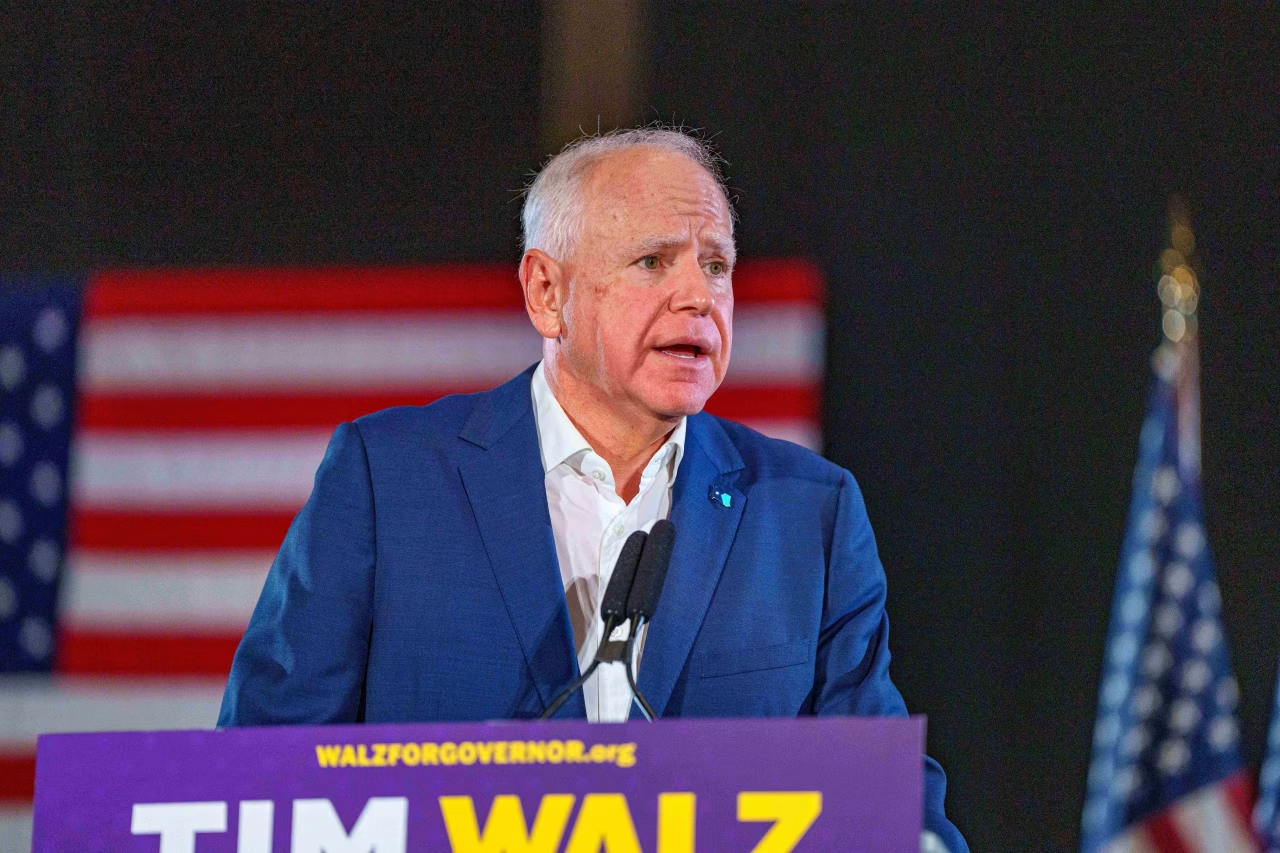
News2 months agoWalz Tried to Dodges Blame Over $8 Billion Somali Fraud Scandal
-
Crime2 months agoSomali’s Accused of Bilking Millions From Maine’s Medicaid Program
-
Crime2 months agoMinnesota’s Billion Dollar Fraud Puts Omar and Walz Under the Microscope
-
Politics2 months agoIlhan Omar Faces Renewed Firestorm Over Resurfaced Video
-
Business2 months agoTech Giant Oracle Abandons California After 43 Years