Connect with us

Crime

FBI Seizes 2020 Election Records in Fulton County, Georgia, Under Renewed Scrutiny

VORNews

Published

on

FBI Seizes 2020 Election Records

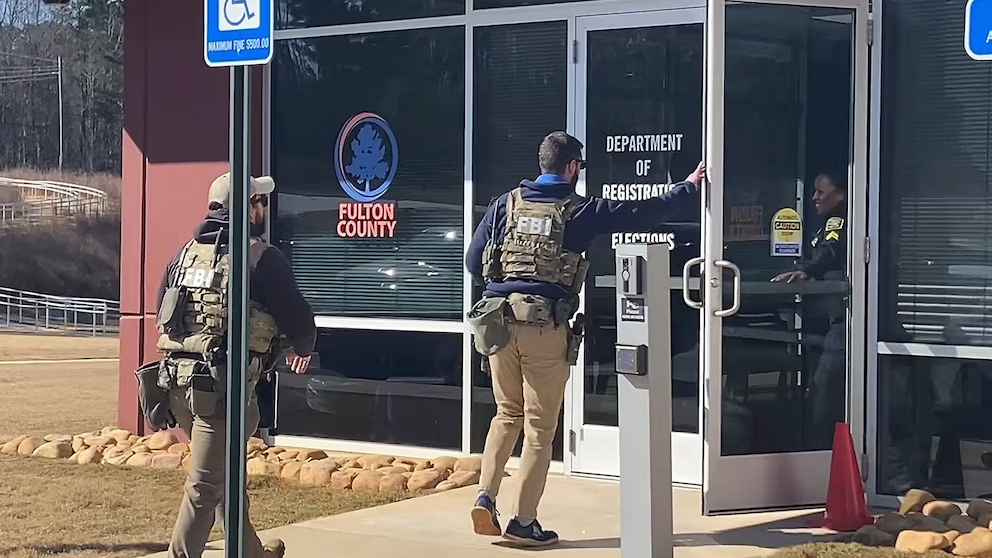
GEORGIA – Federal agents with the FBI carried out a search warrant at the Fulton County Elections Hub and Operations Center in Union City, Georgia, near Atlanta. Agents removed hundreds of boxes of election materials tied to the 2020 presidential contest. Reports put the total at roughly 656 to 700 boxes. The records reportedly include ballots, tabulator tapes, ballot images, voter rolls, and related files.

The seizure has brought Fulton County back into the spotlight. The county, which includes much of Atlanta, is a Democratic stronghold and was one of the most argued-over areas after the 2020 vote. The move has also reopened public debate about election security, claims of voter fraud, and the reliability of voting technology.

President Donald Trump, who lost Georgia to Joe Biden by fewer than 12,000 votes, has long said the state’s results were affected by major problems. Since 2020, Georgia has gone through audits, recounts, and reviews at the state and federal levels. Those efforts upheld the certified outcome and did not find fraud that could have changed the result. Even so, the FBI’s action suggests federal authorities are either following new information or taking another look at old claims.

The warrant was approved by Magistrate Judge Catherine M. Salinas. It called for “all physical ballots from the 2020 general election,” along with connected digital records and voter data. Federal officials described the search as “court-authorized,” but shared few details, citing an ongoing investigation.

Fulton County confirmed the seizure and said the records had been kept as required by law. Some county leaders and staff voiced concern about the scale of the search and the loss of custody over archived materials. They also warned it could affect current election planning. County officials said they were prepared to challenge parts of the warrant in court if needed.

Voter Fraud Claims Return to the Forefront

The search has revived familiar accusations that fraud shaped Georgia’s 2020 result. Critics have pointed to several issues that have circulated for years, including alleged ballot mishandling at State Farm Arena, concerns about unsecured drop boxes, and claimed problems with voter rolls.

Georgia officials have reviewed many of these claims before. Investigations led by Georgia Secretary of State Brad Raffensperger, a Republican, rejected most of them. State reviews often said the claims were unsupported or based on misunderstandings of normal election steps. Still, the arguments have stayed alive online and in political messaging, especially around Fulton County.

A major focus has been on Dominion Voting Machines, which were used in Fulton County and much of Georgia. Some conspiracy theories claimed Dominion systems could be hacked or altered and used to switch votes from Trump to Biden.

Dominion has repeatedly denied those claims. The company has also reached defamation settlements with outlets that promoted the allegations. Supporters of the technology point to hand recounts that matched the machine totals as a key check on accuracy.

Official probes, including cybersecurity reviews by federal agencies, have not found credible evidence of widespread tampering with Dominion equipment. Even so, the FBI’s seizure included tabulator tapes and ballot images, records that could be reviewed to see how votes were recorded and reported. Some observers say that kind of material could support a detailed forensic review of tabulation steps, equipment logs, and reporting outputs.

Election security experts have also warned that broad seizures can create political fallout. They say large-scale federal action, especially years after an election, can deepen distrust if people see law enforcement as taking sides. That concern has grown because the seizure happened more than five years after the 2020 vote, during a period when national leaders have continued to argue about that election.

A Former Employee’s Sworn Statement Draws Attention

Interest in Fulton County’s 2020 records has also been linked to a sworn statement from a former county election employee. The statement has been cited in legal filings and public discussions over the years.

According to summaries of the affidavit, the former worker reported witnessing events they believed raised red flags. Those claims have included access concerns involving voting systems and observations related to ballot handling and chain-of-custody practices. The exact details have differed depending on how the statement is described in court filings and commentary.

Similar affidavits appeared in lawsuits that challenged the 2020 results. Courts often dismissed those cases, saying the claims lacked supporting proof or relied too heavily on hearsay. Still, people pushing for deeper reviews have pointed to the former employee’s sworn statement as a reason to keep pressing for answers, including more scrutiny of Dominion systems and county election procedures.

It is not clear whether that statement played a direct role in the FBI’s warrant. Federal authorities have not explained what triggered the search or what the investigation is focused on. That lack of detail has left space for competing interpretations. Supporters of the seizure see it as a serious step toward accountability, while critics see it as a sign that old claims are being reworked into new investigations.

Legal experts have also raised questions about the sweep of the warrant and the practical impact of taking so many archived records. Some say it is unusual for federal agents to remove large sets of ballots and related materials so long after an election. Others have questioned how the action fits with record retention rules and the normal process for investigating election-related offenses.

Civil rights and election groups watched the situation closely. The ACLU of Georgia sent observers during the operation and documented what they saw, saying transparency matters when law enforcement takes actions that could affect public confidence in elections.

What the FBI Seizure Could Mean for Election Integrity Debates

The Fulton County search happened during a period of intense national disagreement over voting rules and election systems. President Trump has continued to describe the 2020 election as corrupt. Recent moves by the administration, including requests for voter data from states, have also signaled a wider interest in reviewing past election activity. Election officials in many states have pushed back, saying repeated rechecks and broad demands can damage trust and make it harder to run future elections.

Fulton County leaders, including Chairman Rob Pitts, have expressed concern about losing control of records they consider sensitive and irreplaceable, even if only for a time. County officials have said they followed required procedures in 2020. They also point to later elections conducted in the county as evidence that systems and staff can run large contests effectively.

For people who believe the investigation is needed, the seizure looks like a long-awaited step to verify claims that were never fully addressed to their satisfaction. For opponents, it looks like a risky precedent, one that could turn federal power into a tool used against political opponents and local election offices.

What comes next depends on what investigators find and what they choose to make public. Forensic review can take time, and results may not settle the argument for everyone. Even so, the episode shows how the fight over the 2020 election still shapes politics in 2026, from debates about voting technology to basic trust in the people and institutions that run elections.

Related News:

FBI to Launch Sweeping Crackdown on Left-Wing Extremists in Minnesota

Continue Reading

Crime

FBI Raids Virginia State Senator Louise Lucas’s Office

VORNews

Published

on

By

FBI Raids Virginia State Senator Louise Lucas's Office

WASHINGTON, D.C. – On Wednesday, May 6, 2026, federal agents conducted a sweeping series of raids targeting Virginia State Senator L. Louise Lucas. The FBI searched her legislative office in Portsmouth, Virginia, along with a nearby cannabis dispensary she co-owns.

According to federal law enforcement sources, the raids are part of a broad investigation into political corruption and illegal marijuana sales. The sudden law enforcement action has sent shockwaves through Virginia politics. Senator Lucas is one of the state’s most powerful Democrats, and the raid comes just weeks after she successfully led a highly contested effort to redraw Virginia’s voting districts.

Here are the key facts you need to know:

  • The Targets: The FBI raided at least 10 locations, including Lucas’s Portsmouth office and her business, The Cannabis Outlet.
  • The Allegations: Sources say the probe involves federal bribery allegations and the illegal sale of marijuana.
  • The Senator’s Reaction: Lucas was present during the raid but told reporters she had no idea why the FBI was there.
  • No Arrests Yet: While reports indicate some people were detained at the scene, Senator Lucas has not been charged with any crime.

FBI Agents Search Portsmouth Office

The operation began early Wednesday morning. Witnesses reported seeing multiple FBI vehicles, and in some areas, SWAT teams with weapons drawn. Agents ordered staff members to leave the legislative building and were later seen carrying boxes of documents out of the office.

The FBI’s Norfolk field office confirmed the activity in a brief statement. A spokesperson said agents were carrying out “court-authorized” law enforcement activity and assured the public there was no safety threat. However, they declined to give further details about the investigation.

Senator Lucas arrived at her office while the searches were still happening. When asked by reporters about the event, she kept her answer short. “I don’t know what’s going on,” Lucas said. “I’m just going to wait until they tell me.”

The Cannabis Dispensary Connection

A major focus of the raid appears to be The Cannabis Outlet, a retail shop located right next to the senator’s office. Lucas opened the business in 2021, shortly after she helped pass laws to legalize the possession of small amounts of marijuana in Virginia.

However, Virginia’s marijuana laws are currently in a gray area. While it is legal to possess the drug, the state has not yet set up a legal system for retail sales. Because of this, businesses like The Cannabis Outlet operate in a loosely regulated market.

In the past, the shop has faced heavy criticism. Previous media investigations claimed the store sold products that were mislabeled or contained THC levels much higher than state limits allow. Now, federal investigators are reportedly looking into whether the business is tied to a larger bribery scheme. Interestingly, some sources noted that this investigation actually began during the Biden administration, long before the current raids took place.

To understand the impact of this raid, you have to understand Senator Lucas’s role in the state. At 82 years old, she is a towering figure in Virginia politics. She was first elected to the Virginia General Assembly in 1991 and currently serves as the Senate President pro tempore. This makes her the highest-ranking official in the chamber.

Furthermore, she chairs the powerful Senate Finance and Appropriations Committee. Lucas is known for taking strong stands and using her influence to guide state policy. Beyond her political career, she runs several businesses, including a residential service provider for adults with developmental disabilities.

Political Reactions and Redistricting Tensions

The timing of the raid has caused outrage among many Democrats. Just last month, Virginia voters approved a new map for congressional districts. Senator Lucas was the driving force behind this redistricting plan, which gives Democrats a major advantage in upcoming elections.

Because of this recent political victory, some Democratic leaders are questioning the motives behind the FBI’s actions. They point out that the Justice Department is currently operating under President Donald Trump and FBI Director Kash Patel.

Virginia House Speaker Don Scott, a Democrat from Portsmouth, expressed deep concern. He urged the public to wait for the facts before making judgments. “Given the politicization of this administration… I think people should take this with a grain of salt,” Scott said in a statement.

Similarly, U.S. Representative Bobby Scott released a statement defending the senator’s right to due process. He suggested the raid looks like an attempt to punish political opponents, especially after Lucas helped stop what Democrats called a “power grab” over the state’s voting maps.

Meanwhile, State Attorney General Jay Jones, also a Democrat, stated that these types of investigations can easily damage the public’s trust in federal law enforcement. According to the Associated Press, many local politicians share this fear.

As the dust settles in Portsmouth, Virginia, the city is waiting for answers. Federal authorities have not announced any indictments, and the exact details of the search warrants remain sealed by the court.

Governor Abigail Spanberger, a Democrat who received strong support from Lucas during her campaign, has decided to stay quiet for now. A spokesperson simply said the governor is aware of the situation but will not comment without more information.

For now, Senator Lucas remains free and holds her powerful position in the Senate. The coming weeks will reveal whether this investigation leads to criminal charges or if it simply fades into the background of Virginia’s complex political landscape.

Trending News:

Damaging DOJ Report Exposes Biden FBI of Targeting Christians

Ilhan Omar Refuses to Turn Over Documents to Minnesota Fraud Committee


Continue Reading

Crime

Former FBI Director James Comey Indicted for Threatening Instagram Post

A simple beach photo has triggered a massive federal case. Here is everything you need to know about the “86 47” controversy, the clash with President Trump, and what it means for free speech.

VORNews

Published

on

By

Former FBI Director James Comey Indicted

WASHINGTON, D.C. – Former FBI Director James Comey is back in the headlines. In a move that has sparked intense debate across the country, a federal grand jury in North Carolina has indicted the former law enforcement official. The alleged crime? A social media post featuring seashells on a beach.

While it might sound like the plot of a legal thriller, the situation is very real. The Justice Department claims that the photo was a coded, dangerous threat against President Donald Trump. Meanwhile, legal experts and free speech advocates are scratching their heads, wondering how a picture of shells could lead to federal charges.

Let’s break down how a walk on the beach turned into a high-stakes legal battle, the history behind the bad blood between Comey and the president, and why this case could have a massive impact on the First Amendment.

A Walk on the Beach Turns Into a Federal Case

The entire controversy started back in May 2025. According to reports from the Associated Press, Comey was taking a walk along a beach in North Carolina. He snapped a photo of some seashells arranged in the sand. The shells spelled out two numbers: “86” and “47.”

Comey posted the image to his Instagram account with a simple caption: “Cool shell formation on my beach walk.”

Almost immediately, the internet reacted. Some users pointed out that the numbers carried a hidden, political message. In response to the growing uproar, Comey deleted the photo shortly after posting it. He followed up with a message stating that he did not realize some people associated those numbers with violence.

“It never occurred to me, but I oppose violence of any kind, so I took the post down,” Comey wrote.

However, the damage was already done. The very next day, Secret Service agents interviewed Comey. The former FBI director maintained that he simply stumbled upon the shells and did not arrange them himself. Still, the Trump administration saw the post as a clear and present danger, ultimately leading to the recent criminal indictment.

What Does “86 47” Actually Mean?

To understand why the Justice Department cares about a picture of seashells, you have to understand the slang behind the numbers.

The number “47” is straightforward. Donald Trump is the 47th president of the United States. The number “86,” however, is where things get complicated.

In restaurant culture, to “86” an item means to throw it out or remove it from the menu. If a diner runs out of soup, the chef might say, “86 the soup.” By logical extension, some people use “86” as slang for getting rid of a person.

According to the indictment, a reasonable person would view “86 47” as a serious expression of intent to do physical harm to the president. President Trump firmly agreed with this interpretation. In a television interview, he claimed the meaning was obvious.

“A child knows what that meant,” Trump said. “If you’re the FBI director and you don’t know what that meant, that meant assassination. And it says it loud and clear.”

Breaking Down the Federal Charges

The Justice Department is not treating this as a simple misunderstanding. They have formally charged Comey in the Eastern District of North Carolina.

According to reports from PBS News, the indictment includes two specific counts:

  • Making threats against the president: The government alleges Comey knowingly and willfully made a threat to take the life of, and inflict bodily harm upon, the president.
  • Transmitting a threat in interstate commerce: Because the image was uploaded to the internet and crossed state lines digitally, this triggers a separate federal charge.

Acting Attorney General Todd Blanche, a known loyalist to the president, defended the decision to prosecute during a recent news conference. Blanche pushed back against the idea that the Justice Department was overreaching.

“You are not allowed to threaten the president of the United States of America,” Blanche told reporters. “That’s not my decision, that’s Congress’ decision and a statute that they passed.”

Comey Hits Back: “I Am Still Innocent”

James Comey is not backing down. Shortly after the indictment became public, he released a video statement forcefully denying the allegations.

“This won’t be the end of it,” Comey said in the video. “But nothing has changed with me. I am still innocent, I am still not afraid and I still believe in the independent federal judiciary. So let’s go.”

His legal team echoed this defiant tone. They released a statement declaring they will fight the charges in court and look forward to clearing Comey’s name while defending the First Amendment.

To fully grasp this case, you cannot ignore the deep, bitter history between Donald Trump and James Comey. Their feud has been a defining feature of American politics for nearly a decade.

Here is a quick look at how their relationship unraveled:

  • The 2016 Election: Comey led the FBI during the highly controversial investigations into both Hillary Clinton and the Trump campaign.
  • The 2017 Firing: Just months into Trump’s first term, the president abruptly fired Comey. This happened while the FBI was looking into potential ties between the Trump campaign and Russia.
  • The Loyalty Demand: Comey famously claimed that before his firing, Trump demanded his personal loyalty during a private dinner—a request Comey says he refused.
  • The Dismissed 2025 Case: The seashell incident is actually the second time the current Justice Department has tried to prosecute Comey. In late 2025, he was indicted for allegedly lying to Congress. However, a federal judge threw that case out because the interim U.S. attorney who brought the charges was illegally appointed.

Critics of the president argue that this new indictment is just a continuation of a long-running political vendetta. They claim the Justice Department is weaponizing the legal system to punish Trump’s loudest critics.

A Tough Case to Prove in Court

Even if the case goes to trial, legal experts believe the government faces an uphill battle. Proving a “true threat” in a court of law is incredibly difficult in the United States.

As noted by the Washington Post, prosecutors must do more than just show that a message was offensive or in bad taste. They have to prove intent.

Jimmy Gurulé, a law professor at Notre Dame and a former federal prosecutor, expressed serious doubts about the government’s strategy. “Posting numbers constitute a threat? I just don’t accept that,” he said.

Furthermore, a recent 2023 Supreme Court ruling established that prosecutors must show the defendant actually understood the threatening nature of their own words. Because Comey deleted the post and publicly stated he did not intend any harm, prosecutors will have a hard time convincing a jury that he secretly meant to order a hit on the president using seashells.

Beyond the personal drama between two powerful men, this case raises massive questions about free speech in the digital age. Where is the line between a political message and a criminal threat?

If the government can prosecute an American citizen over an ambiguous photo of seashells, free speech advocates worry about the chilling effect it could have on the general public. Will everyday people be afraid to post jokes, memes, or political criticisms online out of fear that a federal agent might knock on their door?

The First Amendment fiercely protects political speech, even when that speech is unpopular, crude, or confusing. For the Justice Department to win this case, they will have to prove that Comey’s Instagram post crossed the line from protected expression into a literal, physical danger.

What Happens Next?

The case now sits with U.S. District Judge Louise Flanagan in North Carolina. In the coming months, Comey’s legal team will likely file motions to dismiss the charges, arguing that the indictment violates his First Amendment rights and lacks hard evidence of a real threat.

Whether the case goes to trial or gets thrown out like the previous one, it guarantees that the bitter feud between James Comey and Donald Trump will remain in the public eye. For now, the nation watches to see if a picture of beach shells is really enough to send a former FBI director to federal prison.

Trending News:

FCC Targets Disney’s ABC Licenses Over DEI and Workplace Discrimination

Alex Jones Announces the Shutdown of Infowars Amid Billion-Dollar Legal Battles


Continue Reading

Crime

DOJ Charges Southern Poverty Law Center With Decade-Long Fraud

VORNews

Published

on

By

DOJ Charges Southern Poverty Law Center

WASHINGTON D.C. — Acting DOJ Attorney General Todd Blanche and FBI Director Kash Patel announced a federal indictment against the Southern Poverty Law Center (SPLC) on Wednesday, alleging the organization engaged in a multi-million dollar fraud scheme spanning more than a decade.

The indictment, returned by a grand jury in Alabama, charges the non-profit with wire fraud and bank fraud for allegedly using donor funds to pay leaders of extremist organizations, including the Ku Klux Klan, while publicly claiming to fight against them.

“This is a serious and egregious violation of a group that purported to dismantle violent extremist groups but in turn actually only fueled the hatred,” Patel said during a press conference at the Department of Justice.

The Scope of the Allegations

According to federal officials, the investigation revealed a complex system of financial deception designed to hide the destination of donor money.

Key findings from the indictment include:

  • Direct Payments to Extremists: The SPLC allegedly paid over $3 million to individuals in leadership positions within hate groups. One individual reportedly received more than $1 million over several years.
  • Shell Companies: Authorities claim the SPLC set up fictitious entities and shell companies across the United States to disguise the source of the payments.
  • Donor Deception: The DOJ alleges the SPLC committed wire fraud by soliciting donations to “dismantle racism” while secretly funneling that money to the very groups they claimed to oppose.
  • Bank Fraud: Officials say SPLC executives provided false information to financial institutions to bypass “Know Your Customer” (KYC) requirements when opening accounts for these shell companies.

“Money Never Lies”

FBI Director Kash Patel emphasized that the investigation relied heavily on financial tracking to uncover the alleged scheme. He noted that while the SPLC tried to make the payments appear legitimate, investigators spent a year combing through a decade of financial records.

“We were able to follow the money, because money never lies, and they got caught,” Patel stated. He added that the investigation is “very much ongoing” and suggested that individuals responsible for the scheme could face future charges, although the current indictment only names the SPLC as an entity.

Transparency and Oversight Questions

During the press conference, Acting Attorney General Blanche addressed questions regarding the timing of the investigation. He noted that the probe had been initiated years ago but was reportedly halted during the previous administration for unknown reasons.

“There was a decision made… I don’t have any insight into why it was made to not pursue the investigation,” Blanche said. “We started it again, and that brings us to where we are today.”

The SPLC, a 501(c)(3) non-profit organization, is legally required to maintain transparency regarding its expenditures and mission. Federal prosecutors argue that the lack of disclosure regarding payments to extremist “informants” constitutes a criminal breach of these regulations.

FBI Director Rebutts Personal Allegations

The press conference took a contentious turn as reporters questioned Patel about recent reports in The Atlantic regarding his personal conduct and alleged absences from the job. Patel vehemently denied allegations of intoxication or professional negligence, calling the reports “baseless lies.”

“I can say unequivocally that I never listen to the fake news mafia,” Patel said. He highlighted a 20% drop in the murder rate and a significant increase in fentanyl seizures as evidence of his effectiveness on the job. Patel also confirmed he has filed a $250 million defamation lawsuit against the publication.

Ongoing Federal Investigations

Beyond the SPLC case, Blanche and Patel confirmed that several other high-profile investigations are active. These include:

  • An investigation into John Brennan and the origins of the 2016 counterintelligence probe.
  • A probe involving Federal Reserve Chair Jerome Powell.
  • Ongoing investigations into large-scale conspiracies related to past presidential elections.

Blanche defended the hiring of veteran prosecutor Joe diGenova to assist with these cases, dismissing concerns about potential conflicts of interest or bias. “Like any prosecutor, I expect that he will follow the facts,” Blanche said.

The SPLC has not yet released a formal statement regarding the indictment. As a defendant, the organization will have the opportunity to file motions and present a defense as the case moves toward trial in federal court.

Trending News:

DOJ Investigation of Former CIA Director John Brennan Deepens

Tulsi Gabbard Sends Criminal Referral to DOJ Over 2019 Trump Impeachment


Continue Reading

Get 30 Days Free

Express VPN

Create Super Content

rightblogger

Flight Buddies Needed

Flight Volunteers Wanted

Trending