Connect with us

News

Peace Prize Awared to Venezuela’s María Corina Machado

Leyna Wong

Published

on

2025 Nobel Peace Prize to María Corina Machado

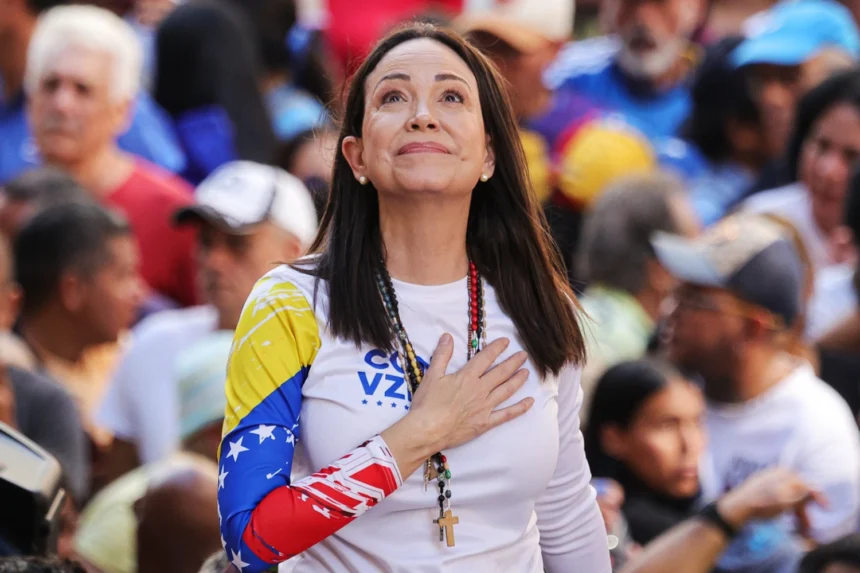
OSLO, Norway — The Norwegian Nobel Committee awarded the 2025 Nobel Peace Prize to María Corina Machado on Friday, a clear nod to democratic resistance and a quiet rejection of one of the world’s most divisive leaders. The Venezuelan opposition figure has inspired millions with a hard-line stance against Nicolás Maduro’s rule.

The announcement, buzzed about through betting chatter and political whispers, recognizes her drive for free elections and civil rights in a country crushed by repression, economic ruin, and widespread abuses. The timing, only days after U.S. President Donald J. Trump announced a delicate Gaza ceasefire, set off heated debate. Critics say the committee ignored a major U.S. diplomatic move because of bias against Trump.

Machado, 56, an engineer and former lawmaker often called the Iron Lady of Venezuela, was honored for promoting democratic freedoms and pushing for a peaceful shift from dictatorship to democracy. The committee’s citation praised her persistence.

Speaking from a secure location in hiding, after evading Maduro’s forces since a disputed July vote, she fought back tears during a video call with Nobel Institute Director Kristian Berg Harpviken. “Oh my God… I have no words,” she said, her voice breaking.

Machado Lives in Constant Danger

She has survived threats, attempts on her life, and a sweeping manhunt. Later on X, formerly Twitter, she dedicated the award to “the suffering people of Venezuela” and thanked Trump for “decisive support of our cause,” linking her struggle to the U.S. president’s foreign policy efforts.

The choice highlights her influence within a split opposition. Banned from running in the 2024 presidential race on contested corruption claims, she backed Edmundo González Urrutia.

His apparent win was tossed by Maduro’s electoral body, a move condemned by the U.S., the European Union, and many in Latin America. Her nationwide organizing kept nonviolent resistance alive, with huge rallies despite violent crackdowns. More than 7 million people have left Venezuela since 2015, creating one of the largest displacement crises outside war.

“Venezuela’s tragedy is a warning to the world about how peace collapses when democracy weakens,” said Jørgen Watne Frydnes, the committee’s chair, at the Oslo event.

He said Machado reflects the goals in Alfred Nobel’s will: fraternity between nations, disarmament, and convening peace efforts. “She unified a fragmented opposition and stood firm against the militarization of Venezuelan society,” he added.

The award carries 11 million Swedish kronor, about 1.05 million dollars, and will be presented on December 10 in Oslo. Her attendance is unclear, given her status as a fugitive under Maduro’s rule.

Trump Overshadowed

The honor also overshadowed the name that dominated prediction lists for months, President Trump. The 45th and 47th U.S. president, now in a second term, had pressed their case for recognition, calling their record unmatched on global stability.

This week, he announced a U.S.-brokered first phase ceasefire in Gaza, with hostage releases and aid routes, and called it the end of “the forever war in the Middle East.” Earlier this year, his team helped cool tensions between India and Pakistan.

He also leveled tough sanctions on Russian oligarchs, which supporters say nudged Moscow toward talks on Ukraine. Supporters described a scenario where he ends conflicts from Yemen to Sudan, then launches a “Global Harvest Initiative” to end hunger. Even in that case, they argue, the committee would still pass him over, given its past decisions.

Backers say this view comes from a history of bias. The Norwegian Nobel Committee, made up of former Norwegian politicians, is often cast as Eurocentric and progressive. Critics point to mixed calls over the years, from the controversy around Henry Kissinger’s award in 1973 to Barack Obama’s 2009 prize for diplomacy early in his first term.

Trump’s blunt style, “America First” approach, and exit from the Paris climate accord clashed with the committee’s emphasis on multilateral cooperation. People familiar with the nomination process, speaking on background, said Trump’s Gaza work drew attention among allies, but worries about trade wars and inflammatory rhetoric weighed more. “For them, peace is not just about stopping wars, it is about values,” said one diplomat in Oslo.

Trump Deserves Credit

Expectation around Trump was high, fueled partly by Trump himself. At a May rally in Ohio, he said, “I’ve done more for peace than anyone since Carter, maybe Wilson. The Nobel? It’s coming, folks, believe me.” Allies, including Sen. Marco Rubio, pushed a nomination letter calling him “the dealmaker the world needs.” Machado also credited Trump’s sanctions for weakening Maduro’s grip in earlier interviews.

A September Pew Research poll found that 62 percent of Americans thought Trump deserved credit for Middle East progress, a view echoed in conservative media. Betting markets then swung to Machado overnight, from single digits to heavy favorite, prompting a probe into potential leaks. After the announcement, the White House responded briefly, “While we congratulate Ms. Machado, this decision places politics over peace.”

Anger on the left toward Trump has soared after his 2024 win and battles over the Supreme Court. Progressive outlets like The Guardian dismissed his nomination as self-promotion. European NGOs lobbied the committee with petitions against him.

A 2025 YouGov survey found unfavorable views among U.S. liberals at 92 percent, near post-Watergate Nixon levels. In Oslo’s political circles, that mood translated into a flat no. “The committee values quiet heroism over bombast,” a spokesperson said. Critics called it elitist gatekeeping.

Trump Congratulates Machado on Peace Prize

Despite the snub, Trump made a courteous move. According to CBS News, he called Machado on Friday evening to congratulate her. “You deserve this more than anyone. Keep fighting, and know America’s got your back,” he told her. He then reposted her message on Truth Social, writing, “Honored. María is a warrior for freedom.

Together, we’ll make Venezuela great again!” The exchange showed a rare pairing, Trump’s hard-nosed approach aligning with Machado’s moral stand. Francisco Palmieri, the U.S. Ambassador to the OAS, said the call showed “strategic solidarity” against authoritarian rulers in the region.

The news ricocheted across Venezuela. State media in Caracas called the award a “right-wing plot.” Opposition areas erupted in cautious celebration, with fireworks in Maracaibo and graffiti in Valencia reading, “María Nobel, Maduro Out.”

The decision will likely sharpen calls to isolate Maduro. The EU signaled new sanctions, and Brazil’s President Lula da Silva urged dialogue, despite his reluctance to confront Maduro. For exiles in Miami and Madrid, the prize felt like vindication after years of hunger, hyperinflation, and mass arrests.

As attention shifts to the ceremony, Machado’s path stands out. She is a mother of two who left business life for street protests and daily risk. Her prize is not just a medal, it is a signal boost for Venezuelans who feel forgotten.

Trump, ever mindful of status, may bristle at the outcome. Yet in Machado’s public thanks, he found a nod to his role. In a world still scarred by conflict, the award suggests that defenders of democracy, not only dealmakers, help light the way.
Related News:

Trump’s Ukraine Peace Push Met with Mainstream Media Maelstrom

News

Trump’s 2006 Call to Police About Epstein Dispels Mainstream Media Narrative

Freshly unredacted Epstein records include an FBI summary of a former Palm Beach police chief describing a 2006 call from Donald Trump. In that call, Trump reportedly thanked investigators for pursuing Jeffrey Epstein and called Ghislaine Maxwell “evil,” a detail that runs against claims of deep involvement.

VORNews

Published

on

By

Trump’s 2006 Call to Police

WASHINGTON. D.C. – A newly public FBI interview tied to the Jeffrey Epstein case is drawing attention as the Department of Justice continues releasing large batches of Epstein-related records.

The interview, conducted in 2019, includes former Palm Beach Police Chief Michael Reiter’s account of a phone call he says he received in July 2006 from then-businessman Donald Trump.

According to the FBI summary, Trump called shortly after news spread about the early Palm Beach investigation into Epstein. Reiter told agents that Trump thanked local authorities for pursuing the case and said “everyone has known he’s been doing this.” Reiter said Trump described Epstein’s conduct with teenage girls as something people already talked about in New York and in local circles.

Reiter also recalled Trump urging investigators to pay attention to Ghislaine Maxwell, whom he described as Epstein’s “operative.” In the interview summary, Trump allegedly told police that Maxwell was “evil” and said they should focus on her. Reiter added that Trump claimed he had once been around Epstein when teenagers were present and “got the hell out of there.”

Those details don’t match the long-running picture often presented in major news coverage that frames Trump as closely tied to Epstein’s criminal activity.

Over the years, reporting has highlighted their social overlap in the 1990s and early 2000s, references in flight logs, and an old Trump quote describing Epstein as a “terrific guy” who liked “beautiful women… on the younger side.” Critics have used those items, especially during election cycles, to suggest something more serious.

This newly surfaced FBI record points to a different version of events, one where Trump distances himself and contacts law enforcement soon after the investigation becomes known.

People familiar with the timeline have also pointed to accounts that Trump had already banned Epstein from Mar-a-Lago around that period, reportedly after an incident involving inappropriate behavior toward a member’s teenage daughter. In Reiter’s telling, Trump was among the “very first people” who reached out once the probe was in the open.

Pushing Back on Familiar Headlines

For years, common narratives have treated Trump and Epstein as near inseparable, often leaning on selective quotes and unverified claims to imply deeper involvement. During the 2016 and 2020 campaigns, and again in later cycles, stories circulated tying Trump to Epstein’s private island or to misconduct with minors. Those claims have repeatedly failed to produce court-tested evidence or findings in official investigations.

The Epstein Files Transparency Act, signed in late 2025, required the release of many records that had been partially withheld. As more pages become readable, Trump’s name appears often, but many mentions are routine, such as messages, contact notes, or passing references.

The 2006 call described by Reiter stands out because it reads as favorable to Trump’s position. It also tracks with Trump’s public comments over the years, including claims that he barred Epstein from Mar-a-Lago and cut ties after hearing about behavior he described as “creepy.”

Reiter’s interview was recorded in 2019 and is now part of the DOJ’s phased releases. The Miami Herald was among the first outlets to spotlight the document, noting it could shift how people talk about what Trump knew and when. Trump supporters say it weakens the “Trump-Epstein buddy” storyline that they believe was used to harm him politically.

Attempts to Tie Epstein Directly to Trump

From the first Palm Beach investigation in 2005 to 2006 through Epstein’s 2019 arrest and death, political opponents have tried to use any Trump-Epstein connection as a weapon. At the same time, Bill Clinton’s repeated appearances in flight logs did not always draw the same level of sustained attention, while Trump’s documented contacts were often treated as more central.

Democratic strategists and media voices have floated theories of Trump’s complicity in hearings and news cycles. Some recent releases also include tips and allegations submitted to the FBI, sometimes arriving close to elections. The DOJ has cautioned that many claims in the broader file set are not credible and were not pursued.

In that context, the Reiter account matters because it presents Trump as someone who, after the investigation became public, called the police to express support and to point them toward Maxwell’s role. The call also came before Epstein’s 2008 plea deal and later federal scrutiny, placing it earlier than many of the talking points that surfaced years later.

What This Could Mean for the Larger Epstein Record

The continuing release of Epstein documents, described as running into the millions of pages, has exposed a wide web of contacts that includes politicians, wealthy donors, and celebrities. Some names raise new questions.

Others add context to relationships that have been argued about for years. Reiter’s description of the 2006 call adds a concrete data point to one of the most politicized storylines in the Epstein saga.

Trump has long denied knowing about Epstein’s crimes while they moved in some of the same social circles. He has said the relationship ended because of Epstein’s behavior. The newly unredacted FBI summary supports that defense in at least one key way: it records a law enforcement leader saying Trump encouraged investigators to pursue the case.

As additional files become public, attention may move away from rumor-driven claims and toward what the documents actually show. For victims and for the public, more transparency can help separate hard facts from political messaging, even when the results don’t fit anyone’s preferred narrative.

Related News:

Trump Approval Rating (February 2026 Poll Results, Approve vs Disapprove)

Continue Reading

News

Democrats Stance on Voter ID Described as Racists By Many Blacks

VORNews

Published

on

By

CNN Delivers Stark Reality Check to Democrats Over Voter ID

WASHINGTON, D.C. – Election rules are back in the spotlight, and national voter ID is once again at the center of the fight. With the 2026 midterms getting closer, Republicans in Congress are pushing bills that would set nationwide standards for voter identification and proof of citizenship. Supporters call it a basic step to protect elections. Opponents say it would block eligible voters and add new hurdles to casting a ballot.

The main bill driving the current debate is the Safeguard American Voter Eligibility (SAVE) Act, listed as H.R. 22 in the 119th Congress. Rep. Chip Roy (R-TX) introduced it in the House, and Sen. Mike Lee (R-UT) introduced a companion bill in the Senate.

The SAVE Act would change the National Voter Registration Act of 1993 by requiring documentary proof of US citizenship to register for federal elections. Examples of acceptable documents include a US passport, a military ID, or other documents that show citizenship, such as a birth certificate that meets REAL ID Act rules.

The House is expected to vote soon on an updated version of the SAVE Act. The push has grown louder with support from former President Donald Trump and conservative activists. This newer version goes further than earlier drafts. It would require photo ID at the polls, along with proof of citizenship during registration.

Republicans say the bill addresses weak spots in states that do not have strict ID rules. House Majority Leader Steve Scalise (R-LA) has framed it as a way to stop noncitizen voting. That is already illegal, but supporters argue that enforcement and verification vary too much by state.

A separate proposal, the Make Elections Great Again (MEGA) Act, was introduced by House Administration Committee Chairman Bryan Steil (R-WI) in January 2026. It is a larger package that includes a national photo ID requirement, tighter rules for mail-in voting, stronger voter roll maintenance, and post-election audits. It is not only about voter ID, but it also includes similar citizenship checks and has support from GOP leaders who want broader election changes.

Even with momentum in the House, the path is steep in the Senate. Senate Minority Leader Chuck Schumer (D-NY) has said the SAVE Act will not move forward there, calling it a modern version of Jim Crow and warning it would keep many eligible voters from voting. Democrats hold a narrow Senate majority, and the bill would still have to clear the filibuster, which usually means finding 60 votes.

It is not close to that number right now. Trump’s public support, including comments about “nationalizing” elections in certain cities, has raised the temperature. It has also triggered pushback, including from local election officials who worry about federal control over state-run elections.

Public Opinion Shows Strong Support, Even With Partisan Tension

Polls show voter ID is popular with the public, across party lines and many demographic groups. A 2025 Pew Research Center survey found 83% of US adults support requiring a government-issued photo ID to vote. That included 95% of Republicans and 71% of Democrats. A 2024 Gallup poll found 83% support for requiring proof of citizenship when registering to vote.

Support also shows up in groups often mentioned in this debate. In the same Pew survey, 76% of Black adults, 85% of White adults, and 82% of Hispanic adults supported photo ID requirements. A Monmouth University poll reported similar results, with 80% support overall, including 62% of Democrats. Those numbers complicate the common claim that voter ID laws are always viewed as discriminatory, since majorities of Black and Latino voters support the idea.

Still, the gap between the parties remains real. Republican voters back these policies at very high rates (some polls show 91%). Democratic voters are closer to the 70% range, while many top Democratic leaders oppose the bills.

Critics say that the split suggests party leaders are not matching what many Democratic voters say they want. On X (formerly Twitter), users such as @RilesZrk have pointed to polling figures like “87% of Blacks & 82% of Latinos support voter ID” while challenging Democratic opposition.

The Case For a National Voter ID Law

Supporters of a national voter ID law say it would reduce fraud and increase trust in election results. Research often finds that in-person voter fraud is rare, with some studies putting rates as low as 0.00004%. Backers respond that even a small number of cases can damage confidence. The Heritage Foundation argues that voter ID rules can prevent more than one type of fraud, including impersonation and noncitizen voting, and that these laws do not meaningfully reduce turnout.

Supporters also point to the broad popularity of voter ID as proof that it feels reasonable to many voters. A Heritage analysis argues that voter ID laws have not shown negative effects on registration or turnout across demographic groups. A 2023 study in the Proceedings of the National Academy of Sciences found that ID laws can increase participation from both parties, which can reduce the idea that one side gains an advantage.

Heading into 2026, allies of Trump and many Republicans say nationwide standards would reduce confusion and conflict, especially in battleground states. They argue that a patchwork of state rules invites disputes like those seen after the 2020 election.

The Case Against It: Voter Barriers and Real-World Logistics

Opponents, including the ACLU and the Brennan Center for Justice, argue that strict ID laws can create obstacles that hit some groups harder. They point to low-income voters, older voters, minority voters, and rural voters as groups more likely to struggle with document access. Estimates often cited in this debate say up to 11% of eligible voters do not have a qualifying ID.

Some figures put the share higher for certain groups, including 25% of Black voters and 18% of voters over age 65. Critics also highlight costs tied to getting documents, sometimes estimated at $75 to $175, plus travel challenges in areas with fewer government offices.

They also argue that the fraud concern is overstated. Noncitizen voting is rare and already illegal, and they say existing penalties and enforcement tools already cover it. A Bipartisan Policy Center analysis of the SAVE Act points to possible unintended effects, including a Kansas example where similar rules blocked 31,000 eligible citizens. Research on turnout is mixed, but opponents often cite findings that show lower participation among some minority groups under stricter rules.

For the 2026 cycle, critics also warn about day-to-day election administration. They expect local offices to get overloaded, lines could grow, and more voters could be pushed into provisional ballots. The National Conference of State Legislatures has warned that conflicts between federal rules and state election laws could create confusion for voters and election workers.

Democratic Leaders vs. Democratic Voters

Many Democratic leaders have attacked the SAVE Act in strong terms. They argue it shifts the burden onto voters and could result in eligible citizens getting removed from the rolls. Schumer has compared it to older voter suppression tactics. Rep. Glenn Ivey (D-MD) has called it a “solution in search of a problem.”

At the same time, polling continues to show that many Democratic voters support photo ID requirements. That gap has fueled criticism that party leadership is taking a harder line than its voters.

Some commentators argue Democrats often frame voter ID as racist, even though polling shows solid support among Black voters (76% in the Pew survey) and Latino voters (82%).

A KFF/theGrio survey found Black voters see racism as a major problem in the GOP (76%), and also a minor problem in the Democratic Party (53%). Critics, including filmmaker Ami Horowitz, have also pushed back on the “racist” label by interviewing Black voters in New York who say they do not see voter ID laws that way.

For Democrats heading into 2026, the risk is political as much as policy-based. If voters see party leaders as ignoring popular reforms, it could weaken support among moderates.

What Minority Voters Say: Support Is Strong, Access Concerns Are Real

Polling shows Black and Latino voters largely support voter ID laws. At the same time, some research suggests these groups are more likely to lack IDs. One commonly cited figure says 13% of Black Americans do not have the needed ID, compared with 5% of White Americans. Groups like the Brennan Center argue that strict rules can widen turnout gaps if states do not make IDs easy to get.

Some Black conservatives, including people aligned with Trump, argue that voter ID is not racist and should be treated as a normal requirement. Pew polling has also shown many Black voters view Trump negatively (72% rated his presidency poorly), while also showing some movement in political preferences, including only 63% backing Biden in 2024. Some commentators say Democrats focus too much on the voter ID framing and not enough on issues many voters rank higher, like jobs and prices.

How This Could Affect the 2026 Midterms

If a national voter ID law becomes reality, it could reshape how the 2026 midterms play out. Supporters think consistent rules could cut down on disputes. Opponents expect lower turnout among some groups, especially in states that do not currently require strict ID, such as California and New York. The NCSL has also pointed to implementation hurdles, including matching mail ballot timelines and running citizenship checks through systems tied to SAVE-style requirements.

Lawsuits would likely follow quickly. The Brennan Center has called the idea “catastrophic” for voters. If courts block the law, Republicans could use that as more proof that the system is vulnerable, which could deepen partisan distrust.

Some studies suggest overall turnout changes are small, but any decline could fall harder on Democratic-leaning groups. On X, the argument shows up from both sides, including people like @fawfulfan who say a clear federal ID rule could reduce claims of selective suppression.

Either way, the fight over a national voter ID law is about more than paperwork. It is about trust in elections, the balance between access and security, and how much control Washington should have over rules that states have long managed. As 2026 gets closer, the outcome may depend on Senate math, public pressure, and how far each party is willing to push.

Related News:

CNN Delivers Stark Reality Check to Democrats Over Voter ID

Continue Reading

News

Tim Walz Exposed By Minnesota DHS Whistleblower

VORNews

Published

on

By

Minnesota DHS whistleblower exposes Tim Walz

WASHINGTON, D.C. – A former Minnesota Department of Human Services (DHS) employee says she paid a steep price for speaking up. Faye Bernstein, a long-time agency worker, claims she faced years of retaliation from Tim Walz after raising concerns about weak controls that she believes helped fuel Minnesota’s growing social services fraud crisis.

Bernstein says she warned leaders about risks in 2018 and 2019, before federal prosecutors began putting public numbers on the damage. Prosecutors now estimate that as much as $9 billion in taxpayer money may have been stolen since 2019 across multiple programs.

A 20-year DHS veteran who worked in contract management and compliance, Bernstein has shared her story on national TV, including Fox News. She says that after she reported irregular contracting practices, she became the target of what she calls a coordinated effort to discredit her.

Her claims come as federal investigators continue to probe fraud tied to child nutrition programs, Medicaid housing supports, autism services, and other benefits. Prosecutors say many of these cases involve networks concentrated in Minnesota’s Somali-American community.

The controversy has reached Congress. The U.S. House Oversight Committee has held hearings where state lawmakers accused Gov. Tim Walz’s administration of brushing off warnings, punishing whistleblowers, and failing to put strong safeguards in place. Bernstein has also pushed back on Walz’s public statements that he didn’t know about the problems, calling that claim “absolutely false.”

Warnings Met With Pushback

Bernstein says her problems started early in Tim Walz’s term, which began in 2019. After she was promoted to a lead role within the Behavioral Health Administration, she says she had a broader view of contracts across the agency.

What she saw worried her. Bernstein described contracting as sloppy and poorly controlled, with few clear checks to stop bad actors. She said the state was “completely open to fraud.”

“I saw just extreme sloppiness, messiness in our contracting processes,” Bernstein said in interviews. She says she raised the issue internally and warned that fraud would follow if DHS didn’t tighten its systems. She says her concerns weren’t welcomed.

Bernstein claims managers cut her duties, left her out of meetings, and treated her complaints as a problem. She says she was accused of racial bias when she brought up patterns she believed were tied to fraud.

“The smear campaign starts where you are told you are racist and your job duties are lessened till you basically have no job duties,” she said.

Bernstein says DHS later barred her from agency properties, revoked her credentials, and moved her into roles that had little real work. She also says she endured state investigations that were expensive and draining. In letters and interviews, she describes ongoing harassment and being pushed to the sidelines. She now warns that reporting fraud without anonymity can ruin a career.

Prosecutors Say the Losses Reach Into the Billions

Federal authorities, including the U.S. Attorney’s Office in Minnesota, have charged close to 100 people in related cases. Dozens have already been convicted.

The best-known case centers on Feeding Our Future. Prosecutors say the nonprofit submitted false claims about feeding children during the COVID-19 pandemic and took at least $250 million. Investigators say large sums went to luxury purchases, real estate, and transfers abroad.

From there, investigations widened. Authorities began focusing on Medicaid-linked fraud tied to housing supports, autism therapy, and other services. In public reporting and testimony, estimates have climbed as high as $9 billion or more since 2018, spread across 14 programs flagged as high risk.

Prosecutors say a large share of defendants in major cases, often reported as about 85% to 90%, are of Somali descent. Walz and some community leaders have pushed back against broad claims about the community, arguing that sweeping labels are unfair and inflammatory.

The fraud has been described as among the largest U.S. cases tied to pandemic-era relief. Some allegations also point to overseas links, including concerns about connections to groups such as Al-Shabaab, though those claims are still being investigated.

Political Pressure and Demands for Answers

The fallout has been intense and partisan. Republican lawmakers and some federal officials have blamed Walz and Attorney General Keith Ellison for what they describe as an overly trusting culture that made the scams easier to pull off. Whistleblowers, including Bernstein, have given testimony or statements to Congress describing ignored reports and a hostile work environment at DHS.

Bernstein’s story also fits a broader pattern raised by other employees. Several workers have claimed their warnings were dismissed, or they faced punishment after speaking up. A congressional document has described allegations that include electronic monitoring and threats of being shut out of future state jobs.

Tim Walz’s administration has disputed the $9 billion estimate and says it has taken steps to fight fraud, including forming task forces. Critics say those efforts came late and only after insiders had sounded the alarm for years.

Bernstein Keeps Speaking Out

Bernstein says the cost has been lasting, including damage to her reputation, isolation at work, and ongoing stress. Still, she continues to speak publicly. Her account points to deeper breakdowns inside DHS that, in her view, allowed fraud to spread and grow unchecked.

As federal investigations continue through subpoenas, searches, and more convictions, Bernstein’s experience highlights the risks whistleblowers say they face inside government agencies. For Minnesota taxpayers, the scandal isn’t only about the money. It’s also about trust in programs meant to protect people who need help.

The full scope of the fraud, and who should be held responsible for missing or ignoring warnings, is still coming into view. Bernstein’s claims have kept attention on that question, and she says she won’t stop pushing for answers.

Related News:

AG Pam Bondi Accuses Tim Walz and Frey of Protecting Violent Criminals

Continue Reading

Get 30 Days Free

Express VPN

Create Super Content

rightblogger

Flight Buddies Needed

Flight Volunteers Wanted

Trending