


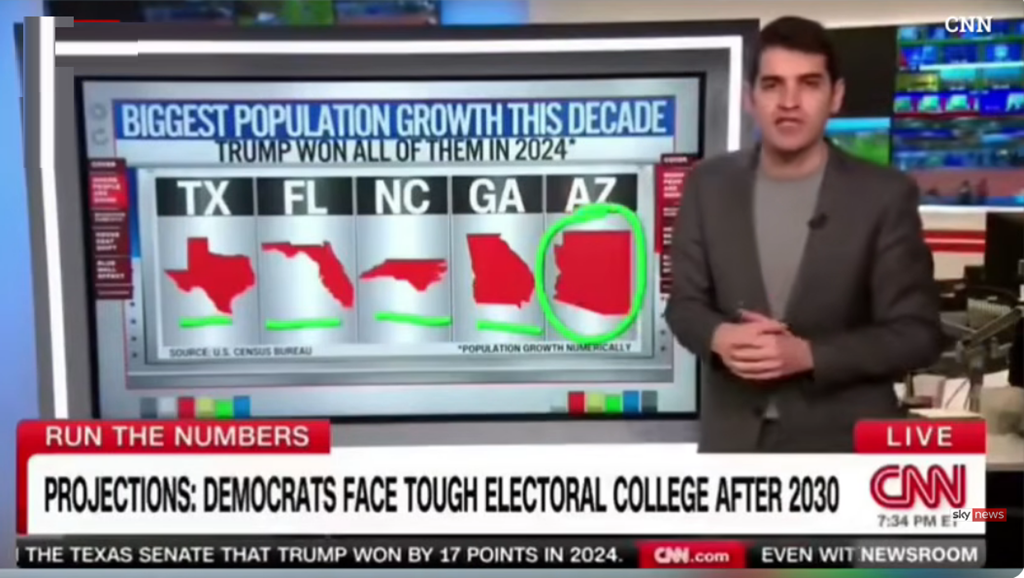

CNN senior data analyst and chief data reporter Harry Enten is spotlighting a clear demographic shift: the fastest-growing states so far this decade are the ones Donald Trump carried in the 2024 presidential election.
Using fresh U.S. Census Bureau population estimates, Enten described it as a “red state boom” alongside a “blue state slump.” In his view, this wave of internal migration could bring major political effects that last well beyond one election cycle.
Enten walked through the numbers on CNN Newsroom in early February 2026. He focused on mid-decade changes, comparing the 2020 Census baseline with mid-2025 estimates. His main point was simple: the states posting the biggest gains, both by percent and by raw numbers, largely sit in Trump’s 2024 column.
He highlighted five standouts since 2020: Texas, Florida, North Carolina, Georgia, and Arizona.
Top Growth States: All Trump-Won in 2024
Based on Census Bureau Vintage 2025 data and Enten’s review:
- Texas and Florida lead the country in overall population gains, adding a large share of the national increase.
- North Carolina, Georgia, and Arizona also show strong growth, including solid percentage jumps.
- Beyond those, other red-leaning states such as South Carolina, Idaho, and Utah have posted high growth rates in 2024 and 2025.
As Enten put it, the biggest population growth this decade has come from five states, and all five backed Trump in 2024. He also stressed that the gains are not only about births or international arrivals. A big driver is domestic migration, with Americans relocating from one state to another.
The Other Side of the Trend: “Blue State Slump” and Out-Migration
On the other hand, Enten contrasted those gains with slower growth, or even losses, in several long-time Democratic strongholds. He described a “blue state slump,” pointing to places where more residents leave than arrive.
Among the states he flagged for net domestic out-migration:
- California, Vice President Kamala Harris’s home state, has posted the largest net loss, with hundreds of thousands leaving each year.
- New York, Illinois, New Jersey, and Massachusetts also rank among the biggest domestic migration losers.
In Enten’s summary, Americans are “voting with their feet.” He linked the movement to common quality-of-life and cost concerns, including lower taxes, cheaper housing, fewer business hurdles, and warmer weather, factors many people associate with Republican-led states.
While this pattern has existed for years, he suggested it picked up speed after 2020. Remote work made moving easier, pandemic-era shifts changed where people wanted to live, and rising costs in major coastal metros pushed more families to look elsewhere. Policy differences also play a role for some movers, including views on crime, schools, and regulation.
What’s Pushing People Out of Blue States
People and analysts often point to a mix of pressures behind the move away from some blue states:
- High living costs: Home prices and taxes in places like California and New York can put ownership out of reach.
- Policy frustrations: Some residents cite concerns about public safety, school performance, and heavy regulation in large cities.
- Lifestyle changes: Many want more space, less density, and fewer day-to-day restrictions.
- Job opportunities: States such as Texas and Florida continue to attract workers in fields like tech, energy, finance, and manufacturing.
At the same time, red states offer clear pull factors. For example, Florida and Texas have no state income tax. Many of these states also promote business growth and market themselves as easier places to build a life, whether you’re raising a family or planning retirement.
Political Stakes: Reapportionment and the Electoral College
Enten warned that if these trends hold through the 2030 Census, the impact could show up in congressional seats and presidential elections. House seats shift after each census, based on population. Because the Electoral College ties to House seats (plus two senators per state), changes in representation can change the math for winning the White House.
Analysts reviewing Census trends have suggested:
- Red states could pick up 8 to 13 House seats after the 2030 reapportionment.
- Blue states, especially California, New York, and Illinois, could lose a similar number.
- As a result, Electoral College votes could move more toward the South and West, which would often help Republican-leaning states.
Enten called the pattern a warning sign for Democrats and good news for Republicans. He also noted that familiar Democratic paths, including relying on the “blue wall” states such as Michigan, Pennsylvania, and Wisconsin, could get harder if population-weighted advantages shrink elsewhere.
In one simulation based on mid-2025 estimates, Enten said Trump would have had more electoral votes in a hypothetical 2024 rerun, which could reduce the need for razor-thin swing-state wins.
A Bigger Picture: Migration, Polarization, and Power
These population shifts also reflect a deeper split in where Americans choose to live. When people move, they bring their values, habits, and political views with them. Over time, that can change states in both directions. Some observers point to new arrivals in places like Texas and Florida as a reason those states could become more competitive.
Still, Enten focused on the near-term imbalance. Growing states gain more political weight. Shrinking states lose it.
In other words, this “red state boom” and “blue state slump” show how choices about housing, jobs, and lifestyle can change American politics almost as much as campaigns do. The 2030 Census will give the clearest answer. Until then, Enten’s takeaway is straightforward: demographics can redraw the map, even before a single vote is cast.