

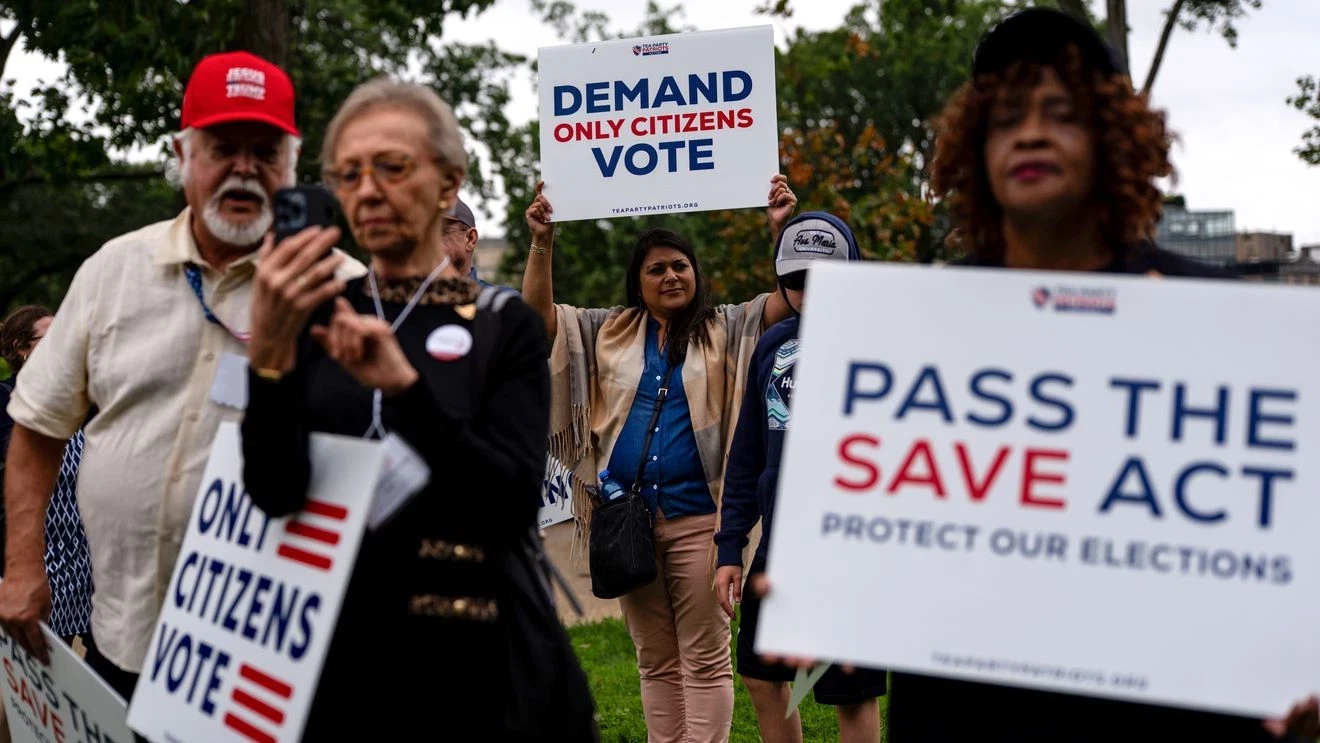

WASHINGTON, D.C. – The Safeguard American Voter Eligibility (SAVE) Act has turned into a major fight over election rules. The House passed it in April 2025, with Republicans mostly in favor and Democrats mostly against.
The bill would require proof of citizenship to register for federal elections. Senate Democrats have lined up to stop it, saying it could block eligible voters. Republicans say the measure protects election integrity. By early 2026, the bill still sits in the Senate, a clear sign of how wide the partisan gap remains.
Below is a breakdown of what the SAVE Act would do, what polls say about voter ID, how states handle ID rules, and what research shows about voting irregularities.
What the SAVE Act Would Do, and Why Democrats Oppose It
The SAVE Act (Safeguard American Voter Eligibility Act) would change federal election law by requiring documents that prove U.S. citizenship when someone registers to vote. Examples include a U.S. birth certificate or a passport.
The bill also calls for states to remove non-citizens from voter lists. In addition, it creates a private right of action, which means citizens could sue election officials who do not follow the rules.
Supporters, including House Republicans, describe it as a straightforward step. They say it helps confirm that only eligible citizens vote, especially at a time when immigration and election security stay in the spotlight.
Senate Democrats, including Chuck Schumer (D-NY), argue the bill goes too far. They call it a power grab and warn that it could keep millions of eligible voters from registering. Critics also point out that federal law already bans non-citizens from voting in federal elections.
On top of that, they say getting documents can be harder for some groups, including young voters, people of color, and people who do not have easy access to paperwork. Republicans want a Senate vote, but they still lack the 60 votes needed to clear a filibuster.
Common criticisms of the SAVE Act include:
- It could lower turnout if eligible voters cannot quickly find citizenship documents.
- It clashes with other election reform efforts Democrats supported, such as the For the People Act.
- It may push federal power into an area many states manage on their own.
Polls Show Broad Support for Voter ID Across Parties
Voter ID rules remain popular in national polling. A Pew Research Center survey from August 2025 found that 83% of Americans support requiring a government-issued photo ID to vote.
That includes 95% of Republicans and 71% of Democrats. Similarly, a Gallup poll reported 84% overall support, including 98% of Republicans, 84% of independents, and 67% of Democrats.
Other surveys show similar results:
- Rasmussen Reports found 77% of likely voters view photo ID as a reasonable election integrity step.
- Cygnal reported 70% support for proof of citizenship through voter ID, including majority support among Hispanic and Black voters.
Still, the details matter. Some polling suggests support can drop when policies shift from basic voter ID to stricter proof-of-citizenship demands that could block eligible voters. For example, a PBS NewsHour survey found 59% said access should take priority over stopping ineligible voting. Critics of the SAVE Act often lean on that difference, saying voter ID support does not automatically mean support for document-heavy registration rules.
Many Blue States Keep Looser Voter ID Rules
By 2025, 36 states will require some type of ID at the polls. Meanwhile, 14 states and Washington, D.C., did not require voters to show documentation. Instead, they often confirm eligibility through signatures or sworn statements.
Many of the no-ID states lean Democratic, including California, Illinois, Maine, Maryland, Massachusetts, Minnesota, Nevada, New Jersey, New Mexico, New York, Pennsylvania, and Vermont.
In these states, election systems often work like this:
- Voters sign an affidavit confirming their identity and eligibility.
- If officials spot an issue later, they handle challenges after the vote.
- Supporters say the process avoids barriers, while critics say it leaves openings for fraud.
Across the country, 23 states required photo ID, while 13 accepted non-photo ID. Because several blue states do not require ID, Republicans often argue the country needs a federal baseline, which is one reason they promote the SAVE Act.
Blue States and the Federal Government Clash Over Voter Rolls
Under the Trump administration, the Department of Justice (DOJ) has sued more than 29 states and Washington, D.C., tied to disputes over voter roll access. The DOJ has sought unredacted voter records that can include sensitive details, such as partial Social Security numbers.
Many of the states resisting these requests are Democratic-led, including California, New York, and New Jersey. They point to privacy risks and argue the demands go beyond what federal law allows under statutes like the National Voter Registration Act.
Several recent actions highlight the fight:
- The DOJ filed lawsuits against Utah, Oklahoma, Kentucky, West Virginia, and New Jersey in February 2026.
- Courts in California and Oregon rejected DOJ requests, backing state control in those cases.
- Some red states, including Texas and Florida, have complied, while other states have pushed back.
Supporters say these efforts help confirm citizenship and clean up voter lists. Opponents say the same actions can set the stage for aggressive voter roll purges, which may hit minority voters and Democrats harder.
Non-Citizen Voting Exists, but Documented Cases Stay Very Small
Many claims about widespread non-citizen voting in federal elections do not match the available evidence. Research and official reviews often describe it as extremely rare. In most states, people must attest to citizenship under penalty of perjury, which acts as a strong deterrent.
Here are a few data points often cited:
- The Heritage Foundation database lists 77 non-citizen voting cases from 1999 to 2023, compared with billions of ballots cast.
- A Georgia audit found 20 non-citizens registered out of 8.2 million voters, and only 9 had voted.
- Ohio flagged 521 cases from 2019 to 2023, but officials confirmed only one fraud case.
- The Brennan Center has said records over decades show non-citizen voting is extremely rare.
When cases do happen, prosecutors sometimes bring charges. For example, New Jersey indicted two non-citizens for voting in 2020. Even so, experts often link these incidents to mistakes and confusion, not organized fraud.
Deceased Voters on the Rolls Usually Point to Cleanup Delays
Voter lists sometimes include people who have died because records take time to update. That is a maintenance problem, not proof that dead people routinely vote. A 2012 Pew study estimated about 1.8 million deceased individuals remained on voter rolls nationwide, largely due to slow list updates.
Other examples show how small the voting risk appears:
- A Stanford study of Washington (2011 to 2018) found 14 possible cases out of 4.5 million voters, about 0.0003%.
- The Heritage database lists 19 cases since 1997 involving voting connected to deceased individuals.
- California flagged nearly 95,000 deceased registrants in 2025, but reports did not show evidence that those records led to votes.
- Kentucky reported removing more than 212,000 deceased voters since 2019.
States also run audits that reduce inflated claims. In Maryland, for instance, an audit found the number of potentially deceased voters was far smaller than early figures suggested, with 908 out of 4.1 million registrants. Many “dead voter” alerts come from bad matches, such as shared names or data entry issues.
Mail-In Voting Has Safeguards, and Fraud Rates Stay Low
Mail-in voting grew during the pandemic years, but research continues to show very low fraud rates. A Brookings analysis estimated mail ballot fraud at 0.000043% in recent elections, about four cases per 10 million ballots. States that use universal vote-by-mail, such as Washington, have reported even lower rates.
Mail voting includes several built-in checks, including:
- Signature verification and ballot tracking through barcodes
- Reviews of questionable ballots, often with bipartisan oversight
- Prosecutions for rare violations, including illegal ballot collection schemes
The Heritage Foundation has documented 239 absentee ballot fraud cases since 1997, which remains a tiny slice of total ballots cast. Some fraud arguments rely on older reports like Carter-Baker (2005), but modern systems have added stronger tracking and verification tools. Multiple studies also find no clear rise in fraud linked to expanded mail voting.
The fight over the SAVE Act shows a familiar tension. Many voters support safeguards like voter ID, yet available evidence suggests major fraud is uncommon. At the same time, aggressive federal rules can create new hurdles for eligible voters. As future elections get closer, lawmakers could focus on reforms that improve trust while keeping registration and voting workable for everyday people.