

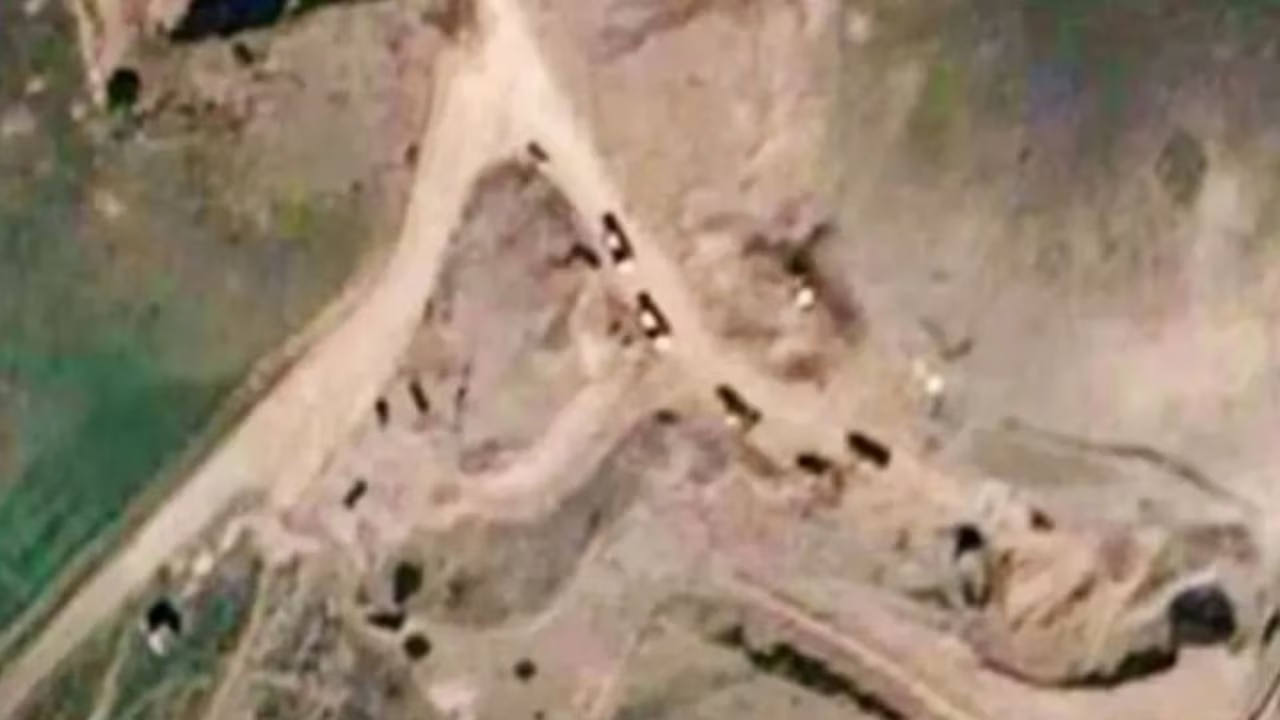

TERRAN – As the dust begins to settle over the Middle East and Iran following a month of intense aerial bombardment, the silence of the current ceasefire is being broken by the hum of heavy machinery. New high-resolution satellite imagery has revealed a flurry of activity at Iran’s most sensitive military sites.
Across several “missile cities”—vast underground complexes designed to withstand nuclear strikes—Iranian engineering crews are working around the clock. Their goal? To clear the rubble from tunnel entrances that were collapsed by precision U.S. and Israeli strikes during Operation Roaring Lion.
While the ceasefire was intended to pave the way for diplomacy, these images suggest a different priority for Tehran: digging out and rearming.
Digging Out the “Missile Cities”
For years, Iran has invested billions into a network of hardened underground bases. These facilities house the Islamic Revolutionary Guard Corps (IRGC )’s vast arsenal of ballistic missiles, kept on rails and ready to be rolled out for launch.
Recent imagery published by CNN and analyzed by groups like the James Martin Center for Nonproliferation Studies shows a consistent pattern of recovery:
- Khomein Missile Base: Engineering vehicles have been spotted removing barriers and debris from a primary tunnel shaft. This entrance was previously confirmed as “degraded” following an Israeli Air Force strike.
- Parchin Military Complex: Analysts at the Institute for Science and International Security (ISIS) note that Iran is not just clearing debris but “burying” new structures under concrete and soil to hide them from future detection.
- Esfahan and Natanz: Intelligence reports indicate that at least three tunnel entrances at nuclear-related sites have been backfilled with soil to harden them against further bunker-buster attacks.
According to Sam Lair, a research associate at the James Martin Center, this activity is part of a standard Iranian military doctrine. “Their concept of operations is simple: absorb the first attack, dig yourself out, and then launch again,” Lair explained.
A Half-Intact Arsenal
The clearing of these tunnels is particularly concerning because of what remains inside them. Despite claims from U.S. Defense Secretary Pete Hegseth that Iran’s missile capabilities were “decimated,” recent intelligence assessments paint a more resilient picture.
Reports cited by the Wall Street Journal suggest that:
- 50% of Launchers Survive: Roughly half of Iran’s mobile and fixed-site missile launchers remain functional, many of them currently trapped behind collapsed tunnel entrances.
- Stockpiles Remain: Iran still holds thousands of short and medium-range ballistic missiles.
- Rapid Reactivation: Once the “mouths” of the tunnels are cleared, these missiles can be moved to alternative launch points within hours.
The Ceasefire Dilemma
The ceasefire, which began on April 8, was meant to stop the bleeding. However, for military planners in Washington and Tel Aviv, it has created a “reconstruction window” that Iran is exploiting.
Western officials are now debating whether the clearing of these tunnels constitutes a violation of the spirit of the truce. If Iran is using this time to move launchers back into “ready-to-fire” positions, the risk of a second wave of conflict increases significantly.
“A ceasefire requires you to accept that your adversary is going to rebuild some of what you destroyed,” Lair told Israel Hayom. The question remains: is this defensive repair or the precursor to a fresh offensive?
China’s Shadow Over the Restoration
The speed of Iran’s recovery has also raised eyebrows regarding foreign assistance. Reports from The Telegraph and the Institute for the Study of War (ISW) suggest that China has been shipping key chemical precursors, like sodium perchlorate, to help Iran reconstitute its solid missile propellant.
Furthermore, leaked documents suggest the IRGC has been using a Chinese-made spy satellite, the TEE-01B, to monitor regional U.S. bases. This real-time data helps Iranian commanders identify which of their own facilities remain under the closest watch, allowing them to prioritize repair work at the most “hidden” locations.
As the international community watches these satellite feeds, the tension is palpable. The Biden-Trump transition period in Washington has left some ambiguity in regional policy, a gap that Tehran seems eager to fill.
If the IRGC successfully clears its underground “cities” and restores its launch capabilities, the leverage held by the U.S. and Israel during negotiations could evaporate. For now, the world waits to see if the machines clearing the rubble are a sign of a nation preparing for peace—or a regime readying its next volley.
Trending News:
No Way Out: Four More Protesters Sentenced to Death in Iran