

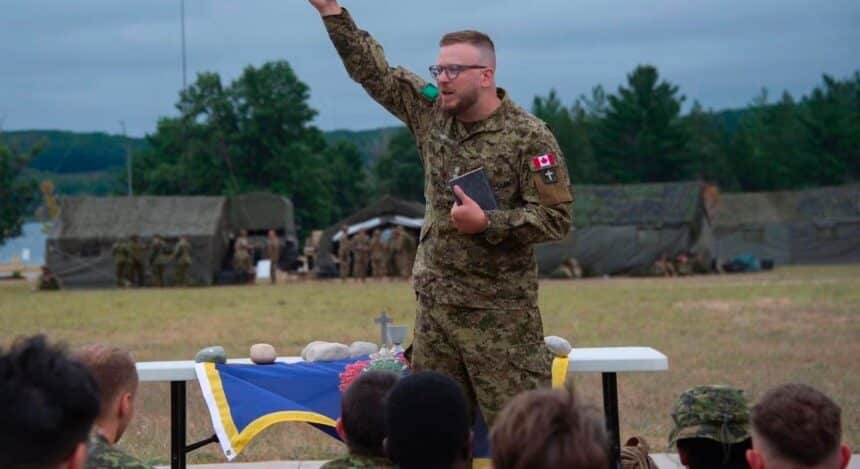


OTTAWA – Canada’s Armed Forces has introduced a strict new policy for its members. Chaplains and military personnel can no longer use religious language during public and semi-public events. This change means all references to God or specific faiths are now banned at official ceremonies. The military says this move will ensure the state remains religiously neutral.
The new rule applies to any event where attendance is mandatory for military personnel. This includes graduation parades, change-of-command ceremonies, and Remembrance Day events. If a chaplain is asked to speak, they must offer a secular message instead of a traditional prayer. The goal is to make these gatherings feel inclusive for everyone, regardless of their personal beliefs.
Key Takeaways
- Total Ban on Public Prayer: Military chaplains must replace traditional prayers with neutral “spiritual reflections” at mandatory government events.
- Strict Neutrality Rules: The policy bans the use of faith-specific words, actions, and symbols by anyone representing the Canadian military in public.
- Private Worship Allowed: Chaplains can still offer traditional prayers and faith-based support during voluntary religious services and private counselling.
The new guidelines were officially issued to military personnel on July 29, 2026. The controversial document is formally titled “Spiritual Reflections in Military Settings”. It gives clear instructions on how chaplains must conduct themselves when speaking publicly. They must focus on shared human values like hope, gratitude, and mutual support.
Under the new directive, speakers must avoid using language tied to any specific spiritual tradition. Chaplains are no longer allowed to mention God or the divine. The Defense Department says this is necessary because speakers are acting as representatives of the government. They are not acting as representatives of their own religion during these ceremonies.
Traditional prayers and blessings have been part of military events for decades. In the past, chaplains would often use preambles to acknowledge diverse beliefs before praying. The new policy completely removes these religious elements from mandatory military gatherings. It strictly enforces a secular approach to all public military addresses.
Why the Military Made the Change
Military leaders argue that the updated rules are about fairness and respect. Acting Chaplain General Shawn Yaskiw recently addressed the unexpected policy change. He explained that the purpose is to ensure everyone feels respected, including those who are atheists. The military wants ceremonial moments to bring people together without alienating non-believers.
This decision also aligns with Canadian legal standards regarding strict state neutrality. In 2015, the Supreme Court of Canada ruled on the landmark Saguenay case. The court decided that the state has a duty to remain religiously neutral at public meetings. The Department of National Defence cited this legal ruling to justify the new guidelines.
It is important to note that the military is not banning religion entirely. The new restrictions only apply to official events where attendance is explicitly required. Chaplains are still free to practice their own faith in their personal lives. The policy does not limit their personal beliefs in any way.
Chaplains can also continue to provide essential pastoral care to soldiers and their families. They can comfortably hold voluntary religious services on military bases. Traditional prayers are still fully permitted at military funerals and faith-specific gatherings. As long as participation is voluntary, religious expression remains supported by the Armed Forces.
Backlash from Faith Leaders and Politicians
The new guidelines have sparked immediate pushback from several national religious organizations. The Evangelical Fellowship of Canada has strongly objected to the total ban on prayer. Bruce Clemenger, a senior ambassador for the group, openly spoke out against the changes. He argued that the policy actually privileges a secular worldview over religious beliefs.
Clemenger noted that the new rules prevent chaplains from even acknowledging that some people believe in God. He believes this restricts chaplains to a purely humanist expression. Other religious groups agree, stating that the policy erodes the diverse plurality of beliefs within the armed forces. They are calling on the federal government to reverse the mandate immediately.
Politicians are also weighing in on the highly controversial military directive. Conservative defense critic James Bezan called the policy a disturbing departure from long-standing traditions. He claimed the rules unjustly interfere with the religious freedom of military members. According to Christian Daily International, critics feel this policy enforces a specific secular worldview rather than true pluralism.
Despite the growing backlash, the military appears completely committed to the new guidelines. Commanders and chaplains are now expected to enforce these strict rules at all upcoming ceremonies. Any non-compliance could lead to administrative consequences for military personnel. Only time will tell if the public pushback will force a revision of the policy.
Trending News:
Mark Carney Snaps At Another Female Reporter: Critics Ask: Is He a Misogynist?
Trade War Heats Up: Canada Pushes “Canada First” Agenda Amid New U.S. Tariffs