Connect with us

News

Candace Owens Champions Conservative Christian Values for Women

VORNews

Published

on

Candace Owens

Candace Owens stands out as one of the most talked-about and influential personalities in today’s conservative media. As a podcaster, author, and political commentator, she’s built a large following by promoting conservative beliefs, often focusing on Christian faith, traditional family values, and a sharp opposition to what she describes as cultural decline.

Owens’ journey from an unknown college dropout to a leading voice for conservative women features bold public debates, a high-profile conversion to Catholicism, and a personal life she openly models as an example of traditional living.

This piece looks at how Owens rose to prominence, her outspoken views on faith and politics, her approach to motherhood and marriage, and her strong advocacy for Christian values.

Rapid Social Media Growth

Born on 29 April 1989 in Stamford, Connecticut, Candace Owens first drew public attention in 2017 with her YouTube channel “RedPillBlack.” Her videos, including titles like “I Don’t Care About Charlottesville, the KKK, or White Supremacy,” caught the eye of right-wing figures such as Alex Jones from InfoWars. Owens, a Black woman, built her profile by challenging what she saw as liberal double standards and victim culture. She described her switch to conservatism as an “overnight” decision, which struck a chord with viewers looking for blunt opinions.

Her popularity soared after joining Turning Point USA in 2017, where she became director of urban engagement. Touring college campuses with TPUSA founder Charlie Kirk, Owens encouraged students to reject progressive ideas and support Donald Trump.

By 2020, she had landed a hosting job at The Daily Wire, creating her show, Candace, which quickly grew in popularity. With millions of Instagram followers and a strong presence on X, Owens blends political commentary with personal stories from her life as a wife and mother.

Owens’ rise has sparked strong reactions. She’s taken on controversial topics such as criticising Black Lives Matter and defending Kanye West’s public statements, earning devoted supporters and harsh critics. Her style, often called “provocative,” helped her gain a reputation as a young, energetic voice in conservative media, able to reach different audiences. But her outspoken nature has also led to heated disputes, especially regarding faith and foreign policy.

Defending Christian Values

Owens presents herself as a defender of Christian beliefs in a society she claims is turning against faith. She often points out what she calls a widespread attack on Christianity in mainstream media and entertainment, highlighting the removal of religious symbols and the spread of secular ideas. Her phrase, “Christ is King,” started trending among her fans when she began using it on X in November 2023, sparking debate online.

Some critics claim the phrase is misused by extremist groups, but Owens says she uses it to affirm her Christian beliefs, not to promote hatred. In a chat with Piers Morgan, she said, “Factually speaking, I have never said something that is antisemitic, and had I said something that is antisemitic, [critics] would have simply showed the clip.” Owens sees defending her faith as a way to inspire other conservative women who feel sidelined by a secular culture.

Her criticism of modern culture extends to celebrities like Beyoncé and Cardi B, who she claims set poor examples for modesty and family values. Owens also rejects “gentle parenting,” calling it too soft and ineffective. She argues that society has drifted away from the strict, faith-driven upbringing she values. By framing cultural debates as a “battle for goodness,” Owens encourages conservative women to stand firm in their beliefs.

Outspoken Views on Israel

One of the most controversial parts of Owens’ career is her criticism of Israel and what she sees as the excessive influence of pro-Israel groups in America. After the Hamas attack on Israel in October 2023, Owens posted, “No government anywhere has a right to commit a genocide, ever. There is no justification for a genocide” about Israel’s actions in Gaza. She also called Jerusalem’s Muslim Quarter a “ghetto,” which led to backlash.

Her comments sparked a public clash with Ben Shapiro, co-founder of The Daily Wire and a strong supporter of Israel. In a leaked video, Shapiro called Owens’ stance on the Israel-Hamas conflict “disgraceful.” Owens replied on X, suggesting that loyalty to Israel should not override faith in God, comments some viewed as feeding into negative stereotypes about Jews.

Their falling out ended with Owens leaving The Daily Wire in March 2024.

Groups like the Anti-Defamation League and the Zionist Organisation of America accused her of spreading anti-Semitic ideas, including claims about Jewish control in Hollywood. Owens denies these allegations and says critics are trying to silence her views on Israeli policy.

She has also discussed arms sales to Azerbaijan, which she says were used against Armenian Christians, as a reason for her position. While some far-right figures have cheered her on, including Nick Fuentes, Owens has publicly rejected any association with them.

Her stance on Israel has made her a divisive figure, but it’s also strengthened her support among conservatives who see her as willing to challenge powerful interests, even at personal cost.

Converting to Catholicism

In April 2024, Owens announced she had converted to Catholicism, calling it “a decision to go home.” She was baptised at London’s Brompton Oratory, choosing a Latin Mass community. She shared the moment with Father Julian Large, quoting Isaiah 41:10: “So do not fear, for I am with you; do not be dismayed, for I am your God.” Owens’ husband, George Farmer, is a devoted Catholic, and her references to Catholic teaching had been growing in recent years.

Previously a Reformed Evangelical Protestant, Owens had hinted at her spiritual voyage for months. In March 2024, she answered a question about becoming Catholic by writing, “Almost there,” with a cross emoji. Farmer, who converted while studying at Oxford, played a big part in her decision. Owens said seeing her husband attend daily Mass and weekly confession made her curious about the faith.

Reactions to her conversion were mixed. Some Catholic conservatives welcomed her, while a few Black Catholics voiced doubts and encouraged her to study the Church’s teachings on anti-Semitism and racism. Scholar Jalane Schmidt suggested sending her Church documents, and Gloria Purvis stressed the need for a public apology for her past statements.

Supporters see Owens’ conversion as proof of her honest search for truth. Her embrace of Catholicism fits with her support for traditional values and her criticism of modern secular life. Some critics, however, say her conversion matches a shift toward Christian nationalism, pointing to her use of “Christ is King” in ways they feel target Jewish groups. Still, joining the Catholic Church has given Owens even more influence among conservative women who see faith as central to their identity.

Family Life and Motherhood

Owens puts her personal life at the heart of her public image. She met George Farmer, a British conservative activist and ex-CEO of Parler, at a Turning Point UK event in 2018. They married in August 2019 at Trump Winery in Charlottesville, joined by friends like Larry Elder and Charlie Kirk. Owens has had four children: a son in January 2021, a daughter in July 2022, another son in late 2023, and a fourth child in May 2025.

Owens embraces the “trad wife” label, promoting a lifestyle built around traditional gender roles, homemaking, and raising children. On Instagram, she shares moments from her daily routine, from early-morning workouts to keeping her pantry organised. She often posts with a playful defiance, once writing, “I cook dinner for my husband 5-7 days per week. How’s that for feminism?”

Her stance against modern feminism appeals to conservative women who put family before career. Owens also criticises parenting trends like gentle parenting and dismisses popular self-help slogans as unhelpful.

Motherhood hasn’t softened Owens’ tone; it’s made her more determined. She says raising her children has strengthened her resolve to promote a culture based on Christian values and personal responsibility. By talking openly about her battles with an eating disorder and a past suicide attempt, she adds depth to her story and frames her life as one of overcoming challenges through faith and discipline.

A Leading Conservative Woman

As a Black woman who supports conservative ideas, Owens holds a unique place in American politics. In 2018, she co-founded BLEXIT, a campaign encouraging Black Americans to leave the Democratic Party, earning her a reputation as a trailblazer in right-leaning circles.

She’s gained praise from Donald Trump, who called her a “very smart thinker,” and Ted Cruz, who joked she should be on the Supreme Court. Owens’s ability to challenge liberal viewpoints while embracing her identity has made her an example for conservative women seeking independence from mainstream political thinking.

Owens’ advocacy, whether against anti-Christian bias, progressive trends, or strong support for Israel, shows her commitment to protecting Christian values and traditional womanhood. Her podcast, now independent after leaving The Daily Wire, continues to attract millions, with episodes on faith, culture, and family.

Conclusion

Candace Owens’ path from college dropout to a major conservative commentator is a story of boldness, faith, and persistence. Her outspoken positions on faith and politics have made her a divisive figure, but they’ve also inspired a loyal following among conservative women.

Her move to Catholicism, marriage to George Farmer, and focus on motherhood have deepened her dedication to Christian values, which she champions vigorously. As she continues to shape public debate, Owens remains a strong and unapologetic voice for conservative women who value faith, family, and tradition.

Related News:

Trump Threatens to Revoke Rosie O’Donnell’s U.S. Citizenship, Reigniting Decades-Long Feud

News

Trump’s 2006 Call to Police About Epstein Dispels Mainstream Media Narrative

Freshly unredacted Epstein records include an FBI summary of a former Palm Beach police chief describing a 2006 call from Donald Trump. In that call, Trump reportedly thanked investigators for pursuing Jeffrey Epstein and called Ghislaine Maxwell “evil,” a detail that runs against claims of deep involvement.

VORNews

Published

on

By

Trump’s 2006 Call to Police

WASHINGTON. D.C. – A newly public FBI interview tied to the Jeffrey Epstein case is drawing attention as the Department of Justice continues releasing large batches of Epstein-related records.

The interview, conducted in 2019, includes former Palm Beach Police Chief Michael Reiter’s account of a phone call he says he received in July 2006 from then-businessman Donald Trump.

According to the FBI summary, Trump called shortly after news spread about the early Palm Beach investigation into Epstein. Reiter told agents that Trump thanked local authorities for pursuing the case and said “everyone has known he’s been doing this.” Reiter said Trump described Epstein’s conduct with teenage girls as something people already talked about in New York and in local circles.

Reiter also recalled Trump urging investigators to pay attention to Ghislaine Maxwell, whom he described as Epstein’s “operative.” In the interview summary, Trump allegedly told police that Maxwell was “evil” and said they should focus on her. Reiter added that Trump claimed he had once been around Epstein when teenagers were present and “got the hell out of there.”

Those details don’t match the long-running picture often presented in major news coverage that frames Trump as closely tied to Epstein’s criminal activity.

Over the years, reporting has highlighted their social overlap in the 1990s and early 2000s, references in flight logs, and an old Trump quote describing Epstein as a “terrific guy” who liked “beautiful women… on the younger side.” Critics have used those items, especially during election cycles, to suggest something more serious.

This newly surfaced FBI record points to a different version of events, one where Trump distances himself and contacts law enforcement soon after the investigation becomes known.

People familiar with the timeline have also pointed to accounts that Trump had already banned Epstein from Mar-a-Lago around that period, reportedly after an incident involving inappropriate behavior toward a member’s teenage daughter. In Reiter’s telling, Trump was among the “very first people” who reached out once the probe was in the open.

Pushing Back on Familiar Headlines

For years, common narratives have treated Trump and Epstein as near inseparable, often leaning on selective quotes and unverified claims to imply deeper involvement. During the 2016 and 2020 campaigns, and again in later cycles, stories circulated tying Trump to Epstein’s private island or to misconduct with minors. Those claims have repeatedly failed to produce court-tested evidence or findings in official investigations.

The Epstein Files Transparency Act, signed in late 2025, required the release of many records that had been partially withheld. As more pages become readable, Trump’s name appears often, but many mentions are routine, such as messages, contact notes, or passing references.

The 2006 call described by Reiter stands out because it reads as favorable to Trump’s position. It also tracks with Trump’s public comments over the years, including claims that he barred Epstein from Mar-a-Lago and cut ties after hearing about behavior he described as “creepy.”

Reiter’s interview was recorded in 2019 and is now part of the DOJ’s phased releases. The Miami Herald was among the first outlets to spotlight the document, noting it could shift how people talk about what Trump knew and when. Trump supporters say it weakens the “Trump-Epstein buddy” storyline that they believe was used to harm him politically.

Attempts to Tie Epstein Directly to Trump

From the first Palm Beach investigation in 2005 to 2006 through Epstein’s 2019 arrest and death, political opponents have tried to use any Trump-Epstein connection as a weapon. At the same time, Bill Clinton’s repeated appearances in flight logs did not always draw the same level of sustained attention, while Trump’s documented contacts were often treated as more central.

Democratic strategists and media voices have floated theories of Trump’s complicity in hearings and news cycles. Some recent releases also include tips and allegations submitted to the FBI, sometimes arriving close to elections. The DOJ has cautioned that many claims in the broader file set are not credible and were not pursued.

In that context, the Reiter account matters because it presents Trump as someone who, after the investigation became public, called the police to express support and to point them toward Maxwell’s role. The call also came before Epstein’s 2008 plea deal and later federal scrutiny, placing it earlier than many of the talking points that surfaced years later.

What This Could Mean for the Larger Epstein Record

The continuing release of Epstein documents, described as running into the millions of pages, has exposed a wide web of contacts that includes politicians, wealthy donors, and celebrities. Some names raise new questions.

Others add context to relationships that have been argued about for years. Reiter’s description of the 2006 call adds a concrete data point to one of the most politicized storylines in the Epstein saga.

Trump has long denied knowing about Epstein’s crimes while they moved in some of the same social circles. He has said the relationship ended because of Epstein’s behavior. The newly unredacted FBI summary supports that defense in at least one key way: it records a law enforcement leader saying Trump encouraged investigators to pursue the case.

As additional files become public, attention may move away from rumor-driven claims and toward what the documents actually show. For victims and for the public, more transparency can help separate hard facts from political messaging, even when the results don’t fit anyone’s preferred narrative.

Related News:

Trump Approval Rating (February 2026 Poll Results, Approve vs Disapprove)

Continue Reading

News

Democrats Stance on Voter ID Described as Racists By Many Blacks

VORNews

Published

on

By

CNN Delivers Stark Reality Check to Democrats Over Voter ID

WASHINGTON, D.C. – Election rules are back in the spotlight, and national voter ID is once again at the center of the fight. With the 2026 midterms getting closer, Republicans in Congress are pushing bills that would set nationwide standards for voter identification and proof of citizenship. Supporters call it a basic step to protect elections. Opponents say it would block eligible voters and add new hurdles to casting a ballot.

The main bill driving the current debate is the Safeguard American Voter Eligibility (SAVE) Act, listed as H.R. 22 in the 119th Congress. Rep. Chip Roy (R-TX) introduced it in the House, and Sen. Mike Lee (R-UT) introduced a companion bill in the Senate.

The SAVE Act would change the National Voter Registration Act of 1993 by requiring documentary proof of US citizenship to register for federal elections. Examples of acceptable documents include a US passport, a military ID, or other documents that show citizenship, such as a birth certificate that meets REAL ID Act rules.

The House is expected to vote soon on an updated version of the SAVE Act. The push has grown louder with support from former President Donald Trump and conservative activists. This newer version goes further than earlier drafts. It would require photo ID at the polls, along with proof of citizenship during registration.

Republicans say the bill addresses weak spots in states that do not have strict ID rules. House Majority Leader Steve Scalise (R-LA) has framed it as a way to stop noncitizen voting. That is already illegal, but supporters argue that enforcement and verification vary too much by state.

A separate proposal, the Make Elections Great Again (MEGA) Act, was introduced by House Administration Committee Chairman Bryan Steil (R-WI) in January 2026. It is a larger package that includes a national photo ID requirement, tighter rules for mail-in voting, stronger voter roll maintenance, and post-election audits. It is not only about voter ID, but it also includes similar citizenship checks and has support from GOP leaders who want broader election changes.

Even with momentum in the House, the path is steep in the Senate. Senate Minority Leader Chuck Schumer (D-NY) has said the SAVE Act will not move forward there, calling it a modern version of Jim Crow and warning it would keep many eligible voters from voting. Democrats hold a narrow Senate majority, and the bill would still have to clear the filibuster, which usually means finding 60 votes.

It is not close to that number right now. Trump’s public support, including comments about “nationalizing” elections in certain cities, has raised the temperature. It has also triggered pushback, including from local election officials who worry about federal control over state-run elections.

Public Opinion Shows Strong Support, Even With Partisan Tension

Polls show voter ID is popular with the public, across party lines and many demographic groups. A 2025 Pew Research Center survey found 83% of US adults support requiring a government-issued photo ID to vote. That included 95% of Republicans and 71% of Democrats. A 2024 Gallup poll found 83% support for requiring proof of citizenship when registering to vote.

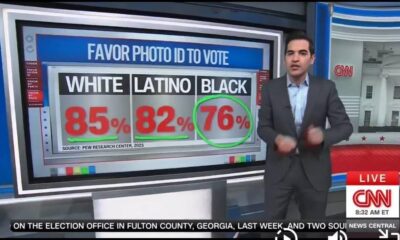
Support also shows up in groups often mentioned in this debate. In the same Pew survey, 76% of Black adults, 85% of White adults, and 82% of Hispanic adults supported photo ID requirements. A Monmouth University poll reported similar results, with 80% support overall, including 62% of Democrats. Those numbers complicate the common claim that voter ID laws are always viewed as discriminatory, since majorities of Black and Latino voters support the idea.

Still, the gap between the parties remains real. Republican voters back these policies at very high rates (some polls show 91%). Democratic voters are closer to the 70% range, while many top Democratic leaders oppose the bills.

Critics say that the split suggests party leaders are not matching what many Democratic voters say they want. On X (formerly Twitter), users such as @RilesZrk have pointed to polling figures like “87% of Blacks & 82% of Latinos support voter ID” while challenging Democratic opposition.

The Case For a National Voter ID Law

Supporters of a national voter ID law say it would reduce fraud and increase trust in election results. Research often finds that in-person voter fraud is rare, with some studies putting rates as low as 0.00004%. Backers respond that even a small number of cases can damage confidence. The Heritage Foundation argues that voter ID rules can prevent more than one type of fraud, including impersonation and noncitizen voting, and that these laws do not meaningfully reduce turnout.

Supporters also point to the broad popularity of voter ID as proof that it feels reasonable to many voters. A Heritage analysis argues that voter ID laws have not shown negative effects on registration or turnout across demographic groups. A 2023 study in the Proceedings of the National Academy of Sciences found that ID laws can increase participation from both parties, which can reduce the idea that one side gains an advantage.

Heading into 2026, allies of Trump and many Republicans say nationwide standards would reduce confusion and conflict, especially in battleground states. They argue that a patchwork of state rules invites disputes like those seen after the 2020 election.

The Case Against It: Voter Barriers and Real-World Logistics

Opponents, including the ACLU and the Brennan Center for Justice, argue that strict ID laws can create obstacles that hit some groups harder. They point to low-income voters, older voters, minority voters, and rural voters as groups more likely to struggle with document access. Estimates often cited in this debate say up to 11% of eligible voters do not have a qualifying ID.

Some figures put the share higher for certain groups, including 25% of Black voters and 18% of voters over age 65. Critics also highlight costs tied to getting documents, sometimes estimated at $75 to $175, plus travel challenges in areas with fewer government offices.

They also argue that the fraud concern is overstated. Noncitizen voting is rare and already illegal, and they say existing penalties and enforcement tools already cover it. A Bipartisan Policy Center analysis of the SAVE Act points to possible unintended effects, including a Kansas example where similar rules blocked 31,000 eligible citizens. Research on turnout is mixed, but opponents often cite findings that show lower participation among some minority groups under stricter rules.

For the 2026 cycle, critics also warn about day-to-day election administration. They expect local offices to get overloaded, lines could grow, and more voters could be pushed into provisional ballots. The National Conference of State Legislatures has warned that conflicts between federal rules and state election laws could create confusion for voters and election workers.

Democratic Leaders vs. Democratic Voters

Many Democratic leaders have attacked the SAVE Act in strong terms. They argue it shifts the burden onto voters and could result in eligible citizens getting removed from the rolls. Schumer has compared it to older voter suppression tactics. Rep. Glenn Ivey (D-MD) has called it a “solution in search of a problem.”

At the same time, polling continues to show that many Democratic voters support photo ID requirements. That gap has fueled criticism that party leadership is taking a harder line than its voters.

Some commentators argue Democrats often frame voter ID as racist, even though polling shows solid support among Black voters (76% in the Pew survey) and Latino voters (82%).

A KFF/theGrio survey found Black voters see racism as a major problem in the GOP (76%), and also a minor problem in the Democratic Party (53%). Critics, including filmmaker Ami Horowitz, have also pushed back on the “racist” label by interviewing Black voters in New York who say they do not see voter ID laws that way.

For Democrats heading into 2026, the risk is political as much as policy-based. If voters see party leaders as ignoring popular reforms, it could weaken support among moderates.

What Minority Voters Say: Support Is Strong, Access Concerns Are Real

Polling shows Black and Latino voters largely support voter ID laws. At the same time, some research suggests these groups are more likely to lack IDs. One commonly cited figure says 13% of Black Americans do not have the needed ID, compared with 5% of White Americans. Groups like the Brennan Center argue that strict rules can widen turnout gaps if states do not make IDs easy to get.

Some Black conservatives, including people aligned with Trump, argue that voter ID is not racist and should be treated as a normal requirement. Pew polling has also shown many Black voters view Trump negatively (72% rated his presidency poorly), while also showing some movement in political preferences, including only 63% backing Biden in 2024. Some commentators say Democrats focus too much on the voter ID framing and not enough on issues many voters rank higher, like jobs and prices.

How This Could Affect the 2026 Midterms

If a national voter ID law becomes reality, it could reshape how the 2026 midterms play out. Supporters think consistent rules could cut down on disputes. Opponents expect lower turnout among some groups, especially in states that do not currently require strict ID, such as California and New York. The NCSL has also pointed to implementation hurdles, including matching mail ballot timelines and running citizenship checks through systems tied to SAVE-style requirements.

Lawsuits would likely follow quickly. The Brennan Center has called the idea “catastrophic” for voters. If courts block the law, Republicans could use that as more proof that the system is vulnerable, which could deepen partisan distrust.

Some studies suggest overall turnout changes are small, but any decline could fall harder on Democratic-leaning groups. On X, the argument shows up from both sides, including people like @fawfulfan who say a clear federal ID rule could reduce claims of selective suppression.

Either way, the fight over a national voter ID law is about more than paperwork. It is about trust in elections, the balance between access and security, and how much control Washington should have over rules that states have long managed. As 2026 gets closer, the outcome may depend on Senate math, public pressure, and how far each party is willing to push.

Related News:

CNN Delivers Stark Reality Check to Democrats Over Voter ID

Continue Reading

News

Tim Walz Exposed By Minnesota DHS Whistleblower

VORNews

Published

on

By

Minnesota DHS whistleblower exposes Tim Walz

WASHINGTON, D.C. – A former Minnesota Department of Human Services (DHS) employee says she paid a steep price for speaking up. Faye Bernstein, a long-time agency worker, claims she faced years of retaliation from Tim Walz after raising concerns about weak controls that she believes helped fuel Minnesota’s growing social services fraud crisis.

Bernstein says she warned leaders about risks in 2018 and 2019, before federal prosecutors began putting public numbers on the damage. Prosecutors now estimate that as much as $9 billion in taxpayer money may have been stolen since 2019 across multiple programs.

A 20-year DHS veteran who worked in contract management and compliance, Bernstein has shared her story on national TV, including Fox News. She says that after she reported irregular contracting practices, she became the target of what she calls a coordinated effort to discredit her.

Her claims come as federal investigators continue to probe fraud tied to child nutrition programs, Medicaid housing supports, autism services, and other benefits. Prosecutors say many of these cases involve networks concentrated in Minnesota’s Somali-American community.

The controversy has reached Congress. The U.S. House Oversight Committee has held hearings where state lawmakers accused Gov. Tim Walz’s administration of brushing off warnings, punishing whistleblowers, and failing to put strong safeguards in place. Bernstein has also pushed back on Walz’s public statements that he didn’t know about the problems, calling that claim “absolutely false.”

Warnings Met With Pushback

Bernstein says her problems started early in Tim Walz’s term, which began in 2019. After she was promoted to a lead role within the Behavioral Health Administration, she says she had a broader view of contracts across the agency.

What she saw worried her. Bernstein described contracting as sloppy and poorly controlled, with few clear checks to stop bad actors. She said the state was “completely open to fraud.”

“I saw just extreme sloppiness, messiness in our contracting processes,” Bernstein said in interviews. She says she raised the issue internally and warned that fraud would follow if DHS didn’t tighten its systems. She says her concerns weren’t welcomed.

Bernstein claims managers cut her duties, left her out of meetings, and treated her complaints as a problem. She says she was accused of racial bias when she brought up patterns she believed were tied to fraud.

“The smear campaign starts where you are told you are racist and your job duties are lessened till you basically have no job duties,” she said.

Bernstein says DHS later barred her from agency properties, revoked her credentials, and moved her into roles that had little real work. She also says she endured state investigations that were expensive and draining. In letters and interviews, she describes ongoing harassment and being pushed to the sidelines. She now warns that reporting fraud without anonymity can ruin a career.

Prosecutors Say the Losses Reach Into the Billions

Federal authorities, including the U.S. Attorney’s Office in Minnesota, have charged close to 100 people in related cases. Dozens have already been convicted.

The best-known case centers on Feeding Our Future. Prosecutors say the nonprofit submitted false claims about feeding children during the COVID-19 pandemic and took at least $250 million. Investigators say large sums went to luxury purchases, real estate, and transfers abroad.

From there, investigations widened. Authorities began focusing on Medicaid-linked fraud tied to housing supports, autism therapy, and other services. In public reporting and testimony, estimates have climbed as high as $9 billion or more since 2018, spread across 14 programs flagged as high risk.

Prosecutors say a large share of defendants in major cases, often reported as about 85% to 90%, are of Somali descent. Walz and some community leaders have pushed back against broad claims about the community, arguing that sweeping labels are unfair and inflammatory.

The fraud has been described as among the largest U.S. cases tied to pandemic-era relief. Some allegations also point to overseas links, including concerns about connections to groups such as Al-Shabaab, though those claims are still being investigated.

Political Pressure and Demands for Answers

The fallout has been intense and partisan. Republican lawmakers and some federal officials have blamed Walz and Attorney General Keith Ellison for what they describe as an overly trusting culture that made the scams easier to pull off. Whistleblowers, including Bernstein, have given testimony or statements to Congress describing ignored reports and a hostile work environment at DHS.

Bernstein’s story also fits a broader pattern raised by other employees. Several workers have claimed their warnings were dismissed, or they faced punishment after speaking up. A congressional document has described allegations that include electronic monitoring and threats of being shut out of future state jobs.

Tim Walz’s administration has disputed the $9 billion estimate and says it has taken steps to fight fraud, including forming task forces. Critics say those efforts came late and only after insiders had sounded the alarm for years.

Bernstein Keeps Speaking Out

Bernstein says the cost has been lasting, including damage to her reputation, isolation at work, and ongoing stress. Still, she continues to speak publicly. Her account points to deeper breakdowns inside DHS that, in her view, allowed fraud to spread and grow unchecked.

As federal investigations continue through subpoenas, searches, and more convictions, Bernstein’s experience highlights the risks whistleblowers say they face inside government agencies. For Minnesota taxpayers, the scandal isn’t only about the money. It’s also about trust in programs meant to protect people who need help.

The full scope of the fraud, and who should be held responsible for missing or ignoring warnings, is still coming into view. Bernstein’s claims have kept attention on that question, and she says she won’t stop pushing for answers.

Related News:

AG Pam Bondi Accuses Tim Walz and Frey of Protecting Violent Criminals

Continue Reading

Get 30 Days Free

Express VPN

Create Super Content

rightblogger

Flight Buddies Needed

Flight Volunteers Wanted

Trending