



Politics
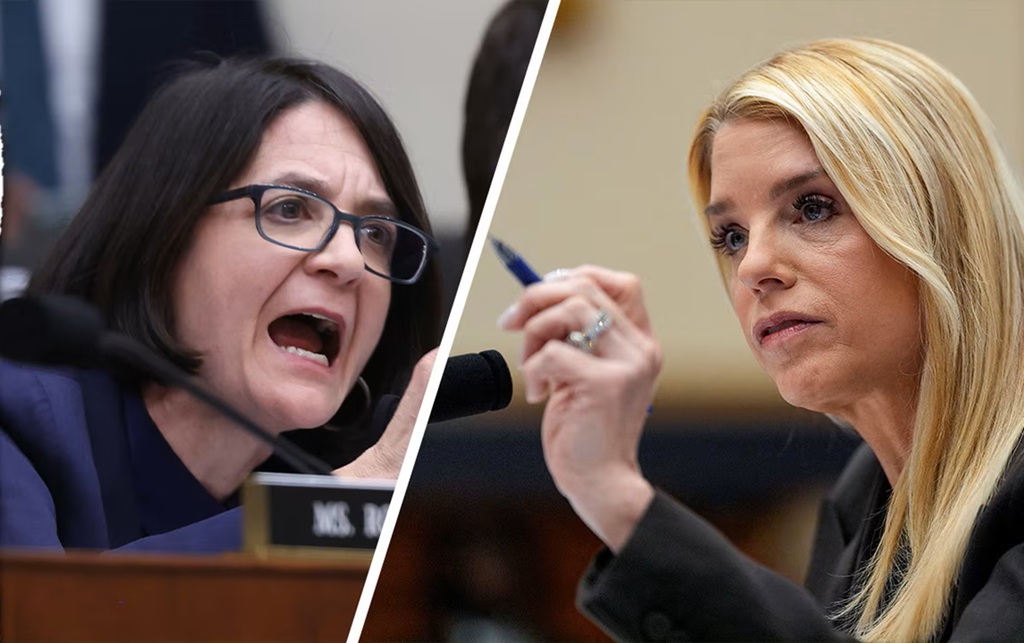
Pam Bondi Unleashes on Becca Balint In Blazing House Clash
Explosive Exchange Highlights Deep Partisan Divide in Oversight of Justice Department
Attorney General Deflects Questions on Trump Officials’ Epstein Ties, Turns Tables on Democrat Lawmaker
WASHINGTON, D.C. – Attorney General Pam Bondi forcefully defended the Trump administration during a tense House Judiciary Committee oversight hearing on Wednesday. She stood her ground as Democrats pressed her on the Department of Justice and the newly released Epstein files.
The sharpest exchange came during a long back-and-forth with Rep. Becca Balint of Vermont, where Bondi sidestepped questions about Jeffrey Epstein ties and pushed back with claims that Balint was helping fuel antisemitism.
What was supposed to be a standard DOJ oversight hearing turned combative fast. Democrats focused on the release of millions of pages tied to Epstein, records that have renewed attention on powerful people who crossed paths with the late convicted sex offender. Epstein survivors sat in the audience, which raised the stakes and added a heavy emotional presence in the room.
Balint, a Jewish lesbian lawmaker known for her progressive politics, led one of the toughest lines of questioning. She asked whether the DOJ had interviewed senior Trump administration officials mentioned in unredacted material, including Commerce Secretary Howard Lutnick, Navy Secretary John Phelan, and Deputy Secretary of Defense Steve Feinberg.
Balint Pressed Pam Bondi
Balint also pointed to Lutnick’s own comments about visiting Epstein’s private island years after Epstein’s 2008 conviction for soliciting prostitution from a minor.
Balint pressed Bondi directly on whether the Justice Department had questioned Lutnick about those connections. Bondi replied briefly that Lutnick “has addressed those ties himself,” and she wouldn’t say whether DOJ investigators had spoken with him. As Balint pushed for a clearer answer, the tension rose.
Balint accused Bondi of stonewalling. “This is pathetic. I am not asking trick questions here. The American people have a right to know the answers to this. These are senior officials in the Trump administration,” she said.
Bondi shot back, first correcting Balint for calling her “secretary,” then saying she was “stunned” Balint was focusing on Epstein instead of issues like border security. The exchange stayed sharp, with both women talking over each other at points.
Then Bondi changed the subject. She criticized Balint for voting against a House resolution that condemned the phrase “from the river to the sea, Palestine will be free” as antisemitic. Bondi suggested Balint’s vote fed what she called an “antisemitic culture right now.” That landed hard.
Pam Bondi Unloads on Balint
Balint snapped back, raising her voice as she challenged Pam Bondi’s point. She referenced her family history, saying her grandfather was lost in the Holocaust. She then left the committee room in protest.
The walkout drew audible reactions from the crowd, and video of the moment spread quickly across social media and news coverage. Bondi stayed composed in the room, and later told reporters she believed the confrontation mattered because it exposed what she described as partisan double standards.
The Bondi Balint clash was only part of a hearing filled with conflict. Earlier, Rep. Pramila Jayapal (D-WA) pressed Bondi to apologize to Epstein survivors in attendance. Bondi refused and instead demanded Dthat emocrats apologize to President Trump. In another tense moment, Bondi called Rep. Jamie Raskin (D-MD), the committee’s top Democrat, a “washed-up loser lawyer” during an argument.
Republicans on the House Judiciary Committee rallied around Bondi. They praised her aggressive posture and steered attention toward the administration’s public safety messaging, including claims of lower crime and other DOJ priorities. They framed Democratic questions as an effort to tarnish Trump allies, not a serious look at department operations.
Calls for deeper investigations
The Epstein files have stayed in the headlines since the DOJ released a portion of the records last month. Critics say the government used heavy redactions to shield influential names. Democrats argue the administration is protecting people with documented Epstein links. Pam Bondi has defended the DOJ’s approach as careful and open, and she has stressed that the documents have not produced new criminal charges.
Balint has said she reviewed parts of the unredacted material and described her questions as basic accountability for public officials. Her response to Bondi’s antisemitism claims, tied to her family’s Holocaust history, highlighted how charged this topic has become and how quickly it can turn personal.
Wednesday’s hearing also showed how oversight in Washington often turns into a political brawl. Bondi’s approach reinforced her image as a fierce Trump ally who won’t concede ground when challenged.
Now, the fallout is building. The exchange has fueled new calls for deeper investigations into Epstein-related ties connected to the administration. It’s unclear what action will follow, but the Bondi Balint showdown is already being treated as a standout moment in the continuing fight over justice, politics, and accountability.
Related News:
Democrats Turn Their Backs on Bill and Hillary Clinton
Politics
Still the Champ: Why the ‘Political Obituary’ of Donald Trump Keeps Getting It Wrong
WASHINGTON, D.C. – For years, mainstream media outlets have raced to be the first to publish Donald Trump’s political obituary. From the pages of The Guardian to the editorial boards of The Washington Post, the narrative has been consistent: the MAGA movement is slowing down, and the former President’s grip on the Republican Party is slipping.
However, as the dust settles on the latest round of primary elections, those predictions look less like analysis and more like “wishful thinking.” On the latest episode of The Ingraham Angle, host Laura Ingraham argued that despite constant headwinds, Trump remains the most powerful force in global politics today.
The most recent evidence of this enduring influence comes from the Hoosier State. Late last year, several Indiana State Senators made headlines for bucking Trump’s preferences on redistricting. At the time, critics were quick to claim that Trump had been handed one of his “biggest defeats yet,” with some even suggesting he left the state with a “black eye.”
The reality of the primary results tells a very different story:
- The Sweep: Five out of the eight Republican incumbents who stood against Trump lost their seats to challengers he endorsed.
- The Holdout: A sixth race remains too close to call, potentially increasing that margin.
- The Message: Voters in Indiana sent a clear signal that the MAGA endorsement still carries massive weight in local GOP politics.
Ingraham pointed out that this isn’t a new phenomenon. She compared the situation to former Representative Liz Cheney’s 2022 primary defeat in Wyoming, noting that Trump often understands the pulse of the base better than the “establishment” figures who represent them.
A Rejection of the “Old” GOP
A significant portion of the current political friction stems from a nostalgic desire—largely among Democrats and “Never-Trump” Republicans—for a return to a specific type of opposition. Former President Barack Obama recently expressed his wish for a “loyal opposition”—a Republican Party that adheres to the traditional norms of the pre-2016 era.
However, Ingraham argues that this version of the GOP is exactly what voters rejected. She noted that the “old” party was one that suffered major losses in 2006, 2008, and 2012. According to Ingraham, the left only “loves” Republicans who cave and lose, whereas the MAGA movement is built on a refusal to be “political roadkill.”
The debate over Trump’s influence isn’t just about personalities; it’s about results. The article highlights a growing divide between the governance of major Democratic-led cities and the booming “Red State” model.
- Urban Struggles: Ingraham cited declining conditions in cities like San Francisco, Chicago, Seattle, and Portland as evidence that modern liberalism is failing to provide safety and affordability.
- The Red State Boom: Conversely, states aligned with MAGA principles are seeing population increases and economic growth.
Why the Left is “Vexed”
The central reason Trump remains a thorn in the side of the political establishment is his refusal to follow their playbook. He didn’t rise through the traditional ranks, and he doesn’t use the standard political jargon. By calling out the failures of both the left and the right, he created a unique lane that neither side has successfully closed.
As the 2024 cycle ramps up, the “wishful thinking” of a post-Trump Republican Party seems further away than ever. Whether it’s in the cornfields of Indiana or on the national stage, the MAGA movement continues to prove that rumors of its demise have been greatly exaggerated.
Trending News:
Victory for Trump as Appeals Court Shuts Down Boasberg
Democrats Panic as Trump Mobilizes Massive Election Army for Midterms
Politics
Tennessee Redistricting War: Democrats Stripped of Power Amid Capitol Chaos
NASHVILLE — The political temperature in Tennessee has reached a boiling point. In a fast-moving and highly controversial special session, the state’s Republican supermajority has successfully pushed through a brand-new congressional map. This move effectively strips Democrats of their only remaining stronghold in the state and cements total conservative control over the state’s federal representation.
The political warfare quickly spilled out of the legislative chambers and into the marble halls of the state Capitol. The resulting scenes were filled with blaring air horns, aggressive chanting, and intense physical clashes that some partisan critics and onlookers have described as a violent riot. As heavily armed state troopers rushed in to maintain order, the future of Tennessee’s political landscape was rewritten in a matter of days.
The Redistricting War Heats Up
The battle lines were quickly drawn following a recent U.S. Supreme Court decision that significantly weakened specific minority protections under the landmark Voting Rights Act. Wasting no time, Tennessee Governor Bill Lee called a special legislative session. The goal was very clear: redraw the state’s congressional maps immediately, just months ahead of the highly anticipated 2026 midterm elections.
At the center of this fierce redistricting war is the city of Memphis. For nearly two decades, the area has been represented by Democrat Rep. Steve Cohen. It has proudly stood as the state’s only majority-Black, majority-Democratic congressional district.
The new map, approved by the GOP leadership, aggressively carves Shelby County into three separate districts. By splitting this vital Democratic voting bloc into rural, deeply conservative surrounding areas, the new lines give Republicans a massive advantage. They now have a clear and unobstructed path to winning all nine of the state’s U.S. House seats.
Protests, Chaos, and Clashes at the Capitol
As the legislation moved forward at lightning speed, public outrage exploded. Hundreds of angry protesters descended on the Tennessee Capitol building. What started as a vocal demonstration quickly escalated into a chaotic scene that disrupted the normal flow of government business.
Tensions boiled over during standard committee hearings. Demonstrators chanted loudly, blew air horns, and beat aggressively on the heavy wooden doors of the meeting rooms.
- Locked Arms and Defiance: Democratic lawmakers, including State Sen. Charlane Oliver, stood on their desks and linked arms in protest of what they called a “Jim Crow” effort to silence Black voters. Some members clapped, danced, and refused to follow the standard rules of decorum.
- State Trooper Intervention: The situation grew so intense and loud that Republican leaders had to completely suspend the hearings. State troopers were brought in to physically clear protesters from the rooms and hold back shouting crowds in the hallways, leading to tense standoffs.
- Fiery Symbols: Just outside the chamber doors, State Rep. Justin Jones took a lighter and set fire to a small image of the Confederate flag, repeatedly shouting the chant, “We will not go back.”
While organizers and local activists maintain that the protests were a necessary, peaceful stand for civil rights, the aggressive tactics, building disruptions, and sheer volume of the unrest led some conservative commentators to label the event a riot. Regardless of the label applied to the chaos, the disruptions did not stop the Republican supermajority from swiftly passing the map.
Democrats Stripped of Power
The passage of the new map is a crushing, historic blow to the Tennessee Democratic Party. Despite the loud protests, the walkouts, and the attempts to stall the final vote, Democrats found themselves completely powerless to stop the legislation.
Because Republicans hold a massive supermajority in both the state House and Senate, they did not need a single Democratic vote to pass the new boundaries. Furthermore, to make this mid-decade map change legal, the GOP first had to repeal a 50-year-old state law that strictly banned redrawing districts in the middle of a ten-year census cycle. They did exactly that, easily overriding any loud objections from the minority party.
The result is a total loss of power for Democrats in the state’s congressional delegation. The map effectively erases their one reliable seat in Washington, leaving left-leaning voters in Memphis feeling entirely disenfranchised.
The Legal Fight: NAACP Steps In
With their legislative power stripped away, Democrats and civil rights groups are now turning to the courts as their last line of defense. The NAACP Tennessee State Conference filed an emergency lawsuit just hours after Governor Bill Lee officially signed the map into law.
The lawsuit aims to block the new map from being used in the upcoming 2026 elections. Here are the main arguments driving the high-stakes legal battle:
- Special Session Rules: The NAACP strongly argues that Governor Lee did not clearly state that the special session would be used to repeal the 50-year-old law preventing mid-decade redistricting. Because state law requires special sessions to stick to a strict agenda, they claim the repeal is completely void.
- Voter Confusion: Changing district lines so incredibly close to an election causes massive chaos. County election commissions now have to scramble to update voter rolls, reprogram machines, and mail out notices to citizens regarding their new polling places.
- Candidate Chaos: The official candidate qualifying deadline had already passed back in March. The new law extends that deadline to May 15, forcing candidates who had already spent hundreds of thousands of dollars campaigning in their old districts to essentially start over from scratch.
State attorneys have pushed back hard against these claims. They argue that the state has sovereign immunity from these types of lawsuits and that the governor has every legal right to call a special session to make necessary statutory changes for the election.
What This Means for the 2026 Elections
The fallout from this bitter redistricting war stretches far beyond the borders of Tennessee. Control of the U.S. House of Representatives hangs in a very delicate balance, and every single seat matters on a national scale.
Former President Donald Trump publicly urged state leaders to take action and correct what he viewed as unconstitutional flaws in the old map. By securing an extra, safe seat for the GOP in Tennessee, Republicans are actively strengthening their grip on power ahead of the November midterms.
For everyday voters living in the state, the situation is incredibly murky and stressful. With early voting deadlines quickly approaching, many residents are left wondering which district they actually live in and who will be on their ballot when they show up to vote. Election officials are currently working overtime to update their complex systems, but the risk of widespread voter confusion remains extremely high.
Ultimately, the chaotic scenes at the Capitol and the bitter legal battles highlight a deeply divided state. The Democrats may have been successfully stripped of their power in the legislature, but the fight over Tennessee’s political future is far from over.
As the multiple court cases play out over the coming weeks, the entire nation will be watching closely to see if the new map stands, or if the judges will force lawmakers right back to the drawing board.
Trending News:
Democrats Panic as Trump Mobilizes Massive Election Army for Midterms
Democrats Push Back on the SAVE Act Despite 85% of Voters Backing Voter ID
Politics
The Last of the Real Democrats? How John Fetterman is Bucking the Progressive Tide
WASHINGTON, D.C. – When you picture a modern politician for the Democrats, you probably imagine a tailored suit, a rehearsed smile, and carefully tested talking points. Senator John Fetterman of Pennsylvania is none of those things.
Standing at six-foot-eight, usually dressed in gym shorts and an oversized hoodie, Fetterman looks more like a guy waiting in line at a local hardware store than a United States Senator. But his clothes are not the only thing setting him apart from his colleagues in Washington.
Recently, Fetterman has made headlines for doing something almost unheard of in today’s Democratic Party: he is actively rejecting the “progressive” label. Instead, he simply calls himself a regular Democrat.
For a long time, the Democratic Party was seen as the party of the working class. It was the political home for factory workers, union members, and middle-of-the-road liberals. Today, a growing number of political observers and everyday voters are asking a tough question. Have progressives hijacked the once moderate Democratic Party? And if so, is John Fetterman one of the last “real” Democrats left?
The Rise of the Working-Class Democrat
To understand Fetterman, you have to understand where he comes from. He served as the mayor of Braddock, a small, working-class steel town in western Pennsylvania. Braddock is a town that saw hard times when the factories closed down. Fetterman spent his time there trying to rebuild the community, attract jobs, and reduce crime. He did not do this with high-level academic theories. He did it with practical, everyday solutions.
When Fetterman ran for the Senate in 2022, he ran on a platform that appealed directly to blue-collar workers. He talked about creating jobs, protecting unions, and making healthcare affordable. He also supported things that made the far-left nervous, like the local fracking industry, which provides thousands of jobs in Pennsylvania.
For a while, many in the media called him a progressive champion simply because he supported things like legal weed and a higher minimum wage. But as Fetterman himself pointed out, his views have always been rooted in practical, traditional Democratic values, not extreme leftist ideology.
What Happened to the Middle-of-the-Road Left?
If you look back twenty or thirty years, the Democratic Party looked very different. During the 1990s, leaders like Bill Clinton championed a “Third Way.” This was a middle-of-the-road approach. The party focused on growing the economy, balancing the budget, being tough on crime, and providing a safety net for the poor.
Even during the early years of Barack Obama’s presidency, the party largely stuck to a moderate path. They focused heavily on kitchen-table issues—the things families talk about over dinner, like the cost of healthcare, paying for college, and keeping their neighborhoods safe.
However, around 2016, things began to shift. The presidential campaign of Senator Bernie Sanders energized a new, highly vocal wing of the party. Soon after, new politicians like Representative Alexandria Ocasio-Cortez and the “Squad” arrived in Congress. The energy in the party moved to the far left. According to data from Gallup, the percentage of Democrats identifying as “liberal” or “very liberal” has risen sharply over the last decade.
How the Progressive Wing Took the Steering Wheel
Critics argue that this new progressive wing has hijacked the party’s messaging. Instead of focusing on jobs and wages, the loudest voices in the room started focusing on sweeping, radical changes.
Some of the key moments that made moderate voters feel left behind include:
- The “Defund the Police” Movement: While traditional Democrats wanted police reform, progressive activists pushed slogans about dismantling police departments. This alienated millions of voters who worry about crime in their neighborhoods.
- Energy Policy Extremes: Moderates favor a slow transition to green energy while protecting current jobs. Progressives have pushed for immediate, drastic cuts to fossil fuels, leaving workers in states like Pennsylvania and Ohio fearing for their livelihoods.
- Cultural Messaging: The language used by the progressive wing often feels rooted in elite university campuses rather than factory floors. Many working-class voters feel talked down to or misunderstood by the party’s new, highly educated base.
For a traditional, middle-of-the-road liberal, this shift has been dizzying. The party that once focused on protecting the little guy now seems hyper-focused on complex cultural debates and massive government expansions.
Why Fetterman Left the Progressive Label Behind
Over the past year, Senator Fetterman has drawn a clear line in the sand between himself and the progressive wing. He has shown a willingness to break from the left on several major issues, proving that he is not afraid to upset his own party’s base.
First, there is the issue of border security. While many progressives advocate for highly relaxed border policies, Fetterman has stated clearly that America needs a secure border. He has pointed out that wanting a safe, orderly immigration system does not make you cruel; it makes you practical.
Second, Fetterman has been unflinching in his support for Israel. While the progressive wing of the Democratic Party has become increasingly critical of Israel, and in some cases deeply hostile, Fetterman has draped himself in the Israeli flag. He has refused to back down, stating that standing by traditional American allies used to be a basic, bipartisan value.
Finally, Fetterman is a staunch defender of American energy independence. He knows that in places like Pennsylvania, the energy sector is what puts food on the table. He refuses to sacrifice those jobs to satisfy climate activists who live hundreds of miles away in big cities.
The Progressive Agenda vs. Traditional Liberalism
To understand just how much the party has shifted, it helps to look at the differences between the new progressive agenda and traditional liberalism. Here is how the two sides differ:
- Economic Focus: Traditional Democrats focus on raising the minimum wage, protecting unions, and ensuring fair trade. Progressives focus on concepts like universal basic income, student loan forgiveness (which often benefits higher earners), and massive taxation overhauls.
- Foreign Policy: Traditional liberals believe in strong global alliances and backing democratic nations. The progressive wing has grown increasingly skeptical of American military power and traditional allies.
- Social Issues: Moderates believe in equality of opportunity and protecting civil rights. The progressive wing often pushes for “equity” (equality of outcome) and places a heavy focus on identity politics.
- Tone and Approach: The old-school Democrat tries to build a big tent, welcoming people who might disagree on a few issues. The modern progressive movement is often seen as demanding purity, quickly turning on anyone who steps out of line.
Are Centrist Democrats Becoming a Thing of the Past?
As the progressive wing gains more influence in media and online spaces, politicians like John Fetterman seem to be an endangered species. Many moderate Democrats in Congress keep their heads down. They are afraid of being attacked on social media or facing a primary challenge from a far-left candidate.
But Fetterman’s approach might just be the blueprint for saving the Democratic Party in the American heartland. By refusing to bow to the progressive left, he is speaking to the “silent majority” of Democratic voters. These are people who want good roads, safe streets, fair wages, and a government that works. They are not interested in endless culture wars or radical experiments.
Fetterman’s popularity among average voters suggests that there is still a massive appetite for normal, common-sense politics. People respect a leader who tells the truth as he sees it, even if it makes his own party angry.
A Crossroads for the Democratic Party
The Democratic Party is currently standing at a crossroads. Down one path is the progressive vision: a party focused on sweeping cultural changes, rapid environmental mandates, and highly left-wing social policies. Down the other path is the traditional liberal vision: a party grounded in the economic realities of the working class, strong national defense, and practical, step-by-step progress.
John Fetterman has made it crystal clear which path he is walking. By shedding the progressive label, he is sending a message to the rest of the country. He is proving that you can support unions, defend reproductive rights, and fight for the middle class without adopting extreme far-left views.
Is John Fetterman the last of the real Democrats? Perhaps not the absolute last. But right now, he is certainly the loudest voice reminding the party of its roots. If the Democratic Party wants to keep winning elections in places like the Rust Belt and the Midwest, it might need to spend a little less time listening to the progressive activists on Twitter and a little more time listening to the guy in the hoodie.
Trending News:
Democrats May Be Moving to Rig the System as They Lose the Majority
Far Left Socialist Democrats Have Taken Control of the Entire Party
-
Politics3 months agoIlhan Omar’s Connections to Convicted Somali Fraudsters Surface
-
Politics2 months agoRep. Ilhan Omar Faces Heat as Minnesota Voters Seek Change
-
Politics3 months agoCalls Mount to Expel Rep. Ilhan Omar from Congress
-
Politics3 months agoAOC’s Critique of Rubio’s Speech Turns into an Huge Embarrassment
-
Crime3 months agoErika Kirk Faces Renewed Grooming Allegations Over 2014 Messages
-
News3 months agoAustin Tucker Martin Who Was He And Why Was He at Mar-a-Lago?
-
Business3 months agoCNN Ratings Collapse As Cable Giants Face Extinction
-
News2 months agoIlhan Omar Accused of Leaking U.S. Strike Plans to Iran as Tensions Rise