

TEHRAN – Iran’s Supreme Leader Ayatollah Ali Khamenei, the 86-year-old cleric who has led the Islamic Republic for more than three decades, is reportedly taking extra steps to protect himself.
Several accounts, including opposition-linked outlets such as Iran International and reporting repeated across international media, say Khamenei has shifted to a reinforced underground bunker in Tehran. The move reportedly came after senior military and security officials warned him that the risk of US airstrikes is rising, as American naval and air forces continue a major buildup in the Persian Gulf and nearby areas.
Sources describe the site as a hardened facility with heavy security and a network of tunnels, built to protect high-value figures during air attacks. The reports also point to sharper language from US President Donald Trump, who has again threatened military action unless Iran accepts strict limits on its nuclear program and ballistic missiles.
Trump has spoken about a “massive armada” moving into the region, including the USS Abraham Lincoln carrier strike group, guided-missile destroyers, F-35 fighters, and more air defenses, including Patriot and THAAD systems positioned at bases in allied countries.
US Buildup Brings Back 2020 Fears Inside Tehran
This posture brings back memories of January 2020, when Trump ordered a drone strike that killed Qasem Soleimani, the head of Iran’s Quds Force, at Baghdad International Airport.
That strike stunned Iran’s leadership and showed that Washington was willing to target top figures directly. Analysts say the current buildup, described as larger than earlier deployments, has raised anxiety at the top of the Iranian system. Some reports claim Khamenei has even named potential successors in case he’s targeted.
Iran’s state media and officials have pushed back on the bunker claims. They have also shared photos and coverage of Khamenei at public events, including prayers at the tomb of Ruhollah Khomeini, to signal calm and control. Still, the speculation hasn’t faded. Opposition sources keep saying the move is about personal security and fear of a direct US strike.
Soleimani’s killing remains a turning point for the Iranian regime. The Trump administration defended the action at the time as a step to stop imminent threats to US personnel. In Iran, the strike was seen as a major blow and a public embarrassment that exposed gaps in the country’s security. Iranian leaders promised retaliation, but the episode also showed how quickly the situation could shift.
Now, with US warships closer and Trump warning that any future response would be “far worse” than before, including references in reporting to alleged 2025 strikes on Iranian nuclear sites, the supreme leader appears to be acting on the assumption that the risk is real. In that context, reports of bunker living fit a leadership preparing for worst-case scenarios.
Claims of Mass Killings as Protests Spread
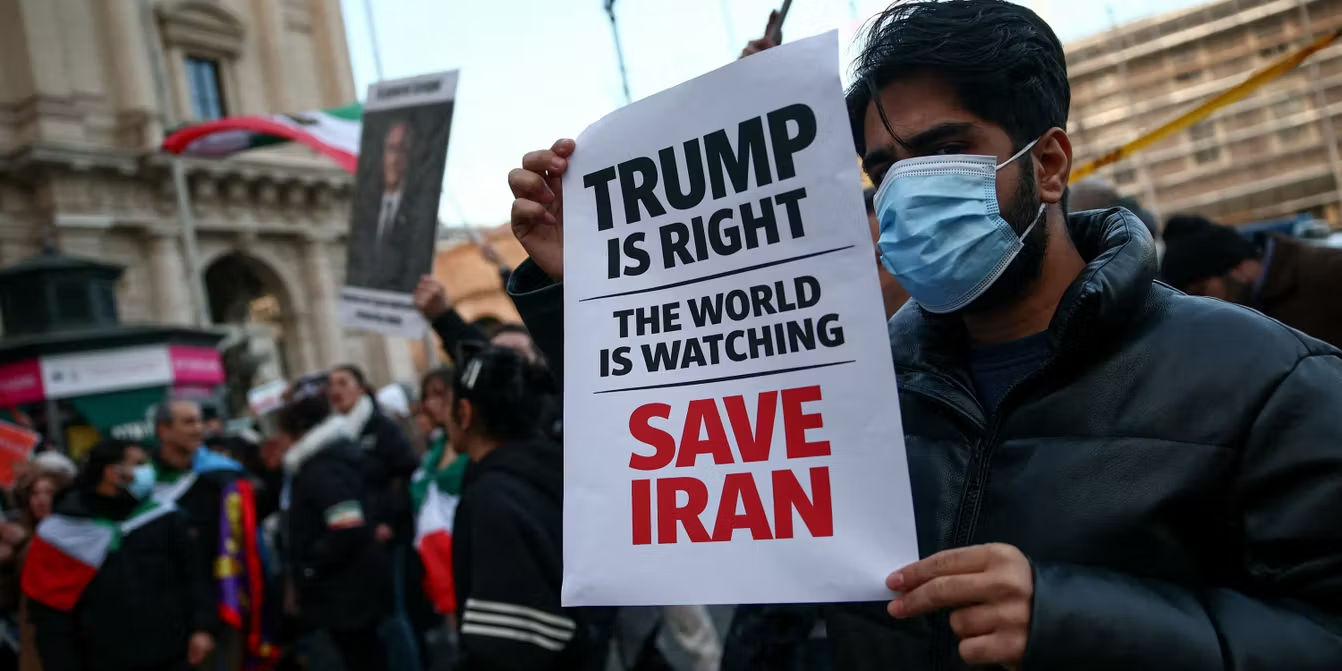
Even as outside pressure grows, the Iranian government is also facing intense anger at home. Nationwide protests tied to the economy, currency decline, and long-running frustration with repression have reportedly met a harsh response. Human rights groups, medical sources, and opposition media describe security forces, including the Islamic Revolutionary Guard Corps (IRGC) and Basij units, using extreme force to shut down demonstrations.
Because of censorship, internet shutdowns, and limits on reporting, death toll estimates vary widely. Iran International has cited internal documents that claim more than 36,500 people were killed during a two-day crackdown in early January 2026, calling it one of the deadliest civilian protest crackdowns ever reported.
Time magazine has published accounts attributed to senior health ministry officials that suggest up to 30,000 deaths in similar clashes, with morgues and burial systems pushed past capacity. Other trackers, including HRANA, have confirmed more than 6,000 deaths, with many more cases still being reviewed, including reports involving children and other non-combatants.
Rising Global Anger and Isolation Around the Islamic Republic
These claims build on a pattern seen during earlier unrest, including the 2022 Women, Life, Freedom protests after Mahsa Amini died in morality police custody. Critics say the government is using live fire, aimed shots to the head and torso, and mass arrests to end dissent. Families of victims also report disappearances, torture, and attempts to hide the scale of the killings, including alleged mass burials.
Outside Iran, patience with the Islamic Republic appears to be wearing thin. Years of support for proxy forces, missile work, and ongoing nuclear disputes have left the country isolated in many forums.
The current crackdown, paired with warnings of regional conflict if Iran is attacked, has added to the outrage from human rights groups and many governments. Many observers now describe the regime as weaker than it looks, held together more by force than broad public support.
With US forces positioned for possible action and protests continuing inside Iran, reports of Khamenei living underground have become a symbol of a leadership under pressure on two fronts. Whether this leads to a wider confrontation or pushes new concessions is still unclear, but the moment is tense for Iran and for the region.