Connect with us

News

US Ambassador Calls Out Iran at Tense UN Security Council Meeting

VORNews

Published

on

US Ambassador Calls Out Iran

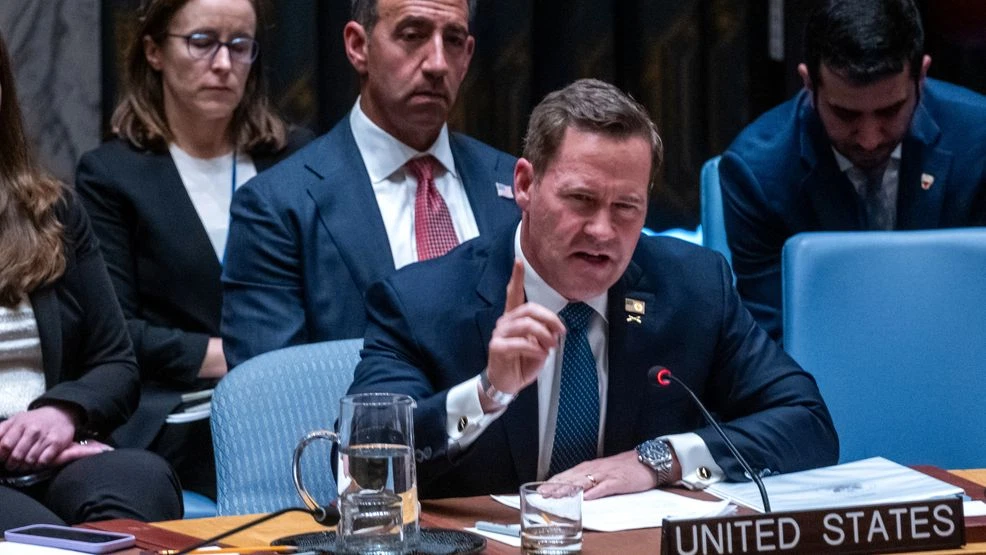
NEW YORK – The sharp clash between US Ambassador to the United Nations Mike Waltz and Iran’s Permanent Representative Amir Saeid Iravani took center stage during an emergency United Nations Security Council meeting on February 28, 2026. Middle East tensions spiked after joint US-Israeli strikes on Iranian targets (Operation Epic Fury), followed by Iran’s counterattacks across the region.

Called under the agenda item, “The situation in the Middle East,” the session focused on how close the region may be to a wider war. Reports cited civilian casualties, the reported death of Iran’s Supreme Leader Ayatollah Ali Khamenei in the strikes, and urgent pleas to calm the crisis from UN Secretary-General António Guterres.

US Ambassador’s Showdown at the UN Security Council

The exchange between US Ambassador Waltz and Iravani became one of the most personal and direct arguments seen at the UN in recent years. It came late in the meeting, after Iravani denounced the US-Israeli operation as “unprovoked and premeditated aggression.” He said it violated Iran’s sovereignty, killed and injured hundreds of civilians (including strikes he called deliberate attacks on residential areas), and amounted to war crimes.

Soon after, Iravani asked to speak again and delivered a pointed message to the US envoy.

“I advise the representative of the United States to be polite,” Iravani said. “It will be better for yourself and the country you represent. Thank you.”

Waltz responded right away using his right of reply. He rejected the warning and aimed his remarks at Iran’s leadership.

“This representative sits here, in this body, representing a regime that has killed tens of thousands of its own people, and imprisoned many more, simply for wanting freedom from your entire tyranny,” US Ambassador Waltz said. He also said he would not “dignify this with another response,” while repeating the US view that the strikes were legal and needed to protect allies, limit proxy groups, and stop Iran from getting nuclear weapons.

The back-and-forth drew audible reactions in the room. It also spread quickly through international media, highlighting just how deep the hostility remains between Washington and Tehran during the current crisis.

What Sparked the Emergency Meeting: US-Israel Strikes and Iran’s Response

The Security Council met after early morning airstrikes on February 28, 2026. The United States and Israel carried out the attacks together, hitting Iranian nuclear facilities, missile locations, and other military sites. US officials described the mission as a firm response to Iran’s long-running threats and its backing of regional proxy forces that have targeted US and Israeli interests.

Iranian state media reported major damage and casualties. During the session, Iravani said “hundreds of civilians” were killed or wounded on the first day. Iran then answered with missile and drone strikes on Israel and on US bases in several Middle Eastern countries, including reported strikes in the Gulf region.

Reports also said the strikes killed Supreme Leader Ayatollah Ali Khamenei. Iranian state media later confirmed that account, which raised fresh concerns about leadership succession and stability inside Iran.

This was the second major US-Israeli action against Iran in under a year. It followed a June 2025 round of strikes that included the US bombing of nuclear sites.

Guterres Presses for De-Escalation

UN Secretary-General António Guterres opened the meeting with a warning about the risks of escalation. He criticized the growing use of force and said it threatened international peace and security.

“The use of force by the United States and Israel against Iran, and the subsequent retaliation by Iran across the region, ignite a chain of events that nobody can control in the most volatile region of the world,” Guterres said. He also stressed that the UN Charter bars threats or force against a state’s territorial integrity.

Guterres called for:

  • An immediate halt to hostilities
  • A return to negotiations to pull the region back from the edge
  • Full respect for international law to reduce the risk of a broader war with severe costs for civilians and regional stability

He warned that the other path leads to “a potential wider conflict” that could devastate the Middle East and spread far beyond it.

International Responses and Pressure to Show Restraint

Many Security Council members and observers weighed in during the session:

  • Russia and China criticized the US-Israeli strikes as “unprovoked aggression” and backed Iran’s claim to self-defense under Article 51 of the UN Charter.
  • European countries, including France (whose president requested the meeting), pushed for restraint and stronger protection for civilians.
  • The European Union said it was deeply concerned and urged all sides to stop military operations.
  • Several non-aligned states also called for an immediate ceasefire and UN-led talks.

The council did not adopt a resolution. Still, the meeting made the split clear, with the United States defending its actions as defensive and lawful.

What This Could Mean for Middle East Stability and Global Security

The argument at the UN reflects how fragile diplomacy looked in 2026. Several risks stand out:

  • The fighting could widen and pull in more players, including proxy groups in Lebanon, Yemen, Iraq, and Syria.
  • Threats in the Gulf could shake global energy markets.
  • Attacks on Iranian facilities raise fears about nuclear escalation.
  • Iran could face internal unrest after the reported loss of its supreme leader.

Analysts have warned that if leaders don’t move fast to cool tensions, the cycle of strikes and counterstrikes could spiral into a larger war. That could also draw in major powers and trigger a major humanitarian crisis.

When the meeting ended, diplomats stressed the need for urgent back-channel contacts to restore calm. The US Ambassador Waltz-Iravani confrontation grabbed headlines, but the military situation on the ground continues to shape what comes next.
News

Trump Supporters Tell Pope to ‘Stay in His Lane’ as Tensions Rise Over Iran Conflict

VORNews

Published

on

By

Trump Supporters Tell Pope to ‘Stay in His Lane’

VATICAN CITY — A sharp divide has opened between the White House and the Holy See, as supporters of President Donald Trump increasingly call for Pope Leo XIV to “stay in his lane.” The friction follows the Pope’s outspoken criticism of the U.S.-led military operations in Iran, which began on February 28, 2026.

Critics within the MAGA movement argue that the pontiff—the first-ever American-born pope—is overstepping his spiritual authority by meddling in complex geopolitical security matters. Many supporters claim his appeals for peace inadvertently favor Islamic interests over the safety and strategic goals of the Christian West.

The tension reached a boiling point this month after Pope Leo XIV described the ongoing conflict as a “spiral of violence” and an “irreparable abyss.” In response, President Trump took to social media to label the Pope as “weak on crime” and “terrible for foreign policy.”

For many Trump supporters, the issue isn’t just about the war itself, but about what they perceive as a double standard in the Vatican’s advocacy.

  • Geopolitical Meddling: Supporters argue the Pope does not understand the necessity of “Operation Epic Fury,” the joint U.S.-Israeli campaign aimed at dismantling Iran’s nuclear capabilities.
  • National Sovereignty: There is a growing sentiment that the Vatican should focus on the souls of the faithful rather than attempting to dictate the military strategy of a sovereign superpower.
  • Safety Concerns: Critics point out that while the Pope calls for dialogue, Iran’s leadership has historically posed a direct threat to both Christian and Jewish communities in the Middle East.

Claims of Favoritism: Is the Pope “More Concerned with Muslims”?

One of the most controversial narratives emerging from the American right is the idea that the Pope’s humanitarian focus is skewed. Some high-profile supporters have voiced concerns that the Pope’s rhetoric seems more protective of Iranian interests than the American soldiers and Middle Eastern Christians caught in the crossfire.

This sentiment stems from several key points of contention:

  1. Condemning Civilization Threats: Pope Leo XIV recently called Trump’s warnings against Iranian infrastructure “unacceptable,” leading some to argue he is shielding a regime that actively persecutes religious minorities.
  2. Focus on Migration: Before the war, the Pope’s criticism of mass deportation efforts had already soured his relationship with the Trump administration.
  3. Diplomatic Outreach: The Vatican’s long history of “cautious engagement” with Tehran is seen by hardliners not as diplomacy, but as a dangerous softening toward an adversary.

The Vatican’s Defense: The Gospel Above Politics

Despite the mounting pressure, the Vatican remains firm. Speaking from the papal plane, Pope Leo XIV stated he has “no fear” of the Trump administration. He maintains that his calls for peace are not political maneuvers but are rooted strictly in the Gospel.

“We are not politicians,” the Pope told reporters. “I will continue to speak out strongly against war, seeking to promote peace and dialogue. Too many innocent people have been killed, and someone must stand up and say there is a better way.”

Church officials, including Msgr. Peter Vaccari of the Catholic Near East Welfare Association has echoed this, stressing that the Church’s role is to protect all human life, regardless of borders or religion.

A Fragmented Faithful

The dispute is forcing American Catholics to choose sides. While many defend the Pope as the “Vicar of Christ,” others find themselves more aligned with the President’s “America First” doctrine.

Conservative commentators have noted that this is not a typical theological debate. It is a clash between two worldviews: one that prioritizes national security and the preservation of Western values, and another that views global peace through a lens of universal humanitarianism.

Summary of Key Criticisms from Trump Supporters

  • Strategic Naivety: Claiming the Pope’s call for a ceasefire allows Iran to regroup and continue its nuclear ambitions.
  • Silence on Persecution: Arguing the Pope is more vocal about U.S. airstrikes than he is about the long-term persecution of Christians within Islamic republics.
  • Interference: Viewing the Pope’s direct appeals to Congress and the public to “stop the violence” as an inappropriate intrusion into American domestic and foreign policy.

As the two-week ceasefire remains fragile, the war of words between Washington and the Vatican shows no signs of cooling down. For now, the “lane” the Pope occupies remains a contested territory in the hearts and minds of the American electorate.

Trending News:

Victory for Trump as Appeals Court Shuts Down Boasberg

Trump Warns China as Vance Leads Peace Talks with Iran

Tulsi Gabbard Sends Criminal Referral to DOJ Over 2019 Trump Impeachment


Continue Reading

News

Kash Patel Vows Defamation Lawsuit Over Bombshell ‘Drinking and Paranoia’ Report

VORNews

Published

on

By

FBI Director Kash Patel Defends Georgia Election Probe

WASHINGTON, D.C. — FBI Director Kash Patel has ignited a legal firestorm, threatening to sue a major national magazine after it published an explosive profile alleging he has struggled with alcohol abuse and crippling paranoia during his time leading the nation’s top law enforcement agency.

The report, published Friday by The Atlantic, relies on accounts from over two dozen current and former officials. These sources paint a picture of a director who is often absent from headquarters, prone to “freak-outs” over his job security, and frequently intoxicated to the point of being unreachable by his own security detail.

Patel, 46, wasted no time hitting back. In a fiery post on X (formerly Twitter), the director labeled the article “fake news” and suggested the reporting met the legal standard for actual malice. “See you and your entire entourage of false reporting in court,” Patel wrote, calling the potential lawsuit a “legal layup.”

The Allegations: Drinking and “Breaching Equipment”

The most startling claims in the report involve Patel’s alleged personal conduct. According to sources cited in the exposé, Patel is a frequent guest at high-end clubs in Washington, D.C., and Las Vegas, where he is reportedly known for “conspicuous inebriation.”

The report details several specific incidents:

  • Morning Disruptions: Meetings and morning briefings were allegedly rescheduled to the afternoon to accommodate Patel’s recovery from late-night drinking.
  • Security Concerns: In one instance, Justice Department officials claimed Patel’s security detail had such difficulty waking him behind a locked door that they requested “breaching equipment”—tools typically reserved for tactical raids—to ensure his safety.
  • National Security Gaps: Current FBI officials expressed fear that the director’s behavior leaves him vulnerable to exploitation or unable to lead during a sudden national crisis.

A Technical Glitch Sparks a “Freak-Out”

Beyond the drinking allegations, the report describes a climate of extreme paranoia within the FBI. Sources told journalists that Patel is “obsessed” with the idea that he might be fired by the White House, especially following the recent removal of former Attorney General Pam Bondi.

A key example provided in the article occurred on April 10, 2026. Patel reportedly encountered a technical glitch while trying to log into an internal FBI computer system. Believing he had been locked out of the building and fired, he allegedly entered a “frantic” state, calling allies and aides to announce his dismissal.

The issue turned out to be a simple IT error, but the “freak-out”—as witnesses called it—reportedly sent ripples of alarm through the administration.

Patel and the FBI Fire Back

The FBI’s communications office has moved quickly to debunk the claims. Benjamin Williamson, a top spokesperson for the bureau, issued a statement calling the article “completely false at a nearly 100 percent clip.”

Patel’s attorney, Jesse Binnall, shared a letter sent to the magazine before publication, arguing that the story relied on “vague, unattributed sourcing” and did not give the director enough time to provide a meaningful response.

Despite the controversy, the White House has publicly stood by the director. White House spokesperson Karoline Leavitt stated that Patel “remains a critical player” on the administration’s team, highlighting that crime rates have dropped during his tenure.

Why This Matters for the FBI

The timing of these allegations is particularly sensitive. The United States is currently involved in high-stakes military operations against Iran, a situation that many argue requires a steady and present hand at the FBI.

“That’s what keeps me up at night,” one unnamed official told reporters, referring to the possibility of a domestic terror threat occurring while leadership is distracted or incapacitated.

As Patel prepares for a potential legal battle, the rift between the FBI’s leadership and its career staff appears to be widening. Whether the director follows through on his threat to sue remains to be seen, but the “boozy” profile has already become a major flashpoint in the ongoing debate over the agency’s future.

Trending News:

FBI Investigates Who’s Funding and Coordinating ICE Protests and Attacks

FBI Director Kash Patel Defends Georgia Election Probe, Points to Probable Cause


Continue Reading

News

Global Energy Markets Shaken as Iran Fires on Ships in Hormuz Strait

VORNews

Published

on

By

Iran

TERRAN – The Strait of Hormuz, a vital chokepoint for the world’s oil supply, has once again become a flashpoint of international conflict. Less than 24 hours after a brief reopening, forces from Iran have reportedly fired on commercial vessels and reinstated strict passage restrictions.

Global energy stability took a hit on Saturday as Iran reversed its decision to reopen the Strait of Hormuz. This sudden U-turn comes after Iranian Revolutionary Guard Corps (IRGC) gunboats allegedly opened fire on a commercial tanker, forcing several other ships to abort their transit. The escalation has reignited fears of a deepening energy crisis and potential military conflict between Tehran and Washington.

According to reports from the United Kingdom Maritime Trade Operations (UKMTO), the incident occurred roughly 20 nautical miles northeast of Oman. Two Iranian gunboats reportedly approached a tanker and opened fire without any radio contact. While the tanker and its crew were reported safe, the psychological impact on the shipping industry was immediate.

Industry monitors, including TankerTrackers.com, noted that several vessels—including a supertanker flagged in India—were forced to turn around. In a separate report, a container ship was also allegedly struck by an unknown projectile, causing damage to cargo but no injuries.

The Sudden Reversal By Iran

The decision to close the strait follows a period of intense diplomatic tension. Just Friday, Tehran had announced that commercial vessels could pass through the waterway. However, the mood soured after U.S. President Donald Trump stated that a U.S. blockade of Iranian ports would remain “in full force” until a new nuclear and security deal is reached.

Iran’s joint military command responded by declaring that control of the strait has returned to its “previous state” under the strict management of its armed forces. Tehran has been clear: as long as Iranian ports are blocked, the world’s most important oil corridor will remain restricted.

Key Takeaways from the Escalation:

  • Vital Chokepoint: Roughly 20% of the world’s oil passes through this narrow strait.
  • Military Action: IRGC gunboats used small arms fire against commercial tankers to enforce the closure.
  • Geopolitical Standoff: Iran demands the lifting of U.S. blockades; the U.S. demands a comprehensive new deal.
  • Global Impact: Oil prices are expected to rise as supply chains are disrupted once again.

Impact on Global Energy and Trade

The Strait of Hormuz is often called the “world’s jugular vein” for energy. With approximately one-fifth of global oil consumption transiting the area, even a temporary closure sends shockwaves through the market.

The current situation is particularly fragile because it coincides with a 10-day truce between Israel and Hezbollah. While mediators from Pakistan and other nations are still hopeful that a peace deal can be reached by the April 22 deadline, the return to hostilities in the water suggests that the path to peace is anything but smooth.

The Human and Economic Cost

Beyond the oil prices, the human toll of the wider conflict continues to mount. Recent fighting has claimed thousands of lives across the region:

  1. Iran: At least 3,000 fatalities reported during recent hostilities.
  2. Lebanon: Nearly 2,300 deaths.
  3. Israel: At least 23 people killed.

For the shipping industry, the risk is becoming untenable. Insurance premiums for vessels in the Persian Gulf have skyrocketed, and some shipping lines are considering longer, more expensive routes around Africa to avoid the Middle East entirely.

All eyes are now on the upcoming diplomatic meetings. If a deal is not reached by Wednesday, many fear the temporary ceasefire between the U.S. and Iran could expire, leading to an even larger military presence in the region.

For now, the Strait of Hormuz remains a “no-go” zone for many commercial operators, and the world waits to see if diplomacy can win out over the sound of gunfire.

Trending News:

No Way Out: Four More Protesters Sentenced to Death in Iran

Satellite Imagery Shows Iran Clearing Bombed Missile Tunnels During Ceasefire


Continue Reading

Get 30 Days Free

Express VPN

Create Super Content

rightblogger

Flight Buddies Needed

Flight Volunteers Wanted

Trending