
News
Russia blocks Facebook; LVMH, Microsoft Halt Sales


Russia said it would block Facebook for excluding state media and CNN said it would stop broadcasting in Russia after a new law punishing “fake news” raised the stakes in Moscow’s fight with foreign corporation.
Friday marked an escalation in the dispute that began after the invasion of Ukraine. Russia blocked a wave of media companies and new, big names announced they were shutting down Russia sales, including Microsoft Corp (MSFT.O) and video game maker Electronic Arts Inc (EA.O). read more
Russia said that Meta Platforms Inc’s (FB.O) Facebook was being blocked for restricting state-backed channels, and it also blocked websites of the BBC, Deutsche Welle and Voice of America for what it said was false information about the war in Ukraine. read more Twitter (TWTR.N) will also be blocked, Russian media said.
The BBC said it would temporarily suspend its work in Russia after introduction of a new law that could jail anyone found to be intentionally spreading “fake” news. read more
AT&T Inc’s (T.N) CNN is stopping broadcasts to “evaluate the situation and our next steps moving forward,” a spokesperson said.
Meta’s head of global affairs, Nick Clegg, said the company would continue to do everything possible to restore its services.
“Soon millions of ordinary Russians will find themselves cut off from reliable information, deprived of their everyday ways of connecting with family and friends and silenced from speaking out,” he said, in a statement posted on Twitter.
Many Russians have downloaded VPN software to avoid state restrictions, but internet provider Cogent (CCOI.O), which said it was the second-largest carrier out of Russia, disclosed plans to cut service, partly to avoid being used for cyberattacks. read more
A slew of major Western brands in a broad range of industries has exited from Russia. Some of the best known have sharply rebuked Moscow for the attack on Ukraine. Others have described reacting to circumstances, including luxury goods maker LVMH (LVMH.PA) which on Friday said it would temporarily shut 124 shops in Russia. read more
Canadian Tire (CTCa.TO) also announced it would temporarily close 41 Russian stores of its Helly Hansen outerwear and luggage group, and private jet maker Bombardier Inc said it had suspended all activities with Russian clients, adhering to international laws. read more
Shipping and supply-chain issues have made it difficult to work in Russia, as well. Companies form Royal Dutch Shell to Apple Inc (AAPL.O) to Toyota Motor Corp (7203.T) have taken actions from stopping sales and operations to exiting completely. Agricultural commodity merchant Louis Dreyfus announced suspension of operations in Russia on Friday.
NO EASY ANSWERS
Russian First Deputy Prime Minister Andrei Belousov laid out options for foreign companies on Friday: stay in the country, exit entirely or hand over their holdings to local managers until they return.
No route comes without risks. Those staying could face a backlash in Western markets where the public has rallied to Ukraine’s cause, those transferring shares could be handing over the keys with few guarantees, while those quitting may face a big loss at best, or might have to sell for a nominal sum.
“It’s a complicated process,” said Darren Woods, chief executive of U.S. energy company Exxon Mobil Corp (XOM.N), which is exiting oil and gas investments that involve partnerships with Russia’s Rosneft (ROSN.MM) and others worth $4 billion. read more
Companies have had little time to prepare.
Russia’s invasion – which Moscow calls a “special operation” – prompted the United States and Europe to impose swift and sweeping sanctions, affecting everything from global payments systems to a range of high-tech products. read more
“Western companies probably haven’t lost so much money so quickly due to geopolitics since the Shah was overthrown in Iran,” said Renaissance Capital chief economist Charlie Robertson, referring to the Islamic revolution more than four decades ago that led to an exodus of Western businesses.
STAYING PUT
Yet some companies plan to keep going. Italian tyre maker Pirelli (PIRC.MI) said it had set up a “crisis committee” to monitor developments but did not expect to halt production at either of its two Russian plants.
For companies packing up, the Russian first deputy prime minister said a fast-track bankruptcy plan “will support the employment and social well-being of citizens so that bona fide entrepreneurs can ensure the effective functioning of business.”
So far global companies, banks and investors have announced they have exposure in some form to Russia of more than $110 billion. That amount could rise. read more
BASF SE (BASFn.DE), the world’s largest chemicals group, said it was halting new business in Russia and Belarus, except for food production for humanitarian causes. It also hinted at the minefield of new rules sanctions have introduced.
“BASF will only conduct business in Russia and Belarus that fulfils existing obligations in accordance with applicable laws, regulations and international rules,” it said.
Swiss food giant Nestle SA (NESN.S), maker of KitKat bars and Nescafe coffee, said it was halting advertising in Russia, while Swiss watchmaker Swatch Group said it would continue operations in Russia but would put exports on hold.
Deutsche Bank (DBKGn.DE) said it had been stress-testing its operations given its big technology centre in Russia but was assured it could run its everyday business globally.
The German lender had opened a new office in Moscow in December, a move it said at the time represented “a significant investment and commitment to the Russian market.”
Also Check: Asean Counties Condemn Military Hostilities’ in Ukraine
Source: reuters
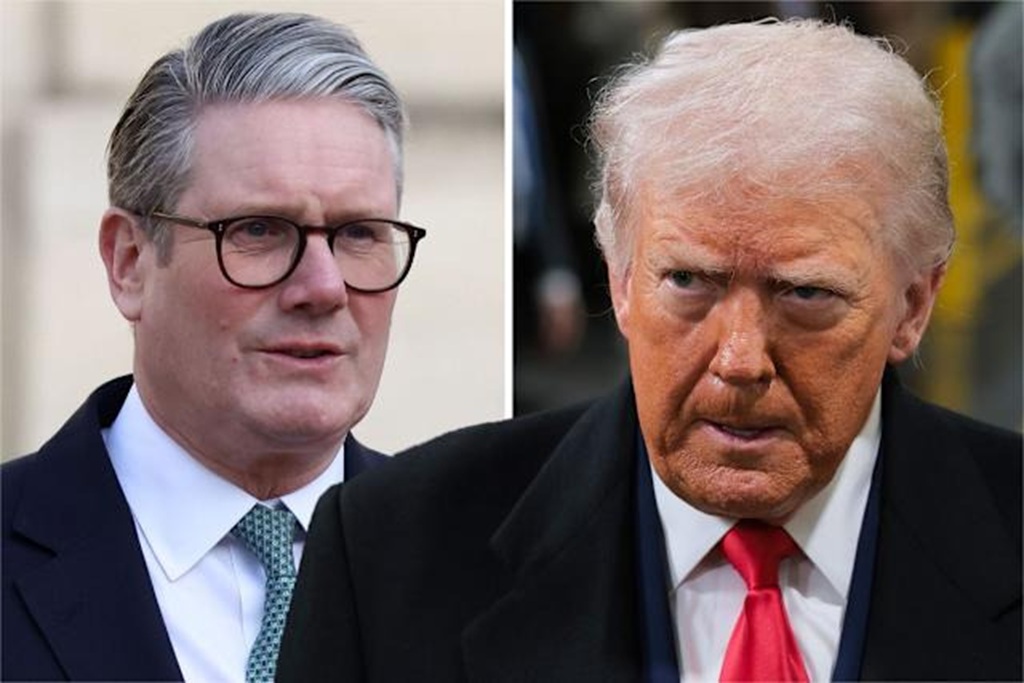
WASHINGTON, D.C. – US President Donald Trump took fresh aim at UK Prime Minister Keir Starmer on Saturday, brushing off reports that Britain may send two Royal Navy aircraft carriers to the Middle East. Trump said any move would come “too late” as the conflict with Iran continues.
Trump delivered the jab on Truth Social, where he framed the UK offer as an attempt to show up after the United States and its allies had already secured the outcome.
Trump’s Harsh Truth Social Message
Trump wrote: “The United Kingdom, our once Great Ally, maybe the Greatest of them all, is finally giving serious thought to sending two aircraft carriers to the Middle East. That’s OK, Prime Minister Starmer, we don’t need them any longer, But we will remember. We don’t need people that join Wars after we’ve already won!”
His post followed reports that the UK Ministry of Defence had put HMS Prince of Wales on higher readiness for a possible deployment. Those preparations could reportedly cut the normal sailing notice time. HMS Queen Elizabeth, Britain’s other Queen Elizabeth-class carrier, also came up in talks about boosting naval presence during the crisis.
At the same time, Trump’s comments highlighted a widening gap between Washington and London since the US-Israel campaign against Iran began on February 28. The operation has targeted Tehran’s nuclear and missile capabilities, while also tying the effort to regime change goals.

What’s Driving the Iran Conflict
Tensions climbed after Iranian actions that included missile strikes on targets in the region, followed by Iranian responses to US-Israeli attacks on key sites in Tehran and other locations. During the campaign, the United States has used British facilities, including RAF Fairford in Gloucestershire and Diego Garcia in the Indian Ocean. London described that access as for “specific and limited defensive purposes.”
However, Britain did not fully back offensive action at the start, and that stance repeatedly drew Trump’s criticism. In recent days, he has mocked Starmer and questioned the strength of the special relationship, while also contrasting him with historic leaders such as Winston Churchill.
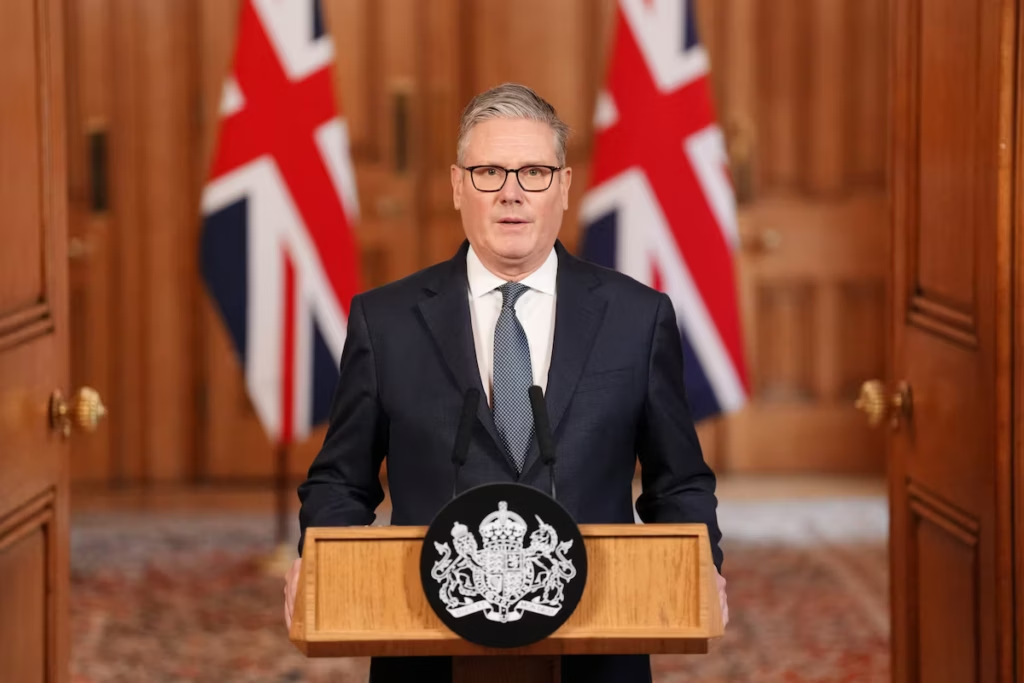
Starmer’s Mixed Signals on the US and Israel
Opponents of Starmer have pointed to what they describe as shifting messages on the Middle East. Early in the crisis, Starmer stressed restraint and called for a “negotiated settlement” aimed at getting Iran to abandon its nuclear ambitions. He also declined to join the first wave of US-Israeli strikes.
Later, Starmer approved access to UK bases, but he framed it as defensive support rather than direct involvement in bombing runs. Throughout, he has leaned on international law, saying any action should meet global standards and avoid widening the conflict.
Critics say that the approach has looked inconsistent:
- Early resistance: Starmer held back immediate use of British bases for strikes, raising concerns about escalation and legality.
- Limited approval later: After pressure, the UK allowed restricted defensive operations from its facilities.
- Carrier readiness reports: New talk of aircraft carrier preparations suggests a step toward deeper involvement, although no final deployment has been confirmed.
Starmer has argued that the pace and limits were intentional. He has said the UK backs Israel’s right to self-defense, but still prefers diplomacy over open-ended military action.

International Law Focus, and Iran’s Record
Starmer has repeatedly urged all sides to follow international law. He has also called on Iran to respect global rules and avoid actions that could expand the conflict.
Still, his critics say the legal messaging sounds one-sided, given Iran’s long record of defying international norms. Iran has faced UN Security Council resolutions and sanctions tied to its nuclear program. It has also faced scrutiny over support for proxy militias, ballistic missile development, and attacks on shipping and regional neighbors. Many countries view those actions as clear violations of international law.
Because of that history, detractors say Starmer’s tougher legal expectations for allies, while Iran has ignored similar rules for years, have fed claims of uneven standards. Trump and his supporters have used that argument to paint Starmer as hesitant, saying the legal focus slowed meaningful help when it mattered most.
What This Means for US-UK Ties
The public clash adds pressure to the US-UK relationship at a tense moment. Trump’s warning that “we will remember” suggests he could weigh the dispute in future decisions on alliances, trade, or security cooperation.
Meanwhile, UK officials have played down the exchange. They have repeated the UK’s commitment to NATO and transatlantic ties, while also stressing an independent foreign policy. As of publication, Starmer’s office had not issued a direct reply to the Truth Social post.
As the Iran conflict continues, with reports of Iranian apologies for some regional attacks and US promises to keep up pressure, the dispute shows how Western allies remain split on timing, scope, and legal framing. Trump’s sharp tone may energize his base at home, while also pushing European partners to line up more closely with US goals in the Middle East.
Trending News:
Trump Outmaneuvers the British Empire in the Strait of Hormuz
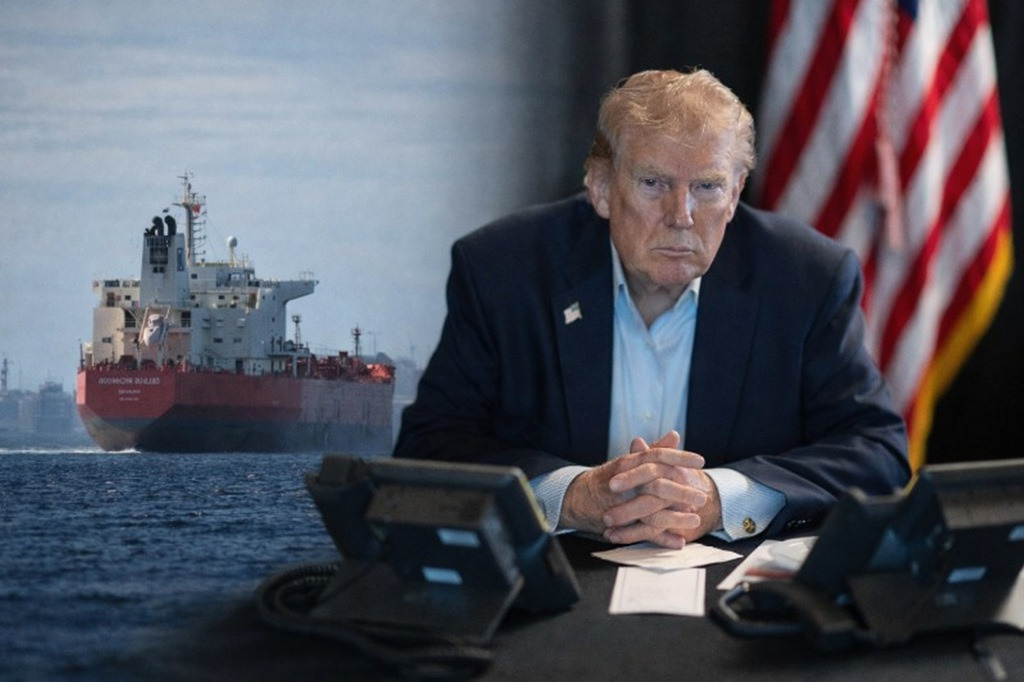
WASHINGTON, D.C. – President Donald Trump has ordered the U.S. government to offer political risk insurance and naval escorts for commercial ships moving through the Strait of Hormuz. The directive follows a pullback by major marine insurers, led by Lloyd’s of London, after threats to Persian Gulf shipping drove war-risk costs higher or pushed coverage off the market.
Supporters say the plan keeps oil and LNG moving and strengthens energy security. Critics say it also challenges a long-standing center of global marine insurance power in London.
The Strait of Hormuz is a narrow 21-mile passage between Iran and Oman. It carries about 20 to 30% of the global seaborne oil trade and a large share of LNG exports from Gulf producers.
After U.S. and Israeli strikes against Iran in late February 2026 (called “Operation Epic Fury” in some reports), threats and attacks around the waterway drove risk levels up fast.
- By early March, traffic through the strait fell by more than 80%. On some days, tankers did not move at all.
- Major Protection and Indemnity (P&I) clubs, including Gard (Norway), Skuld, NorthStandard (UK), the London P&I Club, and the American Club, sent 72-hour cancellation notices for war-risk add-ons that took effect March 5.
- Lloyd’s Joint War Committee widened the “high-risk” area to include the full Persian Gulf. As a result, many underwriters canceled coverage or raised premiums sharply, sometimes two to five times normal levels.
In practice, shipping slowed because money, not missiles, set the limit. Without workable war-risk insurance, shipowners and charterers would not send high-value tankers into danger. That left hundreds of vessels waiting and raised fears of a global energy squeeze.
Lloyd’s holds a major share of marine cargo and war-risk business, and it has long handled complex, high-loss exposures. Its marine roots go back centuries to Britain’s early merchant trade.
Trump’s Response: The U.S. Steps Into Maritime Insurance
On March 3, Trump posted on Truth Social that he had instructed the U.S. International Development Finance Corporation (DFC) to provide “political risk insurance and guarantees” for Gulf maritime trade at a very reasonable price.”
The plan includes:
- Political risk insurance covering losses tied to war, terrorism, or government actions.
- Financial guarantees aimed at backing shipowners, charterers, and private insurers.
- U.S. Navy escorts for tankers when needed, echoing past U.S. protection missions in the region.
- A later announcement of a $20 billion reinsurance facility meant to steady prices and help restore traffic.
Trump framed the goal in simple terms: “No matter what, the United States will ensure the free flow of energy to the world.”
Using the DFC this way stands out because the agency usually supports development-related financing in emerging markets. Still, there is a recent parallel. In 2023, an insurance effort helped support Ukraine grain exports with participation from Lloyd’s and other firms.
What This Could Mean for Lloyd’s of London and the UK
Lloyd’s remains a global hub for specialty insurance and brings billions into the UK economy each year through premiums, jobs, and related services. Around 50,000 people work in insurance and connected roles in the City of London. Marine and energy coverage sit at the center of that system, and war-risk insurance, while niche, can carry real geopolitical weight.
Some analysts think Trump’s move could pull business away from London over time:
- If U.S.-backed coverage stays dependable and priced well, some shippers may favor it after the crisis.
- British headlines have floated the idea that Trump could weaken a roughly £50bn insurance giant.
- Lloyd’s has taken a cooperative tone with the DFC and says it still leads on war-risk expertise. It also argues coverage is still available, even at higher rates, and that some traffic has started to return.
Even so, the message is hard to miss. A private insurance market in London has long been able to slow trade with pricing and capacity. Now, a state backstop is trying to remove that pressure point.
Bigger Ripple Effects for Energy, Alliances, and Markets
This standoff shows how finance, military power, and energy supply connect in real time.
- Energy security and prices: By pushing shipments to resume, the U.S. reduces the risk of price spikes at home and helps allies that depend on Gulf oil and LNG.
- Tension with close partners: In London, some see the policy as a direct hit to a key national industry.
- Oil market reaction: Prices jumped at first, then eased after Trump’s announcement. Still, war-risk costs remain high, and sentiment is shaky.
- Limits of insurance alone: Shipping leaders warn that guarantees only help up to a point. If attacks continue, fear can outrun price. At the same time, more naval activity can raise the sense that the route is a live conflict zone.
The administration’s approach blends money, security promises, and military readiness. In effect, the U.S. is presenting itself as the backstop for key sea lanes.
What Comes Next for Hormuz Shipping and War-Risk Coverage
Results will hinge on execution. That includes the fine print of DFC coverage, how it coordinates with private insurers, and whether Navy escorts become routine. Lloyd’s has signaled it can work with the U.S. effort, so a shared model may emerge instead of a clean replacement.
Still, the larger shift is clear. Where private underwriters once had near veto power over a critical chokepoint, direct government support is moving in to keep tankers sailing.
For now, the U.S. has acted to prevent a supply shock, and it has turned an insurance freeze into a test of who guarantees global energy flows.
Related News:
Trump Says He’s Very Disappointed in Starmer Over Iran
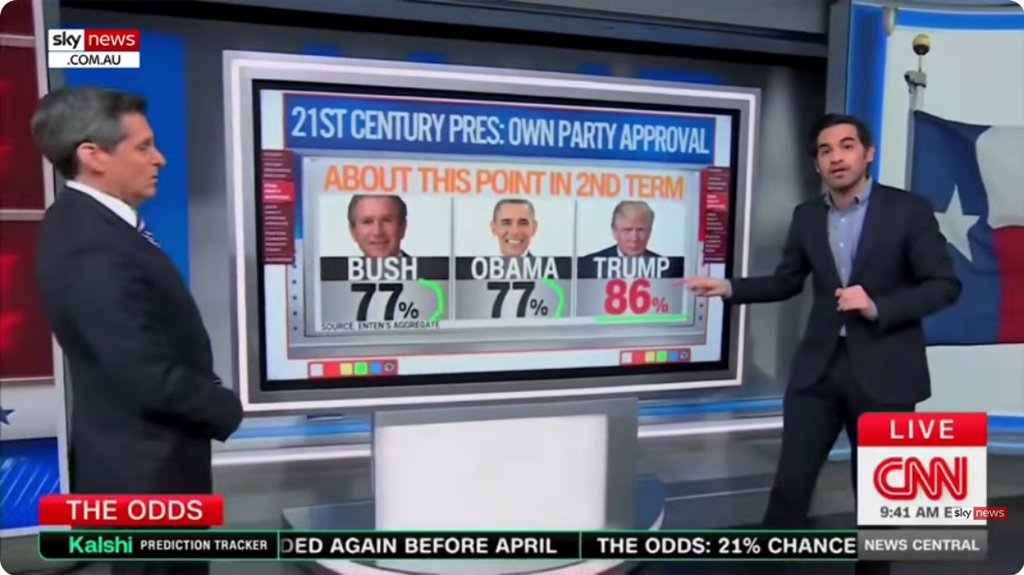
ATLANTA – CNNsenior writer and chief data analyst Harry Enten walked through polling that shows President Donald Trump holding unusually strong support inside the Republican Party. Using CNN survey averages and side-by-side comparisons, Enten said Trump’s current approval among Republicans sits well above where Barack Obama and George W. Bush stood with their own parties at a similar stage of their presidencies.
The discussion came up while the panel talked about Trump’s influence in GOP primaries and the impact of his endorsements. According to Enten, the numbers suggest Trump’s pull with Republican voters remains firm. As he put it, Trump’s “magic touch has not seemed to wear off yet when it comes to the Republican base.”
Main Takeaways From Enten’s Breakdown
- Very high Republican approval: CNN polling averages show Trump at 86% approval among Republicans at this point in his second term.
- Higher than recent presidents at the same stage: At a comparable moment, George W. Bush was at 77% with Republicans, and Barack Obama was at 77% with Democrats.
- More intense support, too: 53% of Republicans strongly approve of Trump’s performance. By comparison, Obama measured 48% and Bush 47% on strong approval at the same point.
- Endorsement power tied to base loyalty: Enten compared Trump’s primary influence to famous athletes like Tom Brady and Babe Ruth. He also said Trump-backed candidates have posted 95% to 99% win rates in recent cycles, helped by tight party loyalty.
- Standout own-party support in the modern era: Enten summed it up plainly, saying Republicans support Trump more than any 21st-century president’s party supporters at this point.
Even as Trump’s overall national approval moves up and down, the Republican core stays steady. That gap between base support and broader approval is a major part of the story.
Own-Party Approval, Side-by-Side
Here’s the same comparison Enten shared, focused on approval within each president’s own party at roughly the same point in their second terms:
| President | Party Approval Rating (%) | Strong Approval (%) | Time Period Context |
|---|---|---|---|
| Donald Trump | 86 | 53 | Current (second term, early 2026) |
| Barack Obama | 77 | 48 | Similar point in the second term |
| George W. Bush | 77 | 47 | Similar point in the second term |
Source: CNN polling averages and historical figures as cited by Harry Enten. Timelines reflect approximate equivalents across presidencies.
Enten stressed that this level of party unity stands out. In many presidencies, overall approval sits in the 40% to 50% range because the country splits along party lines. In contrast, Trump’s near-unified backing from Republican voters gives him a strong base even when national debates heat up.
Why These Numbers Matter for Trump’s Influence
High own-party approval usually turns into real power inside a party, and Enten argued that’s exactly what’s happening here. Because Republicans approve of Trump at such a high rate, his endorsement often carries major weight in primary elections. Since 2020, Trump-supported candidates have won GOP primaries at a pace that goes far beyond what most endorsements can deliver.
As a result, challenges to Trump-aligned candidates often struggle to gain traction. Even when Trump’s broader public numbers soften, Republican enthusiasm hasn’t dropped in the same way.
Enten’s tone stayed data-focused, but he made clear the size of the gap surprised him. “Look at this: 86% of Republicans approve,” he said, while pointing back to the 77% figures for Obama and Bush.
A Quick Look at Party Loyalty Over Time
Presidents often begin terms with strong support from their party, then see it slip when controversies build or conditions change. In that context:
- Bush held about 77% party approval at a similar second-term point, before later drops tied to the Iraq War and economic concerns.
- Obama also measured 77% among Democrats at the same stage, showing solid support but less intensity than Trump’s current numbers.
Trump’s 86% approval, paired with higher strong approval, signals a more locked-in base. That kind of support can cushion a president from pressures that hit other administrations harder.
What to Watch Next
With the 2026 midterms on the horizon, the data suggests Trump still holds major influence within the Republican Party. It’s still unclear how long that strength will last or how it will shape policy fights and candidate choices, but the polling shows little sign of fatigue among GOP voters.
Enten’s segment also highlights something many headline polls miss. National approval matters, but internal party support can say even more about a president’s staying power. After the clip aired, the comments spread quickly on social media and conservative outlets, mainly because the contrast between Trump’s GOP numbers and his broader national approval remains so sharp.
Related News:
Karoline Leavitt Slams CNN’s Kaitlan Collins Over Killed U.S. Soldiers


Trump Slams UK’s Starmer Over ‘Too Late’ Aircraft Carrier Offer

US-Israel Defensive Against Iran Exposes the Weak Leadership of Canada, France and the UK

Trump Outmaneuvers the “British Empire” in the Strait of Hormuz

Carney and Starmer’s Iran U-Turn Betrays Their Closest Ally

CNN Reveals Trump’s GOP Approval Tops Obama and Bush at the Same Point

Amazon Shopping Site Hit By Hours-Long Outage Tied to Bad Code

Britney Spears Taken Into Custody on Suspicion of DUI

Sen. Markwayne Mullin Tapped to Replace Kristi Noem as DHS Secretary

Canada’s Carney Betrays the US Condemns Defensive Strikes on Iran

Karoline Leavitt Slams CNN’s Kaitlan Collins Over Killed U.S. Soldiers

Thai Billionaire Charged With Lese Majeste Over Facebook Post

Russia Bans Facebook, Meta Says It’ll Do “Everything” To Restore Service

Facebook Login Feature – Clash of Clans

4 Things you can do to take your Facebook Lead Generation to the Next Level

Zuckerberg to Allow Violent Speech on Russia After Facebook Blocked

Facebook Loses $200 Billion as Users Shift to TikTok

Downloading Facebook Videos Anonymously with High Quality Video through Snapsave app

The Best Site to Buy Real Facebook Likes and Followers in 2022

Chinese Man Arrested for Using Facebook to Dupe Cryptocurrency Investor

Google and Facebook Under Huge Pressure Over User Privacy

Mosque Set Ablaze in Iran a Citizens Revolt Against the Islamic Regime

AOC Accuses Jessie Watters of Fox News of Sexualizing and Harassing Her

JD Vance Exposes Walz’s Fraud and CNN’s Lies in White House Presser

Milestone Card Credit: How the Milestone MasterCard Can Transform Credit
-

 Crime2 months ago
YouTuber Nick Shirley Exposes BILLIONS of Somali Fraud, Video Goes VIRAL
-

 China1 month ago
China-Based Billionaire Singham Allegedly Funding America’s Radical Left
-
 Politics2 months ago
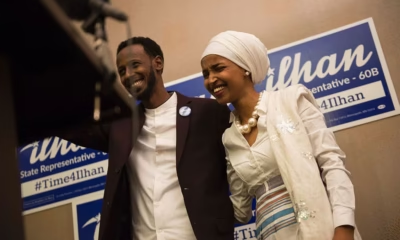
Ilhan Omar Faces Renewed Firestorm Over Resurfaced Video
-

 Crime3 months ago
Somali’s Accused of Bilking Millions From Maine’s Medicaid Program
-

 Business2 months ago
Tech Giant Oracle Abandons California After 43 Years
-

 Politics1 month ago
CNN Delivers Stark Reality Check to Democrats Over Voter ID
-

 Crime3 months ago
Minnesota Fraud Scandal EXPANDS, $10 Billion in Fraudulent Payments
-

 Midterm Elections2 months ago
2026 Midterms Guide: Candidates, Key Issues, and Battleground States