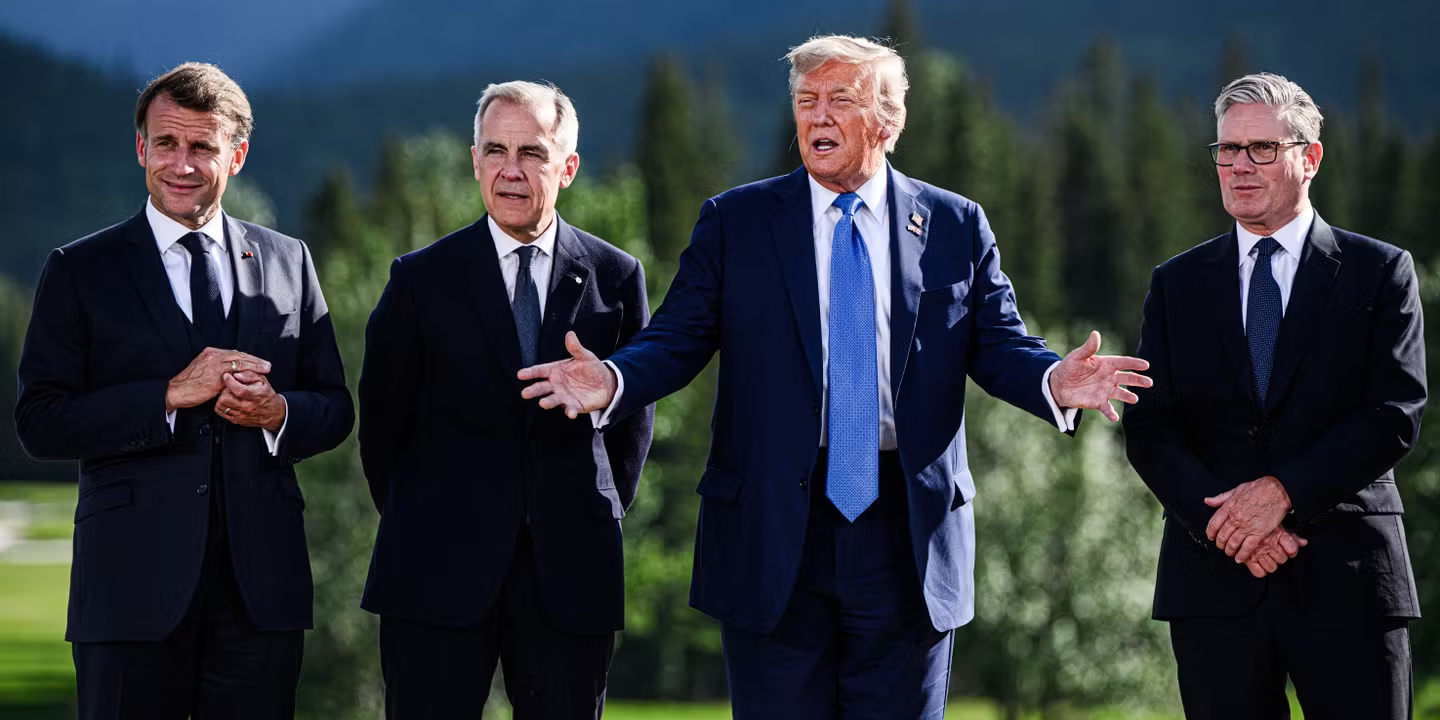


WASHINGTON, D, C. – President Donald Trump took aim at US allies on Tuesday after they refused to join US defensive moves tied to Iran. He said the United States no longer needs their backing after years of carrying most of the alliance’s defense costs.
Speaking from the Oval Office, Trump said the US covers about 62 to 70 percent of NATO’s total defense spending, roughly $980 billion in 2025 alone. He called the allies’ refusal a “very foolish mistake” and framed it as a loyalty test that showed who stands with America in a crisis.
His remarks quickly stirred alarm in Washington and across Europe. Lawmakers and foreign policy analysts now say Trump could move closer to pulling the US out of NATO. At the same time, the White House is pushing ahead with a new group, the “Board of Peace,” which many see as a step away from the 77-year-old alliance and other long-standing global institutions.
Trump Criticizes Allies: “They Don’t Want to Get Involved”
Trump made the comments during a media appearance centered on US operations in the Middle East. He said most NATO members told American officials they would not take part in strikes or naval efforts tied to securing the Strait of Hormuz.
“I think NATO is making a very foolish mistake,” Trump said. “Everyone agrees with us on Iran, but they don’t want to help. We no longer ‘need,’ or desire, the NATO countries’ assistance.”
He then added, “I’ve long said I wonder whether or not NATO would ever be there for us. So this was a great test.”
The moment comes with tensions already running high. US forces are leading defensive strikes on Iranian targets under Operation Epic Fury. NATO allies offered diplomatic support, yet they stopped short of military action because of domestic pressure and fears of a wider conflict.
The US Share of NATO Spending: A Long-Running Complaint
Trump again pointed to what he sees as an unfair financial split inside NATO. Recent alliance figures support the broad point he has made for years.
Here are the numbers he highlighted:
- The United States spent an estimated $980 billion on defense in 2025.
- That accounts for about 62 percent of NATO’s total combined spending, around $1.59 trillion.
- Some estimates place the US share closer to 70 percent when nuclear deterrence and global logistics are included.
- The rest of NATO spent far less, with the United Kingdom next at $90.5 billion.
- All 32 members reached the 2 percent of GDP target in 2025, but the US is still far outspending every other ally at 3.2 percent of GDP.
Trump has long said this gap makes NATO a poor deal for American taxpayers. On Tuesday, he tied that argument directly to the Iran standoff, saying the burden is even harder to justify when allies refuse to act.
Refusal to Help Fuels Fears of a US Break From NATO
European leaders moved fast to contain the fallout. Germany, France, and the United Kingdom released statements supporting US leadership, but none promised troops or ships. One senior NATO diplomat, speaking privately, told reporters, “No one wants to get dragged into another Middle East war.”
That response only added to the sense that relations may be nearing a breaking point. Trump has threatened to leave NATO before, and now some officials believe he may try to act. Congress passed a law in 2023 requiring its approval for any formal withdrawal. Still, legal experts say a president determined to test that limit could create a major crisis by cutting troop levels in Europe or refusing to honor Article 5.
Some former Trump officials say the Iran dispute struck a personal nerve. One insider put it this way: “This was the moment allies were supposed to step up. Instead, they left America holding the bag again.”
What a US Exit From NATO Could Mean
A full US withdrawal is no longer treated as just a theory. For years, think tanks and military planners have studied what could happen if America walked away.
Here is what many of those assessments suggest:
- Europe would face an immediate security gap: Without US forces, bases, and nuclear protection, Russia could test NATO’s eastern edge. Countries like Poland and the Baltic states already fear hybrid attacks or worse.
- Nuclear deterrence would weaken: Britain and France have nuclear weapons, but many experts say they cannot fully replace the American shield. Some scenarios show renewed debate over nuclear arms across Europe.
- The US would lose access and reach: America depends on European ports, airfields, and intelligence links. Without them, projecting force into the Middle East and Africa would get harder and more costly.
- Russia and China could benefit: Moscow might push harder in Ukraine or elsewhere. Beijing could use the split to press its own interests in Asia. Some war games predict a Russian move against NATO territory within three years.
- Europe would spend more, but not fast enough: Non-US NATO members have raised spending to about 2.3 percent of GDP. Even if they climbed to 3 or 4 percent, they would still lack many US capabilities, including airlift, satellites, and heavy armor.
- Washington would face legal and political turmoil: Courts would likely weigh in on presidential power, while Congress could try to block funding or force a showdown.
- One-on-one security deals could replace the alliance model: Trump could favor direct pacts with countries like Poland or the UK while pushing others aside. That would fit the more transactional style he has often preferred.
- Economic effects could spread quickly: Supply chains could take a hit, oil prices could jump if threats around the Strait of Hormuz grow, and a more divided Europe could trigger new sanctions fights.
In short, NATO might still exist without the United States, but it would look much weaker. Europe would face more risk, while the US might save money in the short term but lose influence over time.
Trump’s “Board of Peace” Signals a Different Path
While criticizing NATO, Trump is also building what he presents as an alternative. His new Board of Peace held its first major meeting in February 2026. Under its charter, Trump serves as chairman for life.
The group is described as a lean, deal-focused body built around practical outcomes, starting with Gaza reconstruction. It has already secured $5 billion in pledges. Unlike NATO or the United Nations, membership requires major financial commitments and follows America’s priorities.
Supporters point to several key differences:
- Trump has permanent control.
- The group centers on peace through strength and economic pressure, not long committees.
- It includes select partners, even some outside the usual Western circle, while leaving out reluctant European allies.
- It addresses global flashpoints like Gaza without using NATO-style collective defense rules such as Article 5.
People close to the administration describe the Board of Peace as Trump’s long-term answer to what they see as outdated global structures. One adviser summed it up this way: “NATO was useful in the Cold War. The Board of Peace is built for today’s world.”
Part of Trump’s Broader Fight Against Global Institutions
The clash over Iran fits into Trump’s larger battle with what he calls the “globalist elite.” For years, he has argued that organizations like NATO, the UN, and the World Economic Forum put outside interests ahead of US priorities.
His message has stayed the same: Allies should pay more, or America should step back. In his view, the Iran dispute proves the point. He says Europe’s hesitation was not just about one conflict. He sees it as more proof that allies still resist sharing real risk and real cost.
Critics say that the approach could leave America isolated. Supporters argue it finally puts “America First” into practice.
Democrats, along with some Republicans, warn that abandoning NATO would hand a strategic win to Russia and China. Trump argues the current system already weakens the US by asking it to do too much for too many.
What Happens Next
The White House has not announced any formal move to leave NATO. Even so, Trump’s team is reviewing US troop levels in Europe. At the same time, staff tied to the Board of Peace are expanding contacts in Asia and the Middle East.
European leaders are set to hold emergency NATO meetings next week. Several governments have also started quiet bilateral talks with Washington to protect their own interests if tensions grow.
For now, one point stands out. Trump’s patience with allies he sees as free-riders appears to be gone. The Iran dispute showed exactly where each side stands. Whether that leads to a full US break from NATO, or a reshaped security order built around the Board of Peace, may become the biggest foreign policy story of 2026.
American voters are paying close attention. After years of hearing complaints about unfair deals, many now say they want change. The next few weeks may show whether Trump’s sharp words turn into a historic shift.