Connect with us

Politics

Minnesota Terror Claims and Voter Fraud Shake Walz’s 2026 Re-election Hopes

VORNews

Published

on

Minnesota Terror Claims and Voter Fraud Shake Walz’s 2026 Re-election Hopes
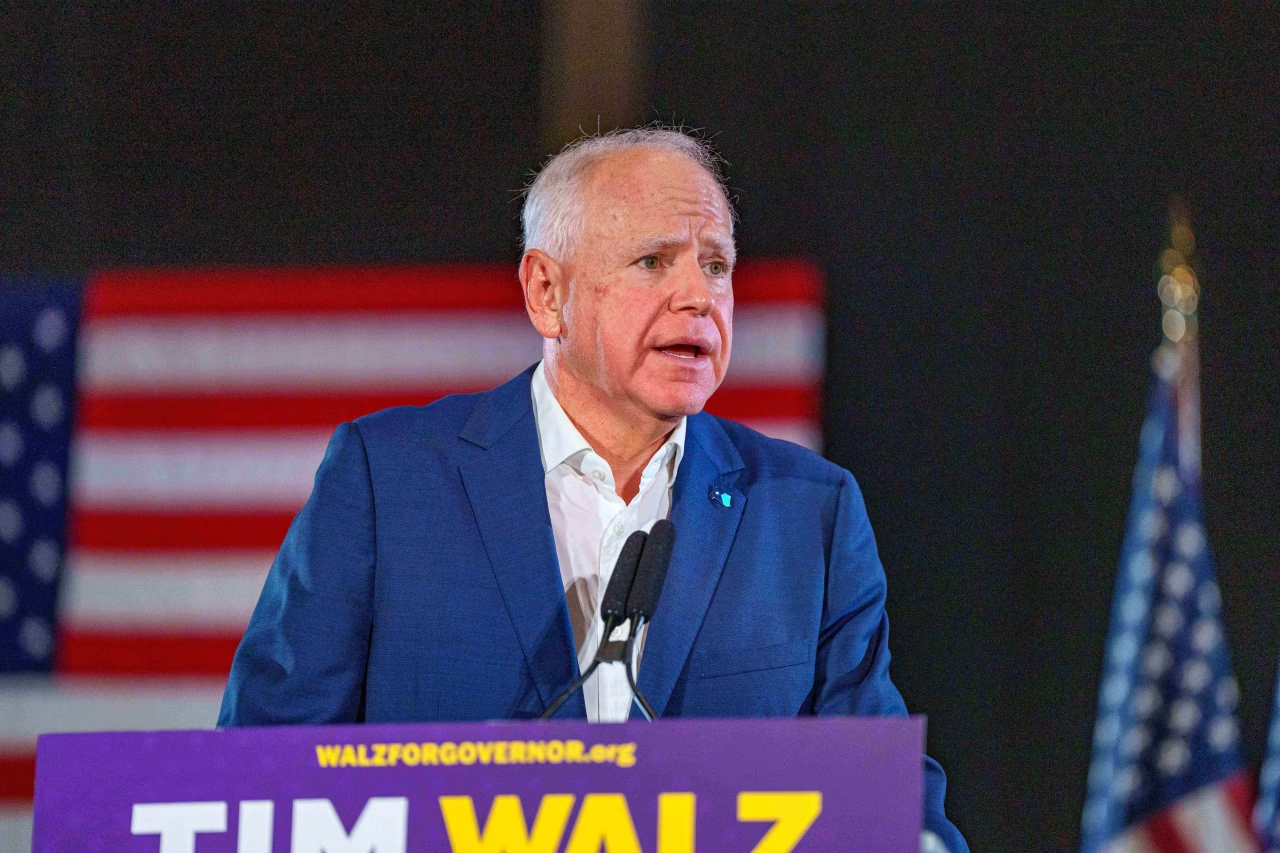
MINNEAPOLIS – Governor Tim Walz’s 2026 re-election bid for an unprecedented third term is under intense pressure, as two major controversies collide: claims of terrorist financing tied to state welfare funds and a mounting voter fraud dispute. Together, they are raising sharp questions about his leadership and Minnesota’s election security.

The most immediate and politically risky threat comes from a new U.S. Treasury Department investigation. Treasury Secretary Scott Bessent announced that federal officials will review allegations that Minnesota tax dollars from state welfare programs may have been diverted to the terrorist group Al-Shabaab in Somalia.

This federal probe follows the high-profile Feeding Our Future scandal, a massive fraud case involving millions of dollars in federal nutrition aid meant for children during the COVID-19 pandemic. Dozens of defendants, many of Somali descent, have been charged or convicted on counts like fraud and money laundering tied to the scheme. So far, prosecutors have not charged anyone with providing material support to a terrorist group.

Even so, conservative reports referenced by Secretary Bessent and Republican lawmakers claim that millions in stolen aid were sent overseas, with some funds allegedly ending up with Al-Shabaab. Bessent has directly blamed what he calls the “feckless mismanagement” of the Walz administration for allowing the fraud to grow.

Governor Walz, a Democrat, has questioned both the timing and intent of the investigation, which comes from the Trump administration, yet he has said he welcomes outside review. He has insisted he has nothing to hide and said federal help is welcome if it strengthens oversight. At the same time, he has warned that the probe appears tied to a wider push to “demonize an entire community” of immigrants.

The political stakes are high. Minnesota is home to the largest Somali-American community in the United States, a well-organized and politically engaged group that leans toward the Democratic-Farmer-Labor (DFL) party. Walz now has to defend his administration’s handling of public funds while also responding to accusations of negligence and racist targeting that could depress support among one of his most loyal bases.

Al-Shabaab

Voter Fraud Allegations Target Omar’s District

On top of the welfare fraud and terrorism controversy, a separate issue involving voter fraud has erupted, with new attention on Minnesota’s Somali community and on the district represented by U.S. Representative Ilhan Omar.

Recent court-related developments and social media posts have drawn attention to reports of hundreds of fraudulent voter registration applications submitted in several Minnesota counties. These reports have stirred fresh debate over election integrity at a time when the state is already under scrutiny.

Officials and media accounts have pointed to roughly 600 fraudulent voter registration applications. Many of the questionable forms appear tied to Rep. Omar’s 5th Congressional District, which includes large parts of Minneapolis and has the state’s highest concentration of Somali-American residents.

  • The Allegations: While court documents on the 600 disputed applications are still taking shape, the claims echo earlier, unproven accusations of organized “ballot harvesting” and vote-buying inside the community. Those earlier accusations gained national attention after a 2020 video and report released by Project Veritas, a conservative activist group.
  • The Context: The focus on Omar’s district, along with her high profile as a frequent target of conservative media and politicians, all but guarantees that these accusations will stay at the center of campaign attacks. Republican critics say the reported flood of suspect registrations shows deep flaws in how Minnesota handles voter registration and verification.

Supporters of Omar and the DFL strongly reject that narrative. They argue that the fraud claims are exaggerated, politically driven, and intended to discredit and suppress high-turnout immigrant voters. Still, when combined with the Feeding Our Future scandal and the new Treasury probe, the voter fraud storyline adds to the sense that Walz’s administration is under siege.

Tim Walz’s Balancing Act: The 2026 Election Picture

Governor Walz now faces the hardest political test of his career. Since Minnesota adopted four-year terms in 1962, no governor has ever won a third full term. Walz was already trying to break that streak. Now he must do it while battling twin political crises that carry both legal and moral weight.

The combination of the two controversies, financial fraud that might have sent taxpayer money to a terrorist group, and voter integrity disputes tied to a key Democratic stronghold, feeds a damaging narrative of “feckless mismanagement”. Republicans are already using that phrase to define the Walz years and to rally voters who are angry about crime, immigration, and election rules.

  • Impact on the Base: Walz has to walk a narrow path. He must condemn fraud clearly and cooperate with investigators, yet he cannot appear to endorse the Trump administration’s view that a whole immigrant group is corrupt. If Somali-American voters feel unfairly blamed or abandoned, turnout in the 5th District and similar communities could tumble in 2026.
  • The Integrity Message: For Republicans, the 600 suspect voter registrations are a handy state-level example to point to when arguing that Democrats are weak on election security. They are likely to fold Minnesota’s case into their larger national message that elections are at risk under Democratic leadership.

For Walz to stay competitive, he needs to show that his administration moved quickly and responsibly once fraud came to light. He also needs to convince swing voters that the federal probes are shaped by politics and not just public interest, and that Minnesota’s institutions still work.

If the Treasury investigation uncovers clear evidence that Minnesota welfare money ended up in the hands of Al-Shabaab, the damage could be devastating. Likewise, if future court action confirms that the voter registration fraud is larger or more organized than current reports suggest, Walz’s path to a third term could evaporate.

Right now, the spotlight is firmly on him, and every new headline adds weight.

As 2026 gets closer, Minnesota’s image as a progressive success story faces a hard test. Walz, once praised for building broad coalitions, is now trying to stay upright on a political tightrope stretched over accusations of fraud and corruption. Can he revive his “One Minnesota” message, or will these controversies, from alleged hawala transfers abroad to suspect voter rolls at home, define how voters remember him?

The stakes could not be higher. Walz has two choices in front of him: restore public trust and reassure skeptical voters, or risk becoming a cautionary example for the DFL in its own backyard.

Related News:

Shadows Over the Ballot Box: Election Integrity Fears Rise Ahead of 2026 Midterms

Politics

Trump Declares ‘Globalization Is Over!’ – The Globalist Dream Dies at Davos

VORNews

Published

on

By

Trump Declares 'Globalization Is Over

DAVOS – In a scene that rattled the calm, polished mood of the World Economic Forum, President Donald J. Trump delivered a clear break with the post-Cold War global order. Speaking in Davos in January 2026, he returned to the mountain gathering with a blunt claim: the globalist project didn’t work for the people it promised to serve.

For years, many political and media voices treated borders as outdated, national identity as a problem to solve, and mass migration as proof of progress. Offshoring was sold as harmless, energy reliance was brushed aside, and social unity often came last behind economic theory. Trump’s message pushed back hard, saying the West is done chasing that promise.

The setting made the contrast sharper. Davos, with its luxury chalets and private jets, usually runs on polite talk about shared goals and global cooperation. Trump arrived with an unfiltered America First pitch.

Tariffs are back. Borders are back. Energy independence is back. And the idea that ordinary workers should pay the price for global integration is under open challenge.

The Globalist Promise, and the Backlash

For decades, leaders across much of the West sold globalization as a rising tide. Trade deals spread, supply chains stretched across continents, and borders were treated more like obstacles than protections.

Public officials and policy experts said moving factories to lower-cost countries would lower prices, while immigration would drive innovation and strengthen aging economies. Energy supply was expected to sort itself out through markets. Social strain from fast demographic change was often dismissed as temporary.

Many communities experienced something else. In parts of the American Rust Belt, in Britain’s post-industrial towns, and across Europe, people watched plants shut down and wages stall. Some areas faced growing tension tied to migration levels that outpaced local capacity to absorb change. The biggest wins often landed in large coastal cities, tech corridors, and finance centers. Smaller towns and working-class regions carried more of the disruption.

That gap between promise and daily life helped fuel public anger. Rising populism didn’t appear out of nowhere. It followed years of frustration over lost jobs, weakened local institutions, and a sense that leaders listened more to global conferences than to their own voters.

Trump used his Davos appearance to name that divide in plain terms. GB News reported that he “terrified” the room by saying globalisation is over. His core point was that the globalist experiment failed on multiple fronts.

He tied it to economic damage from hollowed-out industry, social stress from weakened community ties, and cultural strain from eroded national identity. In its place, he argued for basics that governments once treated as normal: protect key jobs, control borders, and stop depending on foreign energy suppliers.

Trump Tariffs, Border Control, and Energy Security

A major part of Trump’s message focused on tariffs as a tool of national policy. For years, free-trade advocates treated tariffs as outdated and harmful. Trump framed them as a way to protect domestic industry, especially when competing nations subsidize production or tilt the field through currency practices.

His approach signals less interest in the old WTO-style mindset and more interest in deals where the United States pushes its own terms.

Border enforcement also took center stage. For a long time, mass migration was described as both inevitable and good. Those who raised concerns about integration, wage pressure, or cultural cohesion were often labeled intolerant and shut down.

Trump’s position puts sovereignty back at the front, saying nations have the right and the duty to decide who enters, how many, and under what rules. He presents it as self-defense, not isolation.

Energy independence formed the third pillar. Trump argued that heavy reliance on foreign oil and gas leaves economies exposed, especially when hostile governments can squeeze supplies or influence prices.

His push for domestic production includes support for drilling, pipelines, and other sources that reduce dependence. The message was simple: energy security comes first, and policy should protect households and businesses from price shocks and foreign pressure.

How Davos Reacted, and What It Could Mean

The crowd in Davos is used to smoother language about “stakeholder capitalism” and broad cooperation. Trump’s tone landed differently. Some European leaders warned about the risks of trade conflict. Others appeared more cautious, as if they recognized the shift but didn’t want to say so publicly.

GB News commentator Matthew Goodwin highlighted the moment by saying Trump “said the quiet part out loud,” pointing to economic, social, and cultural failures tied to the globalist model. That framing captures why the speech drew attention beyond the room.

In the United States, the address reinforced Trump’s support among voters who feel left behind by past trade and immigration policy. It also raised alarms for corporate leaders tied to global supply chains and for political figures who still favor the older consensus.

Abroad, it added pressure on allies who were used to Washington defending the liberal international order as a top priority.

Trump’s Davos message signals a turning point, whether supporters cheer it or critics fear it. It puts more focus on re-shoring industry, tightening immigration rules, and treating energy security as a national interest rather than an afterthought.

The broader direction is still forming, but the speech made one thing clear: the elite agreement that carried globalization for decades is no longer holding.

For many people in struggling regions and overlooked towns, that shift feels overdue. It suggests that leaders may start measuring success less by abstract models and more by real wages, stable communities, and national resilience.

Whether the change brings renewed prosperity or new friction will play out over time. Still, Davos 2026 is likely to be remembered as a moment when the West’s guiding economic story faced a direct challenge.

Continue Reading

Politics

Democrats Join Republicans to Advance Contempt Resolution Against Bill Clinton

Nine Democrats Buck Leadership on Epstein-Related Measure, Showing Growing Tensions Over Openness and Accountability

VORNews

Published

on

By

Contempt Resolution Against Bill Clinton, Democrats

WASHINGTON.D.C. – House Oversight and Government Reform Committee Democrats split sharply on Wednesday as nearly half of them joined Republicans to advance a resolution recommending former President Bill Clinton be held in contempt of Congress.

The committee vote passed 34-8, with two members voting “present.” The move follows Clinton’s refusal to sit for a closed-door deposition after the committee issued a subpoena tied to its continuing review of Jeffrey Epstein’s network and how federal authorities handled related matters.

In a separate vote, the committee also advanced a contempt resolution involving former Secretary of State Hillary Clinton. That measure moved forward 28-15, with three Democrats crossing the aisle. Still, the broader Democratic support for the Bill Clinton resolution pointed to rising frustration, even inside the party, over what critics call resistance to cooperation in a case that has held public attention for years.

Chairman James Comer (R-Ky.) called the vote a win for accountability. “Republicans and Democrats on the House Oversight Committee acted today to hold former President Bill Clinton in contempt of Congress for willfully defying lawful and bipartisan subpoenas,” Comer said in a statement.

“By voting to hold the Clintons in contempt, the Committee sent a clear message: no one is above the law, and justice must be applied equally, regardless of position, pedigree, or prestige.”

Bill Clinton  Linked to Epstein

Republicans issued the subpoenas late last year as part of a wider inquiry into Epstein’s sex trafficking operation, his ties to influential people, and claimed breakdowns in federal oversight. Bill Clinton has been linked to Epstein for years because flight logs show Clinton traveled on Epstein’s private jet multiple times in the early 2000s. Clinton has repeatedly said he had no knowledge of, or involvement in, Epstein’s crimes.

Lawyers for the Clintons offered limited cooperation, including written answers or a private meeting in New York with only the chair and ranking member present. Comer dismissed those offers as unacceptable, saying they would amount to special treatment. “They believe their last name entitles them to special treatment,” Comer said before the vote.

House Minority Leader Hakeem Jeffries (D-N.Y.) worked to line up votes against the resolutions, but nine Democrats still supported the Bill Clinton measure: Reps. Maxwell Frost (Fla.), Raja Krishnamoorthi (Ill.), Summer Lee (Pa.), Stephen Lynch (Mass.), Ayanna Pressley (Mass.), Emily Randall (Wash.), Lateefah Simon (Calif.), Melanie Stansbury (N.M.), and Rashida Tlaib (Mich.). Several of those votes came from the progressive wing, including Pressley, Lee, and Tlaib, signaling that some members prioritized openness in the Epstein matter over party unity.

On the Hillary Clinton resolution, only three Democrats sided with Republicans: Stansbury, Lee, and Tlaib. That smaller break showed stronger support among Democrats for her position.

Ranking Member Robert Garcia (D-Calif.) and other Democrats who opposed the measures argued the investigation has turned political. They pointed to unredacted Epstein files and said the contempt push looked like payback.

Strain Inside the Democratic Party

Some Democrats also suggested holding Attorney General Pam Bondi in contempt over claims that documents were being withheld. During a tense markup session broadcast live on C-SPAN, members traded sharp remarks, with one Democrat calling the effort “political score-settling.”

Democrats who broke ranks said the Epstein case demands fuller disclosure and real accountability. “Transparency matters more than protecting past leaders,” said a source close to the progressive wing, speaking anonymously.

Next, both resolutions move to the full House for a floor vote expected in the coming weeks. If the House approves them, the matter would be referred to the Department of Justice for possible criminal prosecution.

That process can carry penalties of up to $100,000 in fines or up to one year in jail. With Republicans controlling the House and a Trump administration DOJ, passage appears likely, though any effort to enforce contempt against a former president would be uncharted territory.

Political observers say the vote highlights real strain inside the Democratic Party. Younger and more progressive lawmakers appear more willing to step away from the Clinton era, as public pressure for answers in the Epstein case continues. Bill Clinton, now 79, has kept a lower profile in recent years and has focused on work tied to the Clinton Foundation.

Full House to Vote

Hillary Clinton’s team called the proceedings “a partisan witch hunt” in a short statement. Representatives for Bill Clinton repeated his earlier denials of wrongdoing connected to Epstein.

As the resolutions advance, the episode shows how older controversies can return with new momentum. The Epstein investigation, stirred again by recent document releases, has pulled in other major names and also fueled conspiracy theories across the political spectrum.

If the full House votes to hold Bill Clinton in contempt, it would be the first referral of its kind against a former president in the modern era. Legal experts say contempt referrals are unusual and often symbolic, but a DOJ that wants to pursue the case could raise the stakes.

For Democrats, the split adds pressure heading into the midterms and raises fresh questions about party discipline under Jeffries. Republicans, meanwhile, cast the vote as proof they support equal justice and holding powerful figures accountable.

The House floor debate is likely to be heated, and it could force more Democrats to choose between standing with party figures and backing demands for answers in one of the country’s most persistent controversies.

Related News:

Epstein Files Get Broken Down By Alex Jones and Nick Fuentes

Continue Reading

Politics

Chatham House in Panic Over Trump and Western Alliance

VORNews

Published

on

By

Chatham House in Panic

LONDON –  In her annual lecture at Chatham House last week, Director Bronwen Maddox delivered a blunt message about the world under President Donald Trump’s second term. She said the United States is driving what she called “a revolution” in policy, and she didn’t soften the conclusion. “It is not grandiose to call this the end of the Western alliance.”

Her comments spread fast across diplomatic circles and transatlantic news outlets. They land as the Trump administration rolls out moves that, to many observers, break with decades of US-led cooperation. New tariffs aimed at European partners, sharper pressure on the Federal Reserve, and high-profile factory-focused visits at home all point to a different kind of America on the world stage. Critics like Maddox see a widening split with allies. Supporters see a course correction after years of drift.

Maddox’s talk, promoted under the theme “Trump: the end of the Western alliance?”, described a world shaped by major power rivalry, with the US and China at the center. In her view, old alliances hold less weight in this setup. She also defined the Western alliance as more than a defense pact. To her, it is a group tied by shared beliefs: personal liberty, freedom of thought and religion, constitutional democracy, and free trade.

In lines shared widely from the lecture, Maddox said the break is already happening. She described the alliance as a group of countries that once felt they shared principles, not just interests, and that those principles helped fuel prosperity and global influence.

She pointed to rising tariffs against allies and what she described as open contempt for Europe appearing in official US security language. She also raised fears about bigger escalations. Maddox said that if the US took aggressive action toward territory such as Greenland, it would breach the UN Charter and could end NATO as it exists today.

Her delivery stood out for how direct it was. After the lecture, Maddox said many Europeans had hoped the shift would fade. She argued that recent actions make that hope harder to defend.

Trump’s Detroit Stop Puts Manufacturing Front and Center

A few days before Maddox spoke, Trump visited Detroit, Michigan, on January 13, 2026. The trip highlighted his main domestic message: bring industry back and reward US workers. He toured Ford’s River Rouge Complex, long seen as a symbol of US manufacturing, then spoke to the Detroit Economic Club.

Trump praised what he called a rebound in manufacturing and linked it to tariffs and efforts to move jobs back from overseas. He pointed to low gas prices, a strong stock market, and signs that the trade deficit was narrowing. Speaking to business leaders and autoworkers, he said US workers were doing well, and the auto industry was coming back home.

Protests followed the visit, but the trip fit his “America First” storyline. Analysts say that approach collides with the post-World War II model, where US leadership often meant open markets and major security support for allies, even when it felt costly at home.

A Growing Fight With the Federal Reserve

An added source of tension is Trump’s conflict with Federal Reserve Chair Jerome Powell. In recent weeks, the administration has opened a criminal investigation into Powell, tied to testimony about the Fed’s headquarters renovation. Powell pushed back in public. He called the investigation a “pretext” meant to sway interest-rate choices, and he warned that it threatens the Fed’s independence.

The dispute has escalated in a way the Fed rarely sees. It has included subpoenas and talk of possible charges. Trump has criticized Powell for years, saying rates should drop faster to support growth, especially with tariffs reshaping trade and prices. In a rare video statement, Powell said the administration is trying to force monetary policy to match the president’s goals.

Markets have taken notice. Critics across parties warn that weakening central bank independence can raise inflation risks and add instability. Some former Fed officials and a number of Republicans have also said the pressure campaign is dangerous.

America’s Role Abroad, From Global Leader to Narrower Focus

These moves connect to a broader Trump argument: that the US has been in decline for decades and needs a reset. The administration’s direction puts more weight on domestic industry, less dependence on foreign supply chains, and tougher demands on allies. Backers describe it as moving the US toward a more regional focus, instead of acting as the main global backstop.

Supporters say the shift is meant to help households and workers. Policy ideas floated in recent weeks include a one-year cap of 10% on credit card interest rates, a ban on large institutional investors buying single-family homes, and healthcare changes aimed at lower premiums and drug costs through direct payments and more price transparency.

Trump has also talked about lowering electricity costs through deals with tech firms, along with other cost-of-living steps, including possible stimulus checks. Those ideas have drawn pushback from industries such as banking and drug makers.

Maddox and other critics argue that this kind of one-sided approach comes at the worst time. They say China’s rise calls for tighter coordination among US and European partners. In her view, even if some moves strengthen the US in the short term, driving away allies can hand rivals more room to grow.

Across Europe, the message is sinking in that a more inward-looking America may not be a temporary phase. Calls are growing for stronger European independence on defense and foreign policy. Maddox urged the UK and other countries to take firmer positions toward both Washington and Beijing.

Debate continues over whether Trump’s changes will rebuild US strength or speed up global fragmentation. Maddox’s lecture offered a clear marker either way: the post-1945 order that many leaders treated as stable now looks like it is breaking apart.

Related News:

Who Is Leading the Democratic Party in 2026?

New Voter ID Laws 2026: How Will They Affect the 2026 Midterms

Continue Reading

Get 30 Days Free

Express VPN

Create Super Content

rightblogger

Flight Buddies Needed

Flight Volunteers Wanted

Trending