

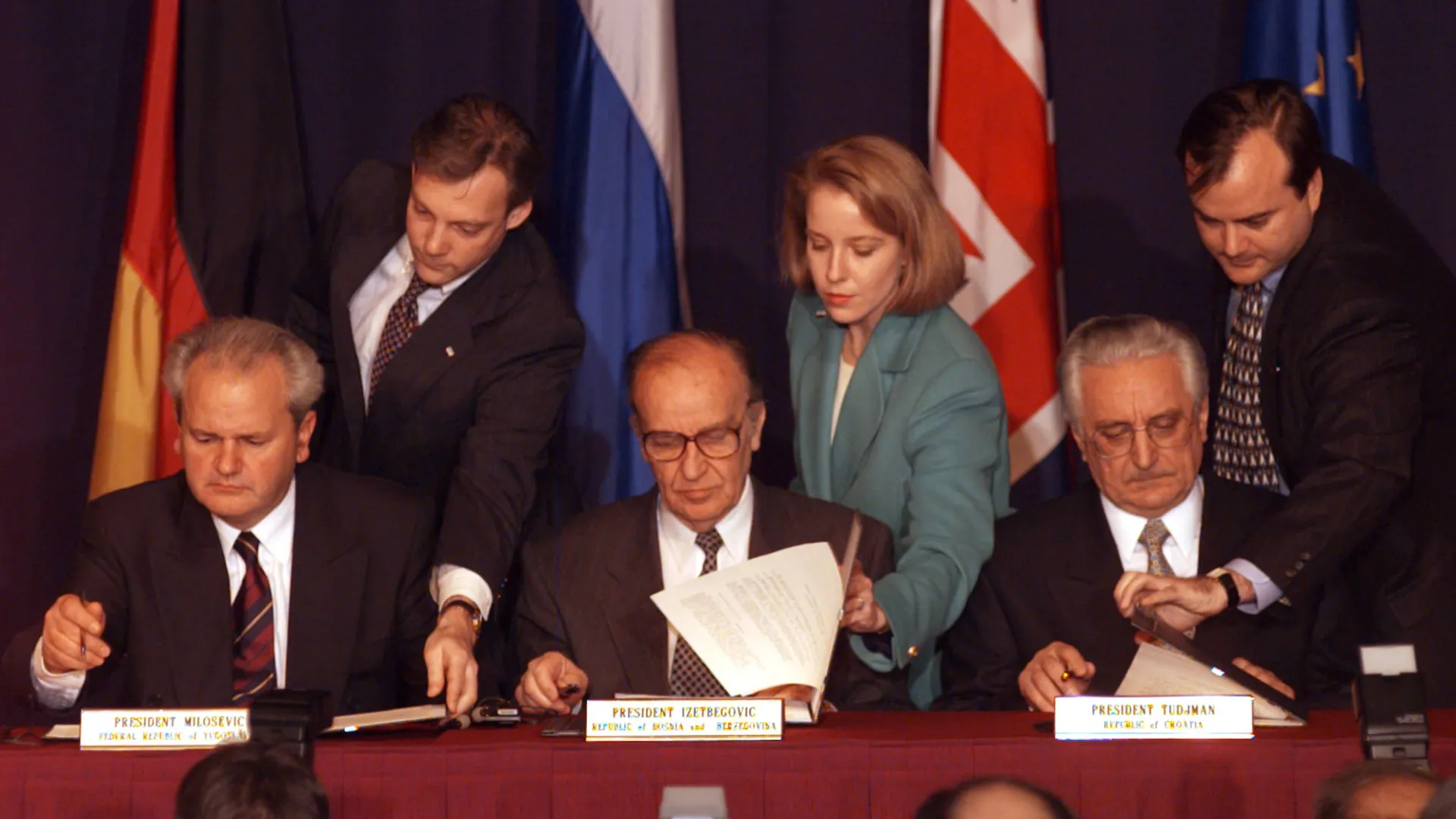


The Dayton Peace Agreement, signed in 1995, marked a historic turning point at the end of the twentieth century. It kept Bosnia and Herzegovina intact as a state and stopped a war that had lasted three and a half years.
The major global powers agreed on an international deal that protected the country’s statehood, borders, and status in international law.
Acting through the Contact Group, members of the UN Security Council (the United States, the United Kingdom, France, the Russian Federation, and the Federal Republic of Germany) set up the basic framework for long-term peace in Bosnia and Herzegovina.
Ending the war and the limits on building a functional state
Most authors agree that the Dayton Peace Agreement played a key role in ending the war in Bosnia and Herzegovina. At the same time, critics, especially of Annex IV,[3] argue that the ethnic-based constitutional and territorial set-up has held back the development of an effective and functional state.
Unlike many other peace agreements, the Dayton arrangement gives clear powers to international bodies to oversee and support its implementation.
The main actors in this process are:
- Peacekeeping forces, led by NATO, under a UN Security Council decision of December 1995
- The Office of the High Representative (OHR), with the High Representative serving as the top civilian authority for implementing the non-military parts of the agreement and supporting peacebuilding
- The European Union Special Representative, who backs reforms linked to Bosnia and Herzegovina’s path towards EU membership
- The Peace Implementation Council (PIC)
In the first post-war decade (1995 to 2005), international institutions helped to improve security and restore freedom of movement for people across the whole of Bosnia and Herzegovina. In the early years after the war, the Presidency of Bosnia and Herzegovina held its sessions in the National Museum because the Serb member of the Presidency at that time refused to use the official Presidency building in Sarajevo as the seat of state institutions.
Within the first five years, the High Representative, working with civil society organisations, designed and imposed a new coat of arms, flag, and anthem. The ruling parliamentary parties were unable to agree on these basic state symbols.
Parliamentary elections held in 1996, 1998, and 2000, with two-year mandates for state and entity parliaments, were meant to speed up democratic consolidation and support multi-ethnic civic parties. In practice, ethnic parties continued to dominate most election results.
Because ethnic parties could not agree on peacebuilding and state-building, the Peace Implementation Council (PIC) gave the High Representative the so-called Bonn Powers in 1998. Using these powers, the High Representative imposed 145 laws that formally belonged under the authority of the Parliamentary Assembly of Bosnia and Herzegovina.
These laws allowed reforms that supported peace consolidation and the creation of core state institutions. As part of these changes, the State Border Service (later the Border Police) and the Indirect Taxation Authority were created.
The Council of Ministers of Bosnia and Herzegovina grew from three to nine ministries, adding portfolios such as security, justice, human rights and refugees, transport and communications, the treasury and finance, and defence. This expansion gave the state a stronger executive capacity to carry out reforms and to support Bosnia and Herzegovina’s European Union integration process.
Joint Armed Forces of Bosnia and Herzegovina as a key post-Dayton reform
The unification of the separate entity armies into a single Armed Forces of Bosnia and Herzegovina is seen as one of the most important reforms after Dayton. This step brought full integration of entity forces and defence institutions at the state level. The development of the Armed Forces in line with NATO standards opened the way for gradual integration into the NATO alliance, as outlined in the Law on Defence of Bosnia and Herzegovina.
Major reforms also took place in the justice and security fields. The Court of Bosnia and Herzegovina and the Prosecutor’s Office of Bosnia and Herzegovina were established, along with the High Judicial and Prosecutorial Council (HJPC). The Intelligence-Security Agency (OSA) and the State Investigation and Protection Agency (SIPA) created the basic structure for a functioning state security system.
The full implementation of the Dayton Peace Agreement is now closely linked to Bosnia and Herzegovina’s integration into the European Union and NATO. Progress has been slow, largely because of a lack of agreement among ruling parties in the Parliamentary Assembly of Bosnia and Herzegovina. Since 2015, the High Representative has gradually reduced the use of the Bonn Powers.
Geopolitical changes near the end of the third decade of the Dayton period, especially the aggression of the Russian Federation against Ukraine in 2022, threatened peace in Europe but also sped up European integration processes. In this context, the Council of the European Union granted Bosnia and Herzegovina candidate status for EU membership, and negotiations are expected to start at the end of 2025.
Blockades of state institutions in Bosnia and Herzegovina and the obstructive actions of the National Assembly of the Republika Srpska slowed legislative work and reform. However, in 2025, rulings by the Court of Bosnia and Herzegovina helped break these blockades. The removal of Milorad Dodik (SNSD) from the post of President of the Republika Srpska marked a turning point in strengthening state institutions and pushing forward the country’s European integration path.
Political instability and the ongoing role of the OHR
As long as political life in Bosnia and Herzegovina remains unstable, with frequent crises of different intensity, the presence and engagement of the Office of the High Representative (OHR) will be necessary.
Its role is especially important in:
- Stopping actions that undermine the Dayton Peace Agreement
- Helping build the level of agreement needed to pass legislation in the Parliamentary Assembly of Bosnia and Herzegovina, which is essential for progress towards the European Union
Over the past thirty years, the OHR has used the Bonn Powers whenever ruling parties could not reach an agreement in the Parliamentary Assembly. This function is likely to remain important until Bosnia and Herzegovina becomes a full member of the European Union. The length of the OHR’s mandate in the coming years is closely linked to progress in EU and NATO integration and to the need to prevent new security risks and threats.
Recommendations for speeding up Bosnia and Herzegovina’s European integration
Key steps that could support faster EU integration include:
- Joint work by the OHR and the European Union Special Representative on putting the reform agenda into practice
- Turning the reform agenda into a joint document of the OHR and the EU Special Representative, prepared in cooperation with the Parliamentary Assembly of Bosnia and Herzegovina.
A major priority for the OHR is to support the adoption of a European clause in the Constitution of Bosnia and Herzegovina. This would make it easier and quicker to bring domestic law into line with the EU acquis communautaire.
The OHR should also increase pressure on parliamentary parties to form a broad coalition in support of a European, democratic, and law-governed Bosnia and Herzegovina after the 2026 elections. Such a coalition would give the winning parties a clear mandate and responsibility to push forward the EU integration agenda.
The OHR also has an important role in helping create international and regional conditions for constitutional reforms that are needed to speed up EU integration. Strengthening the democratic capacity of state institutions is linked to changes in the structure of the Parliamentary Assembly of Bosnia and Herzegovina.
Under these ideas, the House of Representatives would grow from 42 to 97 members, and electoral territorial units would cross entity borders rather than follow them. A larger number of representatives would allow for more thorough legislative work in committees and commissions.
It would also open space for professional associations and civil society organisations to engage more actively in public policy. At the same time, both the structure and the powers of the House of Peoples of the Parliamentary Assembly would be revised.
For the Council of Ministers of Bosnia and Herzegovina, proposals include the creation of two new ministries: a Ministry of Science and Technological Development and a Ministry of Agriculture and Ecology.
These ministries would respond to long-term needs in research, innovation, food production, and environmental protection, and they would support Bosnia and Herzegovina’s progress towards full European Union membership.