



In just over a year, France has gone through three prime ministers. A journalist recently asked me why French politics has become so unstable. The short answer is easy to give, but the full story is about how a system built to avoid chaos has slipped into it.
How Macron Set Off the Current Crisis
The current political mess began with President Emmanuel Macron’s choice in June last year to dissolve the National Assembly and call early elections. He made this move right after the European Parliament elections, hoping a snap election would strengthen his hand.
The bet failed. Instead of gaining ground, he lost his already fragile majority in parliament.
A Presidential System, But Only Under Certain Conditions
France is often seen as a textbook example of a presidential system. The Fifth Republic, created in 1958, was designed to give strong powers to the president and avoid the constant turmoil that marked the Fourth Republic.
This model works smoothly when the president and the parliamentary majority come from the same political camp. In that case, which is how the system was broadly imagined, the prime minister acts as the president’s chief operator, pushing through the presidential agenda.
Things change when the majority in the National Assembly belongs to a different camp. Power then shifts away from the Élysée Palace and towards parliament. The president still matters, especially on foreign policy and defence, but the prime minister becomes the key player on domestic issues.
The French call this cohabitation, and it has happened several times.
Cohabitation in the Past
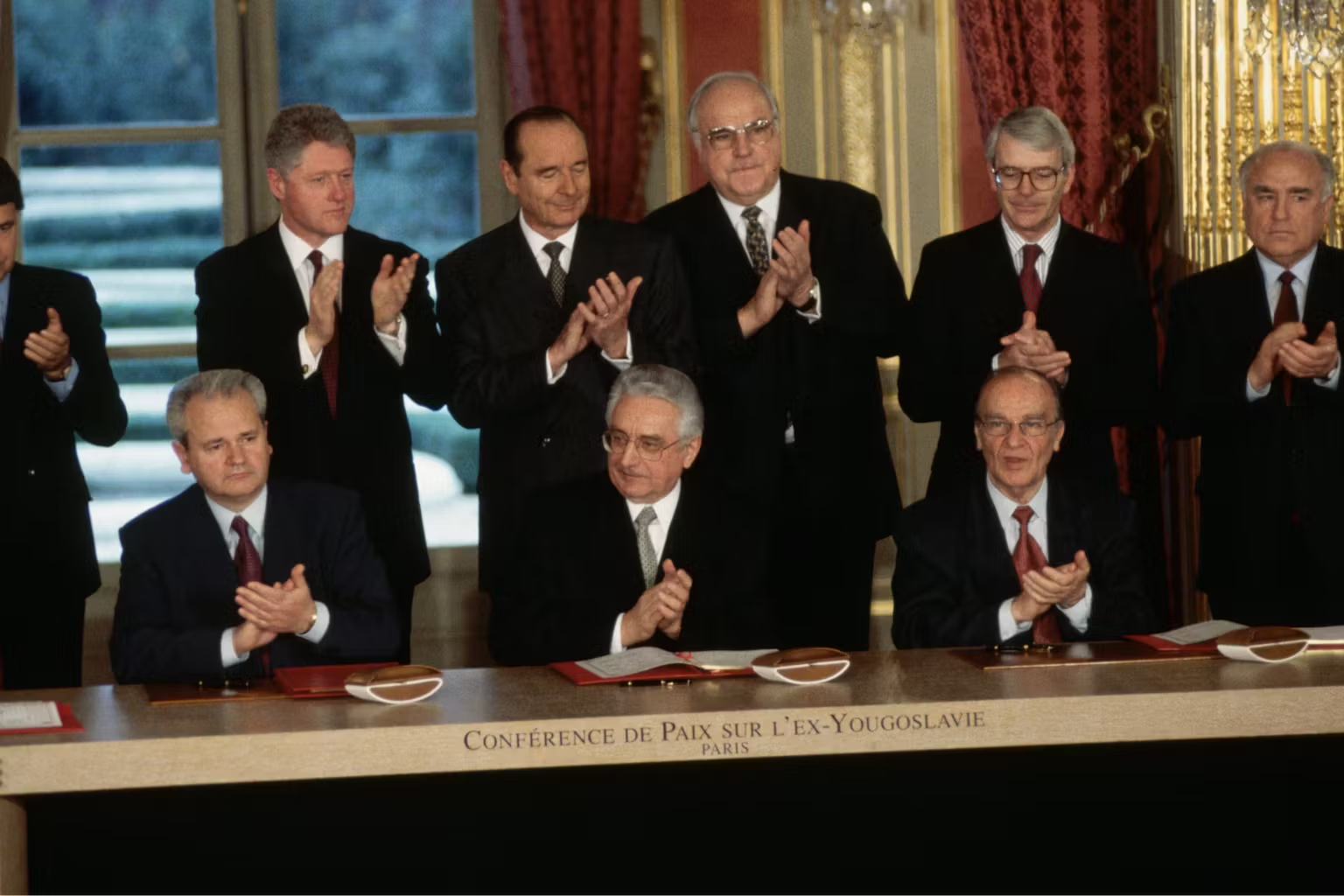
Socialist President François Mitterrand had to govern with prime ministers from the right, first Jacques Chirac, then Édouard Balladur. When Chirac became president, he faced the same situation from the other side. After calling a snap election that also went wrong, he had to work for several years with Socialist Prime Minister Lionel Jospin.
Those periods were tense and often quarrelsome, but they did not break the system. There was always a stable majority in parliament, even if it was not on the president’s side.
Why This Crisis Is Different
The current crisis is different for a simple reason: there is no majority in parliament. The problem is not cohabitation this time; it is fragmentation.
After last year’s snap election, no political bloc controls enough seats to govern alone. Macron’s centrists do not have a majority, and neither do the traditional right, the far right, or the left. The left-wing alliance of Socialists, Greens, and the far left won the largest share of seats, but still fell short of an outright majority.
Since then, Macron has focused on blocking a left-wing government from taking power. He has planned to build a centrist and centre-right coalition, topped up with enough Socialist MPs to get over the line.
The numbers simply do not work.
- If you give the Socialists what they demand, such as higher taxes on the wealthy or rolling back the pension reform, the right refuses to back the government.
- If you give the Socialists what they want, they pull out and can team up with the rest of the left and even parts of the far right to bring the government down.
Sébastien Lecornu, and before him Michel Barnier and François Bayrou, have all come up against the same dead end.
All this is happening while France’s public deficit keeps growing. Many voters now feel that the political class is unable to govern properly and that the system no longer functions. That mood is feeding support for populist parties both on the right and on the left.
Possible Ways Forward
If I had Macron’s ear, I would suggest a government of national unity, something similar to Switzerland’s model, where all major parties share power. Instead of being held hostage by each group, the president could pass responsibility back to them and make them share the burden of governing.
Another option would be a technocratic government, along the lines of what Italy has used during severe political standstills. In that setup, non-partisan experts run key ministries, and parties support them from parliament.
Both ideas sit uneasily with French political habits. They would require a big step into territory that France has rarely tried. That makes them unlikely in practice. A fresh snap election, sooner rather than later, seems the most probable outcome.
Back to the Fourth Republic?
There is an almost ironic twist to all of this. Today’s situation looks strikingly similar to the old Fourth Republic, a period marked by splintered parties, constant bargaining, and fragile coalitions that fell one after another. The Fifth Republic was designed precisely to break with that pattern.
Yet France now appears to be sliding back into the same kind of parliamentary chaos that the founders of the Fifth Republic wanted to leave behind.