Connect with us

Politics

Articles of Impeachment Filed Against Tim Walz Over Massive Fraud

VORNews

Published

on

Articles of Impeachment Filed Against Tim Walz

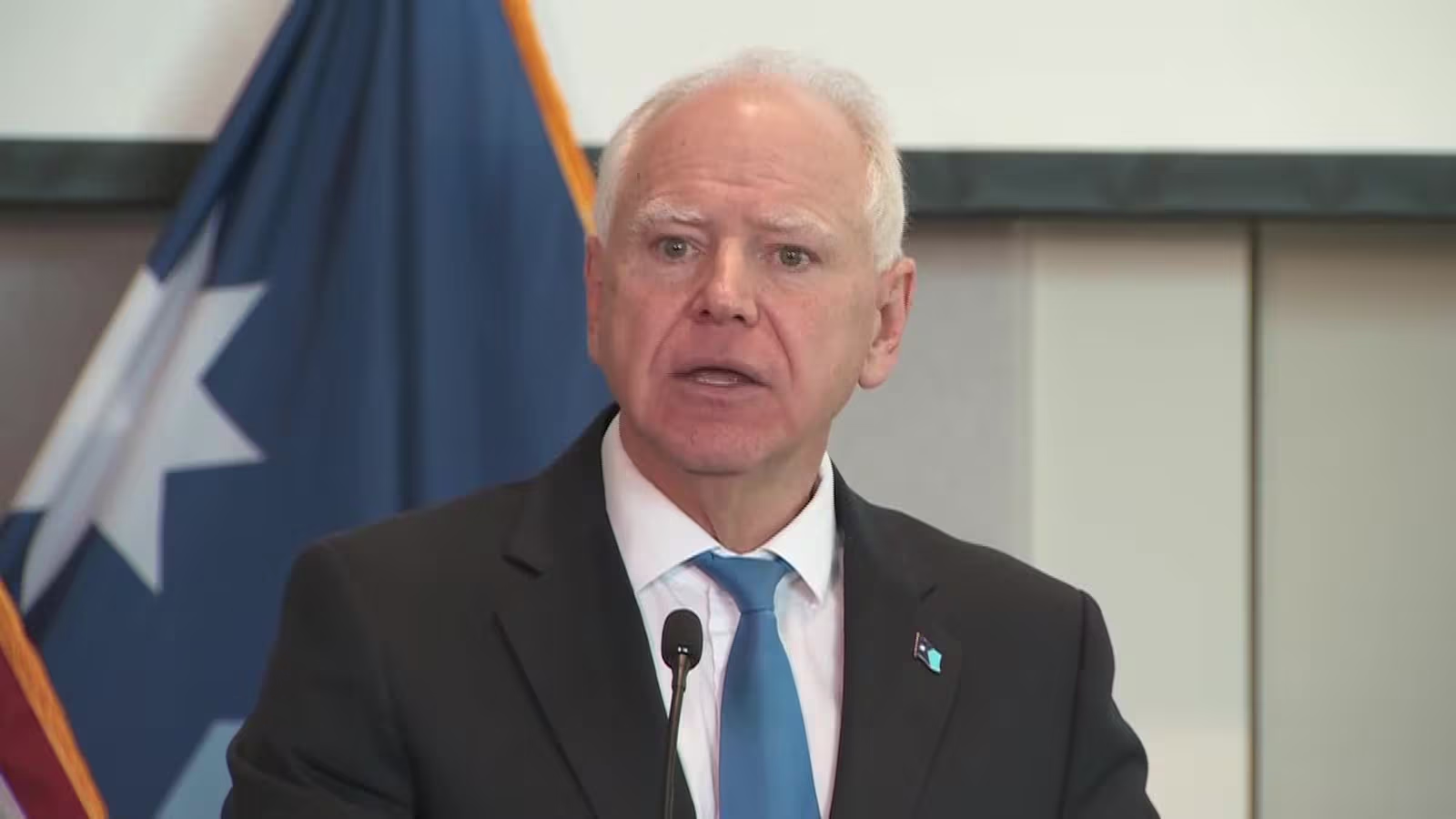
ST. PAUL, Minnesota – Republican lawmakers in the Minnesota House have introduced articles of impeachment against Democratic-Farmer-Labor (DFL) Gov. Tim Walz. The move targets the two-term governor shortly after he said he won’t run for re-election in 2026.

The resolution is dated January 12, 2026, and is led by State Rep. Mike Wiener (R-Long Prairie). It accuses Walz of “corrupt conduct in office” and claims he broke his constitutional oath by failing to faithfully enforce state laws.

At the center of the push are claims of major fraud inside state-run programs. The resolution argues the fraud could involve billions of taxpayer dollars and says Walz did not act fast enough to stop it.

The filing comes as federal investigators continue to look into large fraud schemes tied to programs such as child care assistance and Medicaid. Those probes have drawn wider attention after whistleblower reports and law enforcement raids.

Tim Walz, who has served as governor since 2019 and was the 2024 Democratic vice-presidential nominee, has rejected any claim of wrongdoing. He and his allies have described the impeachment effort as political “retribution.”

The Articles of Impeachment Against Walz, Explained

The resolution lists four articles that accuse Walz of serious failures in office:

  • Article I: Concealment or Allowing Widespread Fraud
    The first article claims Walz knew about broad, ongoing fraud in state programs and either helped hide it or allowed others to do so. It points to warnings from audits, reports, and other public signs of abuse. The resolution also references statements from prosecutors and whistleblowers who say the governor was briefed about large losses but did not take strong action, letting the activity continue.
  • Article II: Blocking Oversight and Investigations
    The second article accuses Walz of getting in the way of proper oversight. It says he did not direct executive agencies to fully cooperate with audits and investigations, allowed resistance to legislative review, and failed to discipline officials tied to program oversight.
  • Article III: Putting Politics Ahead of Accountability (based on the resolution’s descriptions)
    The third article suggests Walz focused more on political messaging than open and transparent management. It argues this approach may have weakened safeguards meant to prevent fraud.
  • Article IV: Failure to Protect Public Funds
    The fourth article claims Walz did not fulfill his duty to enforce laws that protect public money. It accuses him of letting safeguards go unenforced, not putting stronger anti-fraud steps in place, and allowing losses to pile up across several programs.

Supporters of the resolution include Reps. Pam Altendorf, Ben Davis, Krista Knudsen, and others. They say at least 10 GOP lawmakers back the effort and cite estimates that potential losses could reach as high as $9 billion. They argue the impeachment push is about answering public demands for accountability.

Political Backdrop and Legislative Roadblocks

As of early 2026, the Minnesota House is split 67 to 67 between Republicans and Democrats. That balance makes impeachment hard to pass without some bipartisan votes. If the House approves the articles, the matter would move to a trial in the Minnesota Senate. Conviction and removal would require a two-thirds vote, at least 45 of 67 senators.

Because of the close split and the high vote threshold, some observers have called the effort more symbolic than practical.

Minnesota’s 2026 legislative session begins February 17, when the House could take up the resolution. Under the Minnesota Constitution (Article VIII, Section 3), adoption of the articles would temporarily prevent Walz from carrying out his duties until the case is resolved or he is acquitted.

Walz’s office has brushed off the effort as an attempt to ride the momentum of federal actions and political grudges. A spokesperson said: “These legislators are apparently trying to capitalize on the president’s vow for ‘retribution’ against the state.

Wider Fallout and Reactions

Respected career attorneys have resigned over the DOJ’s behavior. The federal government is attempting to pull billions from its constituents. It is shameful that this is how they’re choosing to spend their time, and we urge them to get serious.”

Walz has said his focus remains on protecting Minnesotans from fraud and responding to critics. In early January, he announced he won’t seek a third term as the controversy continues.

The impeachment filing has sparked a heated fight at the Capitol. Republicans frame it as a needed response to misconduct and inaction by the governor’s office. Democrats and Walz supporters call it a distraction and say it reflects growing national political tension spilling into state government.

The dispute has also put a spotlight on weak points in Minnesota’s public assistance programs and raised sharper questions about oversight under Walz’s administration. Analysts note that even if the articles reflect real public concern about fraud, removing a sitting governor remains a steep climb in a divided Legislature.

With the session set to begin, attention will stay on whether any Democrats break ranks or whether the effort stalls and becomes another round of political theater. For now, the articles mark the strongest formal challenge to Walz’s tenure since he took office.


Related News:

New Voter ID Laws 2026: How Will They Affect the 2026 Midterms

Who Is Leading the Democratic Party in 2026?

Politics

California Democrats are Panicking Over the 2026 Governor’s Race

VORNews

Published

on

By

California Democrats are Panicking

SACRAMENTO – In California state where Democrats outnumber Republicans two-to-one, the political establishment is currently grappling with an unthinkable nightmare: a total lockout from the November ballot.

The race to succeed term-limited Governor Gavin Newsom has devolved into a chaotic scramble. With a crowded field of seven major Democratic candidates splitting the liberal vote, the party’s internal anxiety has shifted from “who will win” to “will we even be there?”

Current polling suggests that the state’s unique “top-two” primary system could pave the way for two Republicans—Riverside County Sheriff Chad Bianco and former Fox News host Steve Hilton—to advance to the general election, leaving Democrats on the sidelines for the first time in modern history.

The “Top-Two” Trap

California’s primary system is a “jungle.” Instead of separate party ballots, every candidate runs on a single ticket. The top two finishers, regardless of party, move on to November.

For years, this system favored Democrats, often leading to “Blue vs. Blue” general elections. But in 2026, the math has flipped. While the Republican base has largely consolidated behind two high-profile names, the Democratic vote is being sliced into seven thin pieces.

Current Polling Snapshot (April 2026)

According to recent data from Public Opinion Firm Evitarus, the leaderboard is a statistical dead heat that favors the GOP:

  • Chad Bianco (R): 14-16%
  • Steve Hilton (R): 14-16%
  • Katie Porter (D): 11-12%
  • Tom Steyer (D): 11%

“This is a failure of leadership at the top,” said RL Miller, chair of the party’s environmental caucus, in a recent interview with CalMatters. “The idea that we could end up with two Republicans in a state this blue is terrifying.”

The Democratic panic isn’t just about numbers; it’s about a lack of a “clear heir.” Heavyweights like Senator Alex Padilla and former Vice President Kamala Harris opted out of the race. This left a vacuum that has been filled by candidates who are currently more focused on attacking each other than on the looming Republican threat.

  1. The Swalwell Collapse: Representative Eric Swalwell recently suspended his campaign and resigned from Congress following a series of scandals. His exit was expected to help consolidate the field, but instead, it has only intensified the infighting among the remaining candidates.
  2. Identity Politics and Infighting: Former Rep. Katie Porter, billionaire Tom Steyer, and San Jose Mayor Matt Mahan are all fighting for the same donor pools and demographics.
  3. Leadership Silence: Party titans like Nancy Pelosi and Gavin Newsom have stayed silent. Despite pleas from activists to “cull the field” and pressure lower-polling candidates to drop out, the party leadership has refused to intervene.

The Republican California Strategy: A “Tie” is a Win

For Republicans, the path to the governor’s mansion doesn’t require a majority of Californians—it just requires a unified minority.

Steve Hilton, who carries an endorsement from President Donald Trump, and Chad Bianco, a populist law enforcement figure, are running neck-and-neck. Strategists note that as long as they stay tied, they likely soak up enough of the 25% Republican registration to block any single Democrat from reaching the top two spots.

Both GOP candidates are leaning into “cost of living” issues, targeting the California Environmental Quality Act and promising massive tax cuts to woo independent voters who feel the state has become unaffordable under Democratic rule.

If a Republican wins, they would face a deep-blue State Legislature with Democratic supermajorities. While a GOP governor might struggle to pass new laws, their “veto pen” could grind the state’s progressive agenda to a halt.

More importantly, a Republican victory in California would be a psychological earthquake for the national Democratic Party. It would signal that even the most secure “Blue Wall” states are vulnerable when voters feel the sting of inflation, crime, and housing costs.

Key Factors to Watch Before the June Primary:

  • The “Drop Out” Pressure: Will lower-tier Democrats like Betty Yee or Xavier Becerra exit the race to save the party?
  • Independent Voters: Nearly 22% of California voters are “No Party Preference.” Their shift toward Bianco or Hilton could seal the deal.
  • Voter Turnout: Traditionally, lower turnout in primaries favors Republicans.

For now, the mood in Sacramento is one of “paralysis and frustration.” As mail-in ballots prepare to go out, the Democratic Party is holding its breath. If they can’t thin their own herd, they might find themselves watching the most important race in the state from the bleachers.

As one Democratic strategist put it: “We are watching a slow-motion train wreck, and everyone is too polite to tell the drivers to get off the tracks.”

Related News:

Yamaha Joins the Mass Exodus from California

BMR California Explained: Rules, Income Limits, and How to Apply

Republicans Gain Ground in California While Businesses Flee Blue States


Continue Reading

Politics

Eric Swalwell’s Governor Campaign in Crisis After Multiple Assault Allegations Surface

VORNews

Published

on

By

Eric Swalwell

SACRAMENTO – The race for California’s next governor took a seismic shift Friday as Representative Eric Swalwell’s campaign plummeted into chaos. Two separate investigative reports have surfaced detailing serious allegations of sexual assault and professional misconduct, leading to a mass exodus of campaign staff and a chorus of voices demanding his immediate withdrawal from the contest.

By Friday afternoon, what began as a promising bid to lead the nation’s most populous state appeared to be on the verge of total collapse.

The crisis began with a series of investigative reports published late Thursday and early Friday morning. The reports include testimony from former aides and acquaintances who allege a pattern of inappropriate behavior spanning several years.

One report details an incident of alleged sexual assault involving a former campaign volunteer during a 2022 fundraising event. A second report outlines multiple accounts of “predatory” professional misconduct, with several women describing an environment where career advancement was allegedly tied to personal favors.

While the Congressman has long been a fixture in national politics—known for his frequent cable news appearances and high-profile role in impeachment proceedings—these new allegations have created a political firestorm that transcends his usual partisan battles.

Eric Swalwell’s Campaign in Freefall

The internal reaction to the news was swift and devastating. By Friday morning, at least six senior staffers, including his campaign manager and communications director, had tendered their resignations.

In a joint statement, several departing aides expressed their inability to continue their work:

“We joined this campaign because we believed in a vision for California’s future. However, the nature of the allegations brought to light today is inconsistent with the values we hold. We can no longer, in good conscience, represent this candidacy.”

The loss of top-tier talent leaves the Swalwell operation without a functional leadership structure at a critical juncture in the primary cycle.

The political fallout has not been limited to internal staff. In California, where the Democratic Party holds a supermajority, the “blue wall” of support for Swalwell is rapidly crumbling.

Calls for Withdrawal

  • Prominent Allies: Several high-ranking members of the California Democratic delegation, who had previously endorsed Swalwell, issued a “wait-and-see” stance earlier in the day before eventually calling for him to step aside to “allow the party to heal.”
  • Gubernatorial Rivals: Rival candidates were more direct. State Senator Aisha Wahab and Lieutenant Governor Eleni Kounalakis both issued statements Friday suggesting that the allegations make Swalwell’s continued presence in the race a “distraction” from the needs of Californians.
  • Advocacy Groups: Women’s rights organizations and political action committees that typically support Democratic candidates have frozen their funding and called for an independent investigation.

Swalwell’s Response

Representative Swalwell’s office released a brief, defiant statement Friday afternoon. In it, the Congressman denied the most severe allegations, calling them “politically motivated attacks” intended to derail his momentum.

“I have spent my career fighting for justice and the rule of law,” the statement read. “I am deeply saddened by the departure of my staff, but I intend to stay in this race and allow the facts to come out. I ask for the public to reserve judgment until the full story is told.”

Despite the defiance, political analysts suggest the path forward is nearly non-existent. With no campaign infrastructure and a rapidly evaporating donor base, the logistics of a statewide run become nearly impossible.

The 2026 California Gubernatorial race is already one of the most expensive and watched contests in the country. With Governor Gavin Newsom termed out, the field is crowded with ambitious Democrats.

If Swalwell exits the race, it would trigger a massive realignment of endorsements and campaign contributions. Political strategist Marcus Thorne noted that the “Swalwell lane”—which focused on gun control and tech-forward policy—is now wide open.

“This isn’t just about one man anymore,” Thorne said. “This is about the integrity of the Democratic primary. If he stays in, he risks dragging the entire party down with him in a year where every vote counts.”

The coming days will be decisive. California’s filing deadlines are approaching, and the pressure from the Democratic National Committee (DNC) is reportedly intensifying behind the scenes.

For now, the Congressman remains in the race, but he finds himself increasingly isolated on a political island. As the sun set over the State Capitol on Friday, the question among Sacramento insiders was no longer if Swalwell would exit, but when.

Key Takeaways from the Friday Crisis:

  • Two Investigative Reports: Allegations include sexual assault and workplace misconduct.
  • Mass Resignations: Key leadership, including the Campaign Manager, has quit.
  • Bipartisan Pressure: Both allies and rivals are demanding he end his bid for Governor.
  • Political Vacuum: A Swalwell exit would shift millions of dollars in potential donations to other candidates.

The scandal marks a stunning turn for a politician who once sought the Presidency and has been a leading voice in the House of Representatives. In the fast-moving world of California politics, the next 72 hours will likely determine if Eric Swalwell’s political career can survive or if this is the final chapter.

Related News:

Major Lawsuit Questions Eric Swalwell’s California Governor Eligibility


Continue Reading

Politics

New York Governor Hochul Slammed For Begging Rich to Return

VORNews

Published

on

By

New York Governor Hochul Slammed

NEW YORK – Governor Kathy Hochul faces criticism from both sides of the aisle. She recently urged wealthy people who fled the state to come back. However, folks still remember her 2022 campaign remarks. Back then, she told opponents to grab a bus ticket to Florida.

This change fuels charges of inconsistency. It also spotlights New York’s shrinking tax base. The state struggles to fund its big social programs as a result.

At a Politico event this month, Hochul discussed state finances. She rejected New York City Mayor Zohran Mamdani’s push for higher taxes on the rich. Instead, she stressed the need to keep or attract high earners.

“We need high-net-worth people to back our generous social programs,” she said. Some patriotic millionaires already pay extra, she noted. Then she added a key point. “First, let’s head to Palm Beach and convince some to return home. Our tax base has shrunk too much.”

Hochul admitted that other states offer lower taxes for people and businesses. Data backs this up. Many rich New Yorkers have moved to Florida, Texas, and similar spots in recent years.

Critics point to her words from four years ago. Hochul campaigned against Republican Lee Zeldin. She aimed barbs at Donald Trump and Dutchess County Executive Marc Molinaro.

“Trump, Zeldin, and Molinaro should jump on a bus to Florida where you fit. Get out of town. You don’t match our values,” she declared.

Now, people say those comments pushed conservatives and tax-weary wealthy folks to leave. Many packed up for warmer, cheaper states. Social media lights up with side-by-side videos of her old rant and new appeal. Commentators call it desperate or a total reversal. Budget woes drive the shift, they claim.

New York’s Tax Base Challenges

The state counts on top earners for most income tax revenue. A few percent of residents cover a huge chunk. When they go, schools, health care, transit, and services suffer big losses.

IRS data shows an outflow of rich people and workers. Palm Beach County in Florida draws a lot of that wealth.

Hochul’s camp highlights New York’s strengths in finance, tech, culture, and business. Still, they recognize the competition. Florida’s no-income-tax policy and lower living costs pull people away.

Several factors fuel this exodus, reports show. High income taxes lead the pack since New York tops national rates. Housing, utilities, and daily costs stay sky-high, especially near the city. Remote work after COVID lets pros relocate easily. Policy clashes over crime, schools, and rules send some packing. Plus, many skipped town during pandemic lockdowns and stayed gone.

Reactions Roll In from New Yorkers

Responses hit fast and hard. Nassau County Executive Bruce Blakeman, a Republican running for governor, dubbed it Hochul’s most honest moment. He mocked the pitch to swap Palm Beach sunshine, no state tax, and calm for New York’s issues. Cut taxes and costs instead of pleading, he advised.

Conservatives and business leaders agree. They push for tax cuts, fewer rules, and safer streets to compete. Appeals to patriotic millionaires won’t cut it, they say.

Some Democrats back her, though. They view it as facing facts. A wide tax base funds key services without slamming one group. The state offers incentives to lure businesses and people, they add. Online, memes mock the flip. “Come back, we need your tax money” pops up everywhere.

Bigger Picture: Blue State Exodus

New York isn’t unique. California and Illinois lose residents and firms to low-tax red states, too. This trend stirs national debates. Experts warn of a downward spiral. Fewer taxpayers force rate hikes. That chases away more people.

Hochul resists broad tax hikes on the rich during budget battles. She wants the state to stay competitive. Yet progressives like Mamdani demand more from top earners. Her words seek balance. Keep taxes fair and draw back high earners. With re-election looming, this topic matters. Voters watch budget moves, the economy, and daily life.

Tax-cut fans urge affordable homes, safe streets, cheap energy, and pro-business rules. Left-leaning critics want steeper taxes on the rich and bigger social spending.

Regular New Yorkers ask why people left and what pulls them back for good. Hochul reopened that talk publicly. Her Palm Beach plea may fall flat without policy fixes. Reactions so far scream too late. The next months will show if migration reverses or wealth keeps flowing out. Her mixed signals leave some confused and others mad.

Trending News:

Who Is Leading the Democratic Party in 2026?

Continue Reading

Get 30 Days Free

Express VPN

Create Super Content

rightblogger

Flight Buddies Needed

Flight Volunteers Wanted

Trending