

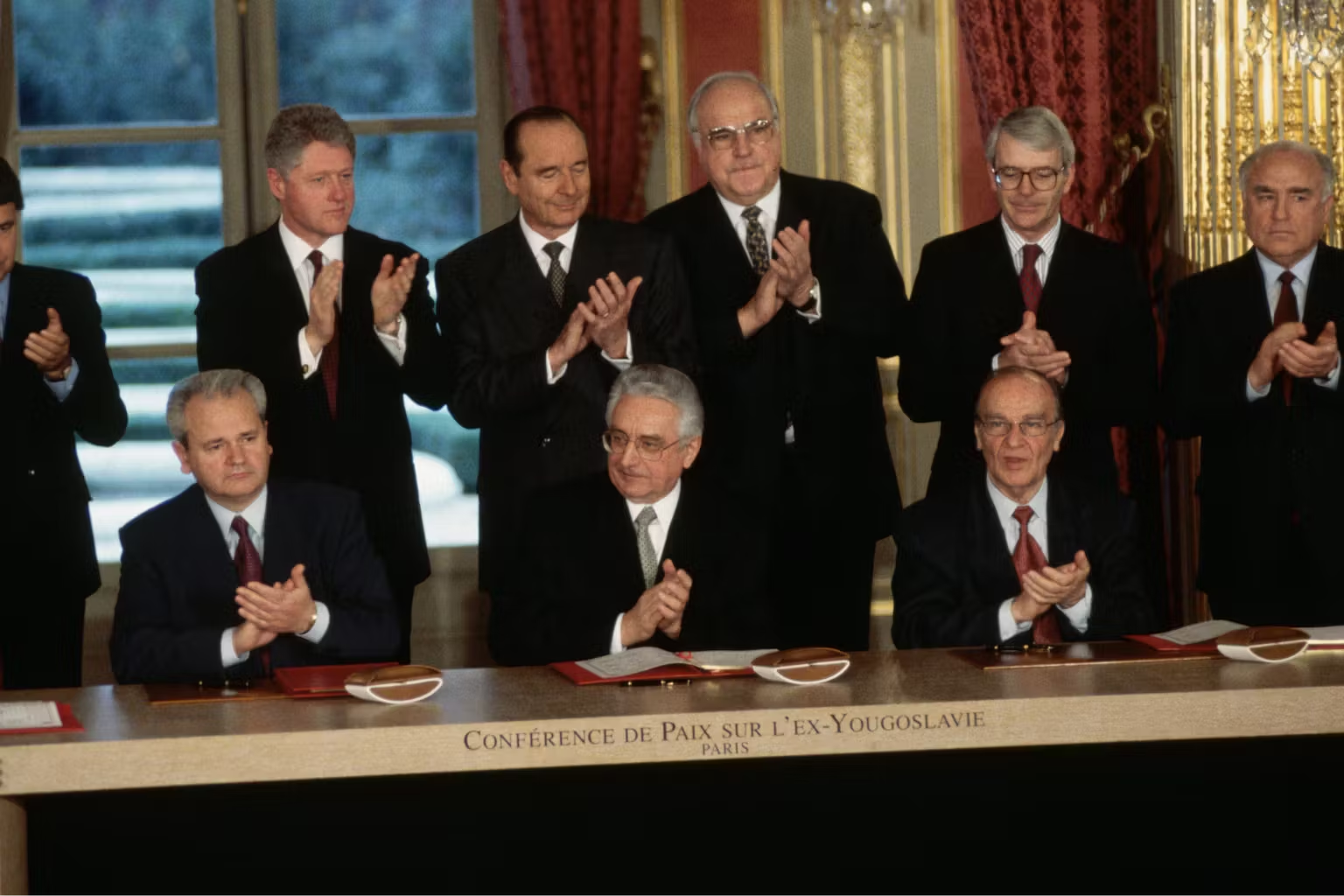


Bosnia and Herzegovina will mark thirty years since the Dayton Peace Agreement on 21 November 2025, just two days before early elections for the President of Republika Srpska (RS), planned for 23 November.
The early elections were triggered by a final ruling of the Court of Bosnia and Herzegovina. The court sentenced Milorad Dodik (SNSD), former President of RS, to one year in prison, later turned into a financial penalty, and banned him from political activity for six years. Under the law, this decision automatically ended his presidential mandate.
The verdict has deepened institutional conflict. Authorities in RS and the SNSD at first refused to accept the ruling and continued to treat Dodik as an active political figure. They have now formally recognised the court’s decision, but state institutions and international actors still demand full and unconditional respect for judicial rulings.
This has created a clear paradox. On paper, Dodik has been removed from political life. In practice, he still controls the SNSD and large parts of the RS institutional system. This gap between formal restriction and real influence sits at the heart of the “Manchurian candidate” model, expressed through the candidacy of Siniša Karan (SNSD) as Dodik’s stand-in.
Candidates, real choice or political proxy?
The Central Election Commission of Bosnia and Herzegovina (CEC) has confirmed six candidates:
- Branko Blanuša (SDS), the joint candidate of the opposition bloc and the main challenger to the ruling camp.
- Siniša Karan (SNSD), the nominee backed by Milorad Dodik and the ruling structure, is widely viewed as Dodik’s political substitute, or, in effect, a “Manchurian candidate”.
The other candidates are Dragan Đokanović (Alliance for a New Policy), Nikola Lazarević (Environmental Party of RS), Igor Gašević (independent), and Slavko Dragičević (independent).
These candidates give the ballot a broader look, but their real impact on the final result is expected to be small. Their main influence is likely to be the possible division of the opposition vote.
How Dodik still shapes the campaign and why the SNSD has not been suspended
Although the Court of Bosnia and Herzegovina imposed a six-year ban on political activity on Milorad Dodik, practice inside the RS tells another story. The ruling says Dodik cannot hold public office or take part in any activity considered political. Yet the real balance of power has barely shifted.
Dodik still controls the key levers within the SNSD. He commands the party structure, an extensive network of loyal officials, and access to public money and institutions. In this setting, he can direct every major process from the background, from the choice of candidates and campaign strategy to party messaging and policy. In effect, he continues to operate as a political leader, even though this type of activity is formally banned.
This gap stems from a long-running clash between RS authorities and state-level institutions in Bosnia and Herzegovina. Tools for enforcing court decisions are weak in areas where state institutions do not have full operational control. This creates a legal and political grey zone where it is very hard to apply the ban.
For this reason, the Central Election Commission of BiH did not suspend the candidacy of Siniša Karan. The CEC is tightly bound by the law and can act only on proven facts that concern the candidate personally. There is no court or administrative ruling against Karan that would make him legally unfit to stand. The SNSD has officially nominated Karan, not Dodik, so the CEC has no legal ground to act, even if many see Karan as Dodik’s proxy.
In short, the election administration follows legal form and procedure. At the same time, political reality plays out in a space where formal rules and real power no longer fully match.
Rhetoric, hate speech, and Dodik’s impact on the campaign
During the campaign, Milorad Dodik and his supporters used sharp and divisive language, often including hate speech directed at Bosniaks and Muslims. This was very visible at rallies, including those in East Sarajevo. SNSD candidate Siniša Karan presented himself as a more “polished” version of Dodik’s message. He copied much of the hate speech and kept a combative attitude towards state institutions, only in slightly milder and more polite wording. Karan did not distance himself from this narrative, which raised doubts about why the BiH Central Election Commission did not question his candidacy.
International organisations reacted to this style of campaigning. The UN Alliance of Civilizations (UNAOC) and the United Nations Special Envoy for Combating Islamophobia, Miguel Ángel Moratinos, sharply criticised the hate speech. They stated that such language against Bosniaks is incompatible with UN principles and values and goes against the core mission of UNAOC, which is to promote mutual respect, constructive dialogue, and peaceful coexistence among people of different cultures and faiths.
The Central Election Commission fined the SNSD 30,000 KM (around 15,000 EUR) for its divisive rhetoric and hate speech. The fine is a formal response, but the ruling structure continues to use inflammatory language. This discourse strengthens the loyalty of SNSD supporters and, at the same time, drives the opposition and international observers to keep a closer watch on the fairness and security of the elections. It is particularly worrying that the competent Prosecutor’s Office has not reacted seriously to these public provocations and open cases of hate speech.
Lifting of OFAC sanctions, what happened and what it means
At the end of October 2025, OFAC (U.S. Treasury / Office of Foreign Assets Control) changed its sanctions list and removed Milorad Dodik on 29 October 2025. This move carries important diplomatic and financial meaning, since it ends some earlier restrictions on his property and financial dealings.
However, removal from the OFAC list does not mean that all other sanctions fall away. The EU, the United Kingdom, Germany, Poland, and Slovenia, among others, apply their own measures. Each state or organisation decides independently whether to keep or lift sanctions.
The end of U.S. sanctions on Dodik and his allies strengthens his position inside Bosnia and Herzegovina and makes his lobbying abroad easier. It does not, however, amount to full political rehabilitation. International actors still view Dodik’s policy line as a source of instability and a channel for Russian influence.
Dodik’s long-term strategy is based on building structures focused on the entity and pushing de facto separatism. Many compare this model to “South Ossetia” in the Balkans, with the possible arrival of Russian military bases. This approach poses serious problems for the EU, NATO, and the United States and continues to shape security and politics in the wider region.
After the lifting of OFAC sanctions, the growing insistence of the Serb member of the BiH Presidency, Željka Cvijanović (SNSD), on cooperation with the United States has shed more light on the background of the arrangement with Washington. In this context, the discussion covers not only Bosnia and Herzegovina’s possible path towards NATO, but also the option of building a U.S. military base on the territory of the RS. The seemingly constructive tone that Dodik’s regime has adopted in contacts with Washington can be read as preparation for such moves.
Will the 2022 Trivić vs Dodik scenario repeat?
Analyses and records from polling stations show that Jelena Trivić likely received more votes than Milorad Dodik in the 2022 RS presidential election. Despite this, the Central Election Commission (CEC), under strong international pressure, declared Dodik the winner.
There is a real concern that something similar could happen in 2025. The answer is that it is possible, but not in the same way. OSCE/ODIHR now has greater monitoring authority, external scrutiny is far stronger, and the legal environment around the elections and pressure on the CEC have changed compared with 2022.
Even with closer monitoring, the risk of manipulation remains high. The SNSD still has a dense network of political and institutional influence over public administration and party resources. This gives the ruling camp ample room for pressure, abuse of power, and various irregularities.
The role of the mayors of Banja Luka and Bijeljina (especially Draško Stanivuković)
Local leaders, above all Draško Stanivuković (Banja Luka, PDP) and Ljubiša Petrović (Bijeljina, SDS), will have a major logistical and political role in the upcoming elections. Their power lies in their influence over polling boards and polling stations, supervision of local administration, prevention of obstruction, and the mobilisation of opposition voters.
If Stanivuković chooses a passive, calculating, ng, or even blocking approach, the opposition will face a serious handicap. If he offers full and active support, the opposition could enter the race with a realistic chance of success. In that case, coordination at the local level would grow stronger, and the opposition bloc would gain more credibility in the eyes of voters.
Is the status of RS under attack, or is RS the one threatening Bosnia and Herzegovina?
Milorad Dodik and the SNSD often claim that Republika Srpska is “under attack” from Sarajevo, foreign courts, and international bodies. However, assessments by international institutions and independent experts present a different view. According to them, Dodik’s policy undermines the constitutional order of Bosnia and Herzegovina, stirs ethnic tensions, increases security risks for the country and the region, and damages RS itself in economic, political, and diplomatic terms.
Put simply, RS as an entity is not under constant attack. It is Dodik’s regime that places Bosnia and Herzegovina at risk and, in doing so, indirectly threatens the stability and future of RS as well.
What would a Karan win mean, and what would a Blanuša win mean?
Political observers and international analysts often describe Siniša Karan as a “Manchurian candidate”, a figure who formally holds office but in reality follows Dodik’s orders. Karan has no strong political profile of his own. He fully carries out Dodik’s instructions and serves as the tool through which Dodik keeps control despite the court ban. In this sense, he acts as a legal façade for the regime. A Karan victory would, in practice, be Dodik’s victory, not Karan’s.
If Karan (SNSD) wins, a continuation of Dodik’s current policy line can be expected. This would likely mean more confrontation with state institutions, the possible creation of parallel structures, higher internal tensions within RS, deeper Russian influence, further economic stagnation and isolation of the entity, and additional instability for Bosnia and Herzegovina.
A win for Branko Blanuša (SDS) would open room for institutional calming and stabilisation. Relations with state-level institutions could become less confrontational. Support from the international community would likely grow. Space would open for political dialogue and reforms and for stronger democratic processes inside the RS. A Blanuša victory would also create an opportunity to start tackling crime and corruption in a more serious way and to gradually weaken Dodik’s hold on power.
The role of the international community and neighbouring states (Serbia and Croatia)
The international community, including the EU, the United States, OSCE/ODIHR, and the UN, is watching the elections in the RS very closely. Their main focus is on respect for court decisions, the fairness and transparency of the election process, and the prevention of hate speech. They use political pressure, sanctions, observation missions, a nd diplomatic activity to influence the situation.
Serbia officially keeps its distance from the elections and says it wants to avoid instability. At the same time, it maintains strong ties with Dodik’s regime. Croatia, for its part, indirectly supports the continuation of SNSD policies because of its own strategic interests in Bosnia and Herzegovina, while also trying not to contribute to wider international tensions.
International actors, including the EU, the US, the UN, and the OSCE, repeatedly stress the need for peaceful and transparent elections. They monitor hate speech, react publicly to threats, and remain ready to act if there are serious irregularities, to protect the credibility and stability of the election process.
Conclusion and short IFIMES assessment
The early presidential election in the RS is taking place in a very tense institutional and political environment. The criminal case against Milorad Dodik has created both a legal precedent and a vacuum of power. The SNSD is trying to fill this gap through its “Manchurian candidate”, Siniša Karan, who serves as Dodik’s proxy.
A win for Karan would mean a continuation of policy based on destabilisation and conflict with state institutions and the international community. In contrast, a victory for Branko Blanuša would open the way for changes in the functioning of institutions, a reduction in tensions, and stronger confidence in state mechanisms in both the RS and Bosnia and Herzegovina. It would also signal a serious attempt to respond to crime and corruption.
The role of the international community remains central. Observation of the election process, resistance to manipulation, action against hate speech, and support for security and constitutional order are all key elements of its engagement.
The final result will largely depend on the ability of the opposition to mobilise supporters and on joint action by local leaders, especially in Banja Luka and Bijeljina. Their active participation could greatly affect both the fairness of the process and the public perception of its legitimacy.