

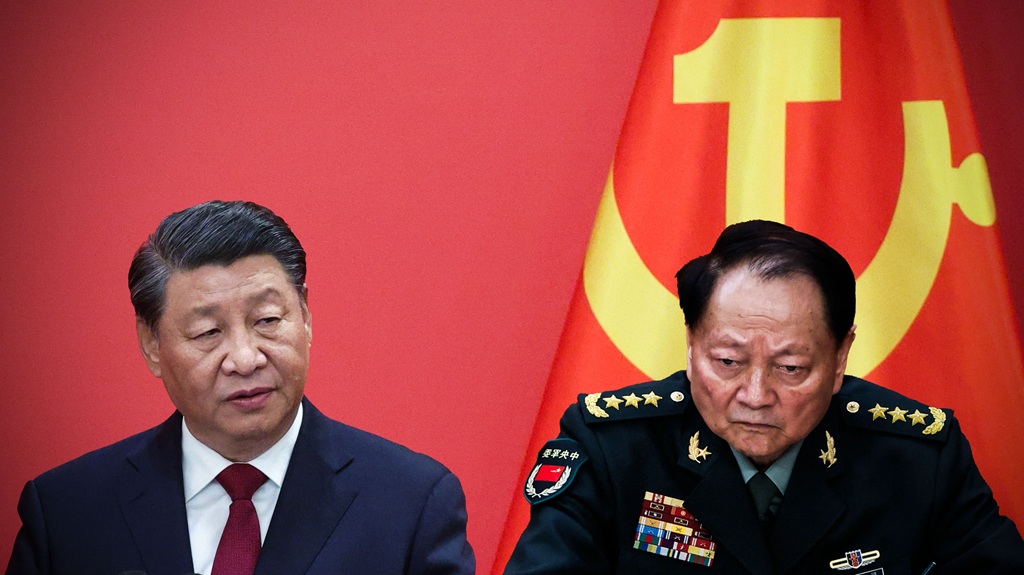


BEIJING – China’s political and military circles are reeling after a major shake-up at the top of the People’s Liberation Army (PLA). General Zhang Youxia, China’s highest-ranking officer in uniform and long viewed as a close ally of President Xi Jinping, has been put under investigation for “grave violations of discipline and the law.”
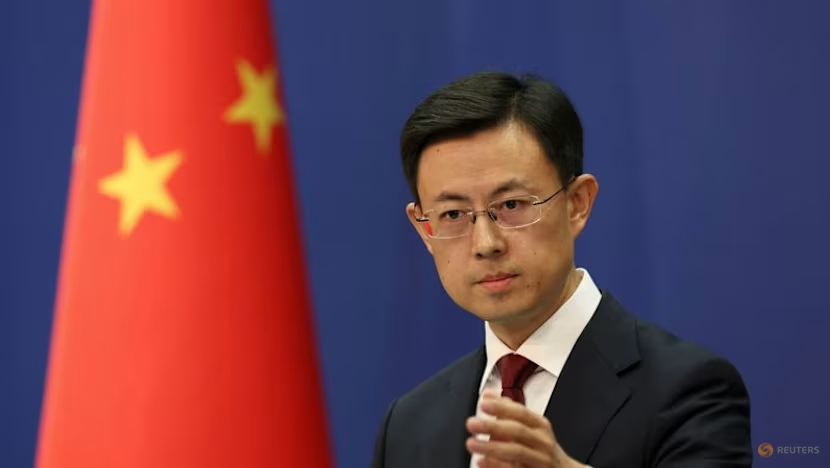
China’s Ministry of National Defense announced the move on January 24, a sharp escalation in Xi’s long-running drive to stamp out corruption and lock in party control over the armed forces. Zhang, 75, served as vice chairman of the Central Military Commission (CMC), the top body that runs China’s military and is led by Xi. As the senior vice chairman, Zhang sat just below Xi on military matters.
He is a combat veteran and a well-known “princeling,” the son of a revolutionary-era Red Army figure. He also stayed in office past the usual retirement age, a sign that Xi had placed unusual trust in him. Their families have deep ties going back decades, and some outside commentary has even described Zhang as unusually close to Xi and his family.
In a brief statement, the ministry accused Zhang and another senior commander, General Liu Zhenli, of conduct that “seriously trampled on and undermined” the CMC chairman’s responsibility system. In plain terms, that points to violating the system built around Xi’s direct authority over the PLA.
The statement also said their actions had fueled “political and corruption problems,” weakened Communist Party leadership inside the military, and caused “immense harm” to combat readiness.
Xi’s Purge in China
The announcement lands in the middle of a broader wave of removals that has hollowed out the CMC leadership team Xi first unveiled at the start of his third term in 2022. Of the original seven members, only Xi and one remaining uniformed figure, Zhang Shengmin (who handles discipline work), are still in place.
Others have already fallen, including former CMC Vice Chairman He Weidong, who was expelled from the Communist Party in October 2025 on graft allegations. Admiral Miao Hua, once head of the CMC’s Political Work Department, was suspended in late 2024 and later pushed out. The Rocket Force has also been hit hard, alongside former defense ministers such as Li Shangfu and Wei Fenghe.
Many analysts say the scope is hard to overstate. One expert quoted in international reporting called it the effective wipeout of the top command. While Beijing has framed these actions as anti-corruption enforcement, the pattern now looks bigger than money alone.
Outside observers increasingly read the campaign as a search for political reliability, with Xi moving against perceived disloyalty, rival networks, or threats to his control, even among officers he helped promote.
This turmoil lands at an awkward moment for China’s military plans. Xi has tied PLA modernization to his broader national goals through 2049. Under his leadership, the PLA has pushed major reforms, built new theater commands, and prioritized joint operations, all aimed at reaching “world-class” capability.
Still, repeated scandals, especially inside the Rocket Force that manages key missile and nuclear forces, have highlighted long-running weaknesses such as pay-to-play promotions and corrupt procurement.
Xi Installing Sicophants
The latest purge is also feeding debate about readiness. Some Western analysts argue that constant leadership turnover could slow near-term military action, including any fast move against Taiwan, because Xi is putting political loyalty ahead of battlefield performance.
Others see a different path: Xi may be clearing out the old guard to install younger commanders who match his line, which could tighten control and improve long-term cohesion, even if it causes short-term disruption.
Inside China, state media has sold the investigation as proof that party discipline reaches everyone. PLA Daily praised the move as a major win for discipline, stressing that rank and connections don’t put anyone above the rules.
At the same time, China’s political system offers little transparency. Official details remain thin, and rumors range from bribery tied to earlier promotions to broader claims about loyalty failures. None of those claims has been confirmed in public.
Outside China, the fallout is being watched closely. Governments and intelligence agencies have long struggled to read Beijing’s military plans because decision-making remains tightly held. The downfall of a figure as prominent as Zhang, once seen as untouchable, sends a clear signal about how unstable elite power can be, even for people once considered part of Xi’s inner circle.
For everyday Chinese citizens and observers abroad, the episode underlines how far Xi has pushed to centralize control. The PLA is now more directly bound to Xi’s authority than at any time in recent decades. As the purges continue, attention will stay fixed on whether this upheaval weakens China’s military in the near term or produces a tighter, more loyal force over time, all while regional tensions keep rising.
Zhang Youxia’s sidelining isn’t just a routine staffing change. It shows how China’s one-party system works at its hardest edge, where loyalty to the top leader comes first. With Beijing facing pressure at home and abroad, the stability of PLA leadership will keep shaping China’s direction and its growing role on the world stage.