Connect with us

News

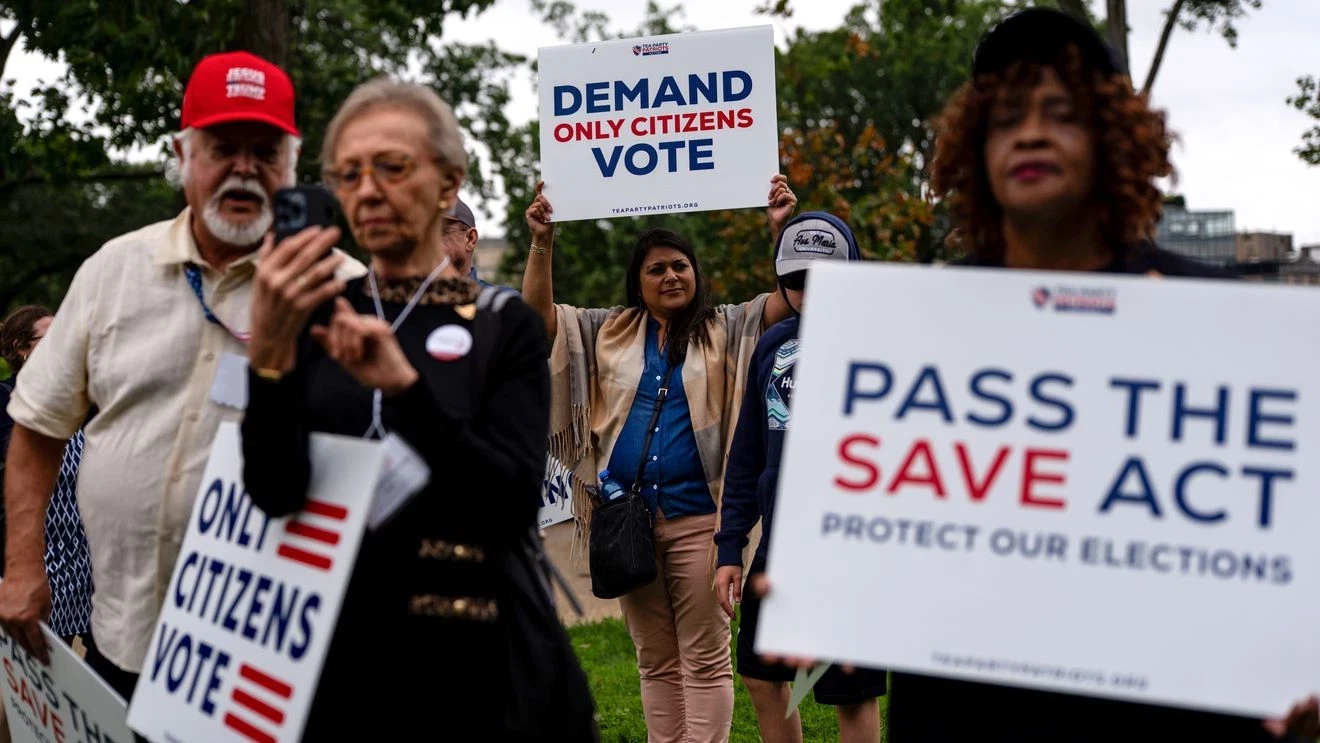
Democrats Push Back on the SAVE Act Despite 85% of Voters Backing Voter ID

VORNews

Published

on

Democrats Push Back on the SAVE Act

WASHINGTON, D.C. – The Safeguard American Voter Eligibility (SAVE) Act has turned into a major fight over election rules. The House passed it in April 2025, with Republicans mostly in favor and Democrats mostly against.

The bill would require proof of citizenship to register for federal elections. Senate Democrats have lined up to stop it, saying it could block eligible voters. Republicans say the measure protects election integrity. By early 2026, the bill still sits in the Senate, a clear sign of how wide the partisan gap remains.

Below is a breakdown of what the SAVE Act would do, what polls say about voter ID, how states handle ID rules, and what research shows about voting irregularities.

What the SAVE Act Would Do, and Why Democrats Oppose It

The SAVE Act (Safeguard American Voter Eligibility Act) would change federal election law by requiring documents that prove U.S. citizenship when someone registers to vote. Examples include a U.S. birth certificate or a passport.

The bill also calls for states to remove non-citizens from voter lists. In addition, it creates a private right of action, which means citizens could sue election officials who do not follow the rules.

Supporters, including House Republicans, describe it as a straightforward step. They say it helps confirm that only eligible citizens vote, especially at a time when immigration and election security stay in the spotlight.

Senate Democrats, including Chuck Schumer (D-NY), argue the bill goes too far. They call it a power grab and warn that it could keep millions of eligible voters from registering. Critics also point out that federal law already bans non-citizens from voting in federal elections.

On top of that, they say getting documents can be harder for some groups, including young voters, people of color, and people who do not have easy access to paperwork. Republicans want a Senate vote, but they still lack the 60 votes needed to clear a filibuster.

Common criticisms of the SAVE Act include:

  • It could lower turnout if eligible voters cannot quickly find citizenship documents.
  • It clashes with other election reform efforts Democrats supported, such as the For the People Act.
  • It may push federal power into an area many states manage on their own.

Polls Show Broad Support for Voter ID Across Parties

Voter ID rules remain popular in national polling. A Pew Research Center survey from August 2025 found that 83% of Americans support requiring a government-issued photo ID to vote.

That includes 95% of Republicans and 71% of Democrats. Similarly, a Gallup poll reported 84% overall support, including 98% of Republicans, 84% of independents, and 67% of Democrats.

Other surveys show similar results:

  • Rasmussen Reports found 77% of likely voters view photo ID as a reasonable election integrity step.
  • Cygnal reported 70% support for proof of citizenship through voter ID, including majority support among Hispanic and Black voters.

Still, the details matter. Some polling suggests support can drop when policies shift from basic voter ID to stricter proof-of-citizenship demands that could block eligible voters. For example, a PBS NewsHour survey found 59% said access should take priority over stopping ineligible voting. Critics of the SAVE Act often lean on that difference, saying voter ID support does not automatically mean support for document-heavy registration rules.

Many Blue States Keep Looser Voter ID Rules

By 2025, 36 states will require some type of ID at the polls. Meanwhile, 14 states and Washington, D.C., did not require voters to show documentation. Instead, they often confirm eligibility through signatures or sworn statements.

Many of the no-ID states lean Democratic, including California, Illinois, Maine, Maryland, Massachusetts, Minnesota, Nevada, New Jersey, New Mexico, New York, Pennsylvania, and Vermont.

In these states, election systems often work like this:

  • Voters sign an affidavit confirming their identity and eligibility.
  • If officials spot an issue later, they handle challenges after the vote.
  • Supporters say the process avoids barriers, while critics say it leaves openings for fraud.

Across the country, 23 states required photo ID, while 13 accepted non-photo ID. Because several blue states do not require ID, Republicans often argue the country needs a federal baseline, which is one reason they promote the SAVE Act.

Blue States and the Federal Government Clash Over Voter Rolls

Under the Trump administration, the Department of Justice (DOJ) has sued more than 29 states and Washington, D.C., tied to disputes over voter roll access. The DOJ has sought unredacted voter records that can include sensitive details, such as partial Social Security numbers.

Many of the states resisting these requests are Democratic-led, including California, New York, and New Jersey. They point to privacy risks and argue the demands go beyond what federal law allows under statutes like the National Voter Registration Act.

Several recent actions highlight the fight:

  • The DOJ filed lawsuits against Utah, Oklahoma, Kentucky, West Virginia, and New Jersey in February 2026.
  • Courts in California and Oregon rejected DOJ requests, backing state control in those cases.
  • Some red states, including Texas and Florida, have complied, while other states have pushed back.

Supporters say these efforts help confirm citizenship and clean up voter lists. Opponents say the same actions can set the stage for aggressive voter roll purges, which may hit minority voters and Democrats harder.

Non-Citizen Voting Exists, but Documented Cases Stay Very Small

Many claims about widespread non-citizen voting in federal elections do not match the available evidence. Research and official reviews often describe it as extremely rare. In most states, people must attest to citizenship under penalty of perjury, which acts as a strong deterrent.

Here are a few data points often cited:

  • The Heritage Foundation database lists 77 non-citizen voting cases from 1999 to 2023, compared with billions of ballots cast.
  • A Georgia audit found 20 non-citizens registered out of 8.2 million voters, and only 9 had voted.
  • Ohio flagged 521 cases from 2019 to 2023, but officials confirmed only one fraud case.
  • The Brennan Center has said records over decades show non-citizen voting is extremely rare.

When cases do happen, prosecutors sometimes bring charges. For example, New Jersey indicted two non-citizens for voting in 2020. Even so, experts often link these incidents to mistakes and confusion, not organized fraud.

Deceased Voters on the Rolls Usually Point to Cleanup Delays

Voter lists sometimes include people who have died because records take time to update. That is a maintenance problem, not proof that dead people routinely vote. A 2012 Pew study estimated about 1.8 million deceased individuals remained on voter rolls nationwide, largely due to slow list updates.

Other examples show how small the voting risk appears:

  • A Stanford study of Washington (2011 to 2018) found 14 possible cases out of 4.5 million voters, about 0.0003%.
  • The Heritage database lists 19 cases since 1997 involving voting connected to deceased individuals.
  • California flagged nearly 95,000 deceased registrants in 2025, but reports did not show evidence that those records led to votes.
  • Kentucky reported removing more than 212,000 deceased voters since 2019.

States also run audits that reduce inflated claims. In Maryland, for instance, an audit found the number of potentially deceased voters was far smaller than early figures suggested, with 908 out of 4.1 million registrants. Many “dead voter” alerts come from bad matches, such as shared names or data entry issues.

Mail-In Voting Has Safeguards, and Fraud Rates Stay Low

Mail-in voting grew during the pandemic years, but research continues to show very low fraud rates. A Brookings analysis estimated mail ballot fraud at 0.000043% in recent elections, about four cases per 10 million ballots. States that use universal vote-by-mail, such as Washington, have reported even lower rates.

Mail voting includes several built-in checks, including:

  • Signature verification and ballot tracking through barcodes
  • Reviews of questionable ballots, often with bipartisan oversight
  • Prosecutions for rare violations, including illegal ballot collection schemes

The Heritage Foundation has documented 239 absentee ballot fraud cases since 1997, which remains a tiny slice of total ballots cast. Some fraud arguments rely on older reports like Carter-Baker (2005), but modern systems have added stronger tracking and verification tools. Multiple studies also find no clear rise in fraud linked to expanded mail voting.

The fight over the SAVE Act shows a familiar tension. Many voters support safeguards like voter ID, yet available evidence suggests major fraud is uncommon. At the same time, aggressive federal rules can create new hurdles for eligible voters. As future elections get closer, lawmakers could focus on reforms that improve trust while keeping registration and voting workable for everyday people.
Related News:

Musk’s Chilling Warning to Senate About the SAVE Act Goes Viral

News

The Press’s ‘War on Trump’ Ahead of the 2026 White House Correspondents’ Dinner

VORNews

Published

on

By

The Press’s ‘War on Trump’

WASHINGTON, D.C. – As Donald Trump returns to the annual gala for the first time as president, the battle lines between the media and the administration are drawn sharper than ever. Things are about to get awkward in Washington. On Saturday night, the White House Correspondents’ Dinner (WHCD) will unfold.

But this year is very different. President Donald Trump will attend the event for the first time while in office. For years, he completely boycotted the dinner. Now, he is stepping right into a room filled with the very people he frequently calls the “enemy of the people.”

The relationship between the press and the president is highly toxic. Some people call it an open war. This weekend’s black-tie event is meant to celebrate the First Amendment. Instead, it is putting the spotlight on a deeply broken relationship. Let’s break down the history, the current tensions, and what we can expect when Trump breaks bread with the Washington press corps.

The President’s Unprecedented Return

Historically, the WHCD is a night of laughs and lighthearted jabs. The president usually sits through a roasting by a famous comedian. Then, the commander-in-chief delivers a few jokes of their own. Trump avoided the dinner entirely during his first term. The last time he attended was in 2015. Back then, Barack Obama was in the Oval Office, and Trump famously sat through a harsh comedic roast.

So, why return now?

  • A Shift in Strategy: Some political experts think Trump wants to show he is unafraid of the media. Going to their biggest party proves he will not back down.
  • The Ultimate Troll: Others believe he sees this as a chance to take a victory lap. He might want to spike the football in front of a deflated press corps.
  • A Change in Programming: The White House Correspondents’ Association (WHCA) broke a major tradition this year. They did not hire a late-night comedian. Instead, they hired a mentalist and magician named Oz Pearlman. Because of this, Trump will not face a traditional comedy roast.

This strategic shift has drawn a lot of attention. According to recent reports from CTV News, Trump’s decision to attend has left reporters anxious. They are actively wondering what he will say and how the crowded room will react to his presence.

The ‘War on Trump’ or the War on the Press?

The media’s coverage of Trump is always heavily scrutinized. Supporters of the president strongly argue that the press is running a “war on Trump.” They point to aggressively negative headlines. They claim reporters refuse to give his administration a fair shake.

On the other hand, journalists say they are just doing their jobs. They argue that the real war is coming directly from the White House. Since returning to office in 2025, the Trump administration has seriously ramped up its battles with the media.

Here are a few recent flashpoints that highlight the tension:

  • Jail Threats: Just days ago, Trump threatened to imprison a journalist. The reporter refused to name a source regarding a missing U.S. airman, and Trump claimed this put military lives at risk.
  • Restricted Access: The White House has selectively restricted press access. They broke long-standing precedent. Now, they hand-pick which reporters are allowed in the rotating press pool.
  • Lawsuits and Raids: The administration has threatened media companies with lawsuits. It has also created strict new regulations for reporters at the Pentagon.

As reported by The Guardian, these harsh actions have shocked press freedom watchdogs. The hostile environment makes covering this administration extremely difficult for working journalists.

A Deeply Divided Press Corps

Not all journalists are happy about the dinner. In fact, the WHCA’s decision to invite Trump has sparked massive controversy inside major newsrooms.

Many reporters believe that inviting a president who openly attacks the press is a bad idea. They feel it normalizes his anti-democratic behavior. More than 250 media professionals recently signed an open letter. This impressive group includes legendary journalists like Dan Rather and Sam Donaldson. They are demanding that the WHCA use the dinner to firmly defend press freedom. They specifically want attendees to call out Trump’s press restrictions to his face.

Why is the press so divided on this issue?

  • The Boycotters: Some newsrooms are quietly wrestling with whether they should even attend. Critics say rubbing elbows with administration officials sends the wrong message to the public. They argue it hurts the media’s credibility. When Americans see reporters partying with politicians, they trust the news less.
  • The Defenders: The WHCA strongly defends the invitation. Association president Weijia Jiang stated that the dinner is dedicated to the First Amendment. She believes that gathering in the same room is a powerful reminder of what a free press means in America. Furthermore, she notes that the dinner raises crucial funds for journalism scholarships.

According to an analysis by CBC News, the friction we are seeing is not just normal tension between the government and the media. It feels like a sustained, deliberate effort to weaken independent journalism.

What to Expect on Saturday Night

The Washington Hilton is completely sold out. Thousands of journalists, politicians, and celebrities will pack into the massive ballroom. The dinner will be broadcast live on CNN and other major networks. All eyes will undoubtedly be on the president.

Will Trump use the microphone to air his usual grievances? Or will he play along and deliver a few lighthearted jokes? Some inside reports suggest his plan might be to lambast the media and then quickly leave. This would create a dramatic, made-for-TV “mic-drop” moment.

Whatever happens, the optics will be wild. Journalists will be clinking champagne glasses in their fancy tuxedos and gowns. At the exact same time, the president who openly calls them “fake news” will be sitting just a few feet away at the head table.

The 2026 White House Correspondents’ Dinner is more than just a big party. It is a loud collision of two powerful forces. The press’s ‘war on Trump’—and Trump’s ongoing war on the press—will reach a boiling point on Saturday night.

Ultimately, the event highlights a painful reality. The relationship between the commander-in-chief and the free press is fundamentally broken. Healing that massive divide will take a lot more than a fancy dinner and a magic show.


Continue Reading

News

Rep. Ilhan Omar Under Fire Over Multimillion-Dollar Disclosure Error

VORNews

Published

on

By

Ilhan Omar Defends Pushing Legislation Tied to Minnesota Fraud

WASHINGTON, D.C. – Representative Ilhan Omar is facing a perfect storm of political heat right now. Over the past week, the Minnesota Democrat has been hit with severe criticism over two major, colliding issues.

First, she drastically changed her personal financial paperwork, wiping away up to $30 million in reported wealth overnight. Second, she is facing fresh questions from state lawmakers about a massive food fraud scheme in her home state.

These two events have given her political rivals plenty of ammunition. Top Republicans are calling for investigations, while Omar’s team insists this is nothing more than a simple math mistake blown out of proportion by political opponents.

Here is a deep dive into what is happening, what the numbers actually say, and why lawmakers are looking so closely at her record.

The Massive Math Mistake

In Washington, members of Congress have to file reports showing how much money they make and what they own. It is a system built to keep politicians honest and transparent.

Last year, Rep. Omar’s financial disclosure raised eyebrows. The filing suggested she had experienced a massive jump in personal wealth. The paperwork valued her assets between $6 million and $30 million. This was a giant leap from her previous filings, and it quickly caught the attention of the press and the public.

However, in a recent update, Omar’s office submitted an amended report. The new paperwork paints a very different picture of her bank account.

Here is a quick look at the major changes in her paperwork:

  • Original Claim: Net worth estimated between $6 million and $30 million.
  • Revised Claim: Net worth estimated between $18,004 and $95,000.
  • Income: Showing an income between $102,503 and $1,005,200 for 2024.
  • Debts: Significant personal liabilities, including up to $50,000 in student loans and up to $50,000 in credit card debt.

The most shocking part? The updated filing showed that interests in a venture capital firm and a winery, tied to her husband, actually have no net value once their debts are factored in.

The Accountant Blame Game

So, how does a person misplace nearly $30 million on a legal document? According to Omar’s team, it was a simple accounting error.

Her office and legal team have defended the Congresswoman, stating clearly that she is not a millionaire. They blame the massive discrepancy on the professionals hired to do the math. When the initial report was filed, the accountants allegedly only looked at the gross value of her husband’s businesses. They completely forgot to subtract the liabilities—the money the businesses owed.

Omar’s team maintains that the mistake was entirely unintentional. They stress that the correction was made voluntarily as soon as the error was caught. She has firmly pushed back against the attacks, calling them a politically motivated stunt designed to raise money for Republican campaigns.

Republicans Pounce on the Discrepancy

Despite the explanation, Republicans are not letting the issue go. House Oversight Committee Chairman James Comer is already pushing for a formal investigation. He has raised concerns that the original, inflated valuations of her husband’s businesses could have been used to attract unknown investors.

Representative Tom Emmer, a fellow Minnesotan and the House Majority Whip, has been leading the charge. During a recent press conference, Emmer blasted the revised disclosure, calling Omar a “complete fraud.”

Emmer pointed out that a multimillion-dollar correction is far from normal. He argued that the drastic change shows either deep incompetence or a deliberate cover-up. Furthermore, Emmer demanded that if Omar personally benefited from the initial errors, she should be held accountable to the fullest extent of the law.

The ‘Feeding Our Future’ Connection

The timing of the financial disclosure scandal is making things worse for Omar, as it overlaps with another major controversy in her home state.

Recently, a Minnesota state oversight committee held a hearing about the “Feeding Our Future” scandal. This was a massive scheme where fraudsters stole more than $250 million from a federally funded child nutrition program during the COVID-19 pandemic. Officials call it the largest pandemic-era scam in history. Fraudsters set up fake shell companies and claimed they were feeding thousands of children, but instead used the money to buy luxury cars, real estate, and exotic vacations.

While Omar is not directly charged with stealing money, Republican state lawmakers suspect she played a role in enabling the fraud.

Here is how she is tied to the controversy:

  • The MEALS Act: In 2020, Omar sponsored the MEALS Act. This law relaxed the rules for food delivery programs, allowing non-school groups to hand out food and get paid by the government.
  • The Goal: Omar’s team says the goal was noble. She wanted to make sure poor children still got free lunches while schools were closed due to COVID-19.
  • The Exploitation: Investigators say the relaxed rules in the MEALS Act created the exact loophole that the Feeding Our Future scammers used to steal millions.

Republican lawmakers in Minnesota have asked Omar to testify and explain why she pushed for the relaxed rules, and how she interacted with some of the people later accused of fraud. So far, Omar has not responded to requests to appear before the state committee.

What Happens Next?

Right now, Representative Omar is fighting a war on two fronts. She is trying to clear her name regarding her personal finances, while also dealing with the fallout of a massive fraud scheme that took advantage of a bill she wrote.

As investigations potentially gear up in Washington and local hearings continue in Minnesota, the spotlight on Omar is only getting brighter. For now, voters and political watchdogs will be watching closely to see if her accounting explanation holds up, and if any real evidence links her to the food program scandal.

Watch This: Omar Rejects Millionaire Label and Wealth Drop Explainer

This video provides a helpful summary of the dramatic drop in Rep. Omar’s reported net worth and the resulting political clashes surrounding her financial transparency.


Continue Reading

News

Bill O’Reilly Slams CNN’s Jake Tapper Over Biased Iran Coverage

VORNews

Published

on

By

Bill O'Reilly Takes on the Progressive Press Over Iran

NEW YORK — Political commentator Bill O’Reilly on Tuesday accused mainstream media outlets of prioritizing their disdain for Donald Trump over accurate reporting on national security.

Speaking on his digital platform, O’Reilly specifically targeted CNN anchor Jake Tapper, alleging that Tapper uses his airtime to undermine the \president’s foreign policy efforts regarding Iran. O’Reilly argued that the media’s focus on Trump’s “hyperbolic” rhetoric distracts from the core objective of dismantling a dangerous terrorist state.

O’Reilly highlighted a recent exchange between Tapper and Republican Congresswoman Elise Stefanik of New York. During the CNN segment, Tapper questioned Stefanik about Trump’s previous threats to “obliterate” Iranian civilization.

“The only reason the congresswoman is on there is so Tapper can try to make her look foolish,” O’Reilly said in his broadcast. He contended that Stefanik was correct to argue that Trump’s strong language was a functional tool designed to bring the Iranian regime to the negotiating table.

According to the transcript of the exchange, Stefanik maintained that Trump’s statements were targeted toward the “Iranian terrorist regime” and helped lead to a ceasefire. Tapper countered by quoting Trump directly: “He didn’t say the regime will be wiped out; he said, ‘Your whole civilization will die tonight.'”

Media’s “Interesting Trap”

O’Reilly described the current media landscape as being caught in a “trap.” He stated that while journalists may dislike Trump, rooting against military efforts in the Persian Gulf “borders on treason.” As a result, O’Reilly claims the media “chips away” at Trump’s actions by focusing on minor faults or elevating alternative viewpoints, such as those from the Vatican.

“They demeans the action,” O’Reilly stated. “Instead of debating the issue about whether Trump’s bellicosity… is actually making progress… the discussion is: ‘Oh, Trump wants to kill innocent people.'”

The Path to Resolution in Iran

The veteran journalist outlined what he believes is the only viable path to peace in the region. He called for a coordinated schedule of weapons inspections to monitor Iran’s uranium enrichment and ballistic missile systems.

Key points of the proposed resolution include:

  • Independent Oversight: Inspections conducted by Austria-based officials.
  • Regular Access: A strict, coordinated schedule for monitoring facilities.
  • Accountability: Verifying the status of Iran’s ballistic missile programs.

O’Reilly noted that the Iranian government, or “Mullahs,” refuse to agree to these terms because they do not wish to stop their current trajectory. He further alleged that the Iranian regime feels emboldened because “the worldwide press has sided with them.”

O’Reilly Questions the Vatican

The commentary also touched upon the role of religious leaders in international conflict. O’Reilly referenced Pope Leo’s calls for peace but argued that such statements require more specificity to be helpful.

“If his holiness is going to raise a question about the conflict… then he’s got to answer one vital question: Is the Vatican okay with the Mullahs having a nuclear weapon?” O’Reilly asked. He argued that while the Pope’s desire for world peace is noble, the practical implications of a nuclear-armed Iran must be addressed.

O’Reilly concluded his report by asserting that the American media has abandoned traditional journalistic standards in favor of a singular goal. “They don’t care about weapons inspectors,” he said. “All they want to do is diminish Donald Trump. That is their agenda 100%.”

He warned that this shift in the media landscape is “horrible” for the country and urged viewers to be aware of the underlying motivations behind national news coverage.

Related News:

Mainstream Media Spins Minnesota ICE Shooting to Stoke Outrage

Mainstream Media Meltdowns Over Trump’s Historic Capture of Maduro


Continue Reading

Get 30 Days Free

Express VPN

Create Super Content

rightblogger

Flight Buddies Needed

Flight Volunteers Wanted

Trending