Politics
CNN Shows Shocking 2028 Polling Numbers for Marco Rubio
ATLANTA, Ga – A new twist has hit the early 2028 presidential race, and it could reshape the Republican field. CNN chief data analyst Harry Enten says fresh polling and prediction market numbers now show Secretary of State Marco Rubio rising into possible front-runner status. Rubio, once viewed as a long shot, is suddenly drawing serious attention as his odds climb fast, while Vice President JD Vance faces a tougher fight to stay on top.
In a recent CNN News Central segment, Enten highlighted Rubio’s sharp rise and tied it to strong Republican support for his foreign policy record. At the same time, Vance remains a major player, and conservative group Turning Point USA has already promised to help elect him in 2028.
This early shift comes as Republicans look ahead to a post-Trump race. With no sitting president in the mix, the field is open. Right now, new numbers suggest Rubio may be moving faster than many expected.
Harry Enten Lays Out Rubio’s Rapid Rise
Harry Enten, known on CNN for breaking down polls and betting data in plain terms, gave Rubio a glowing review in a recent appearance. After looking at updated prediction market numbers, he described Rubio as “hot, hot, hot, like a summer heat wave.”
Enten pointed to Kalshi’s market for the 2028 Republican nomination, where Rubio’s odds climbed to 27 percent. Just six months earlier, he sat at 7 percent.
Even Enten sounded surprised by the jump. “He was just at 7% six months ago. Hello, up like a rocket. 27% chance now,” he said. “That’s quadrupling his chances in four months’ time.”
Rubio is also gaining in broader White House markets:
- On Kalshi’s general election market, Rubio reached 20 percent, just ahead of JD Vance and Democratic favorite Gavin Newsom, who both stood at 18 percent.
- On Polymarket, Rubio posted 18.8 percent for the presidency, narrowly topping Newsom at 18.5 percent and Vance at 17.3 percent.
Those numbers mark a big change from earlier this year. At that point, Vance led GOP betting markets with roughly 48 percent for the nomination. He also posted strong primary numbers in New Hampshire, where he drew 51 percent support, a lead Enten had earlier called “unprecedented.”
Now, Rubio’s upward trend suggests he could move past Vance and take the top spot. Political analysts often say betting markets can reflect changing voter mood long before the first primary ballot is cast.
Why Rubio Is Climbing, Approval Ratings, and Trump Ties
Rubio’s rise appears closely tied to his role as Secretary of State. Recent U.S. action involving Iran won broad support from Republican voters. Among GOP voters, 89 percent approved, and support was nearly unanimous among MAGA Republicans.
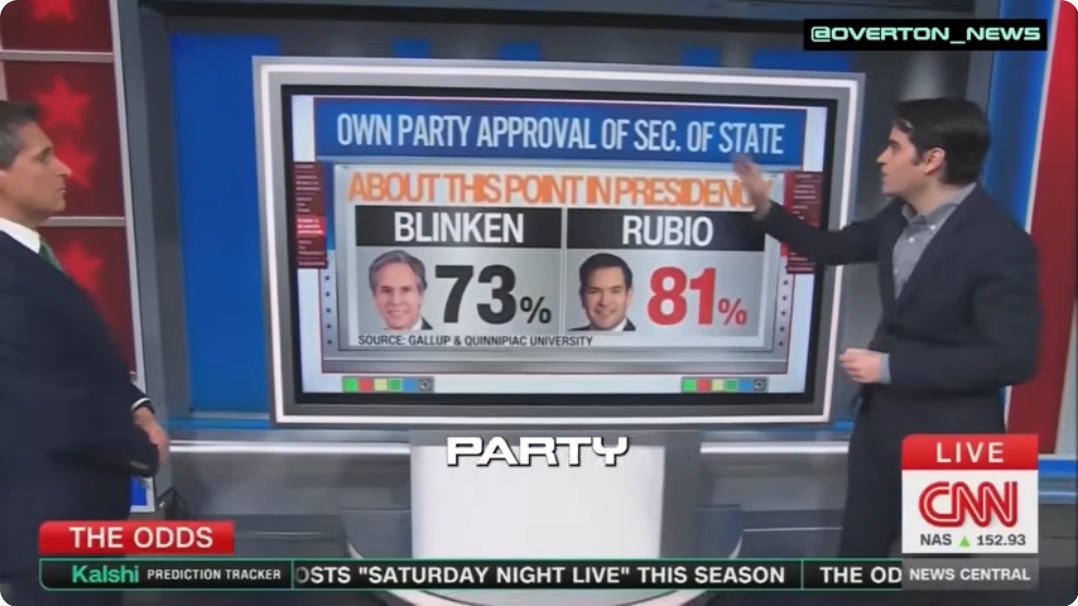
Enten also said Rubio’s personal approval rating among Republicans has reached 81 percent. That puts him ahead of recent Secretaries of State, including Antony Blinken during the Biden years. History also helps Rubio’s case, since six former secretaries of state have later won the presidency.
Enten added that Rubio’s close connection to Trump matters, too. He pointed to their public chemistry and said Rubio seems to be benefiting from the administration’s good standing without losing support from the party base.
Rubio has also stayed active on issues Republicans care about most, including immigration and the economy. Those issues played a major role in Trump’s wins. His background in Florida and his years in the Senate also give him appeal in key battleground states.
JD Vance Remains a Strong Rival Despite Rubio’s Momentum
Even with Rubio getting fresh buzz, JD Vance is still firmly in the race. Early polling shows he keeps strong backing among working-class voters, and he still benefits from the name recognition that came with the 2024 ticket.
Earlier, Enten praised Vance’s lead in colorful terms. He compared Vance to Mario Andretti and said the rest of the field looked like “go-karts.” For months, Vance controlled New Hampshire polls and led prediction markets.
Today, he still holds a strong place near the top. His America First message and appeal to younger conservatives keep him in the fight. In addition, his role as vice president gives him direct access to donors, party activists, and voters across the country.
The battle between Rubio and Vance could shape where the Republican Party heads next. Rubio brings a foreign policy record. Vance speaks more directly to domestic populism. Both fit into the broader Trump movement, but they carry it in different ways.
Turning Point USA Backs JD Vance for 2028
Turning Point USA has already made its position clear. Erika Kirk, the group’s new CEO and the widow of founder Charlie Kirk, said the organization plans to throw its support behind Vance.
Speaking at a recent Turning Point event, she told the crowd, “We are going to get my husband’s friend JD Vance elected for ’28 in the most resounding way possible.”
Kirk also said one of Charlie Kirk’s final conversations centered on support for Vance. She later told reporters that efforts to back a possible JD Vance presidential run are already underway.
Turning Point USA plans to organize young conservative voters, run turnout efforts, and spread Vance’s message online and on college campuses. Because the group has strong reach with Republicans under 30, its support could matter in early primary states.
That endorsement reinforces Vance’s standing inside the MAGA movement. At the same time, it shows how unsettled the race still is, with major allies lining up behind different contenders.
What Rubio’s Surge Means for the 2028 Race
Rubio’s rise comes at an important moment. President Trump has not named a preferred successor, and reports say he has weighed both Rubio and Vance in discussions with donors.
Polls and prediction markets can swing quickly. Still, Enten’s read on the data points to real momentum behind Rubio. If his approval numbers stay high and his foreign policy record continues to help him, he could strengthen his grip on the Republican nomination fight.
Vance, on the other hand, still has a clear path. He can lean on grassroots support, his vice presidential profile, and Turning Point’s organizing power. His team is also likely to focus on domestic wins tied to the current administration.
Other possible Republican names, including Nikki Haley and Tulsi Gabbard, remain far behind in current markets, both below 10 percent. On the Democratic side, Gavin Newsom has started to emerge as an early favorite in some betting models.
Voters continue to rank the economy and border security as top concerns. Recent Harvard CAPS/Harris polling shows both Rubio and Vance perform well on those issues.
No one has officially launched a 2028 campaign yet, but the race is already gaining heat. Early fundraising, endorsements, and public visibility will shape who breaks through first.
Rubio vs. Vance, Key Strengths at a Glance
- Marco Rubio: Strong foreign policy profile, 81 percent GOP approval, rising odds that reached 27 percent for the nomination, plus a historical boost from the secretary of state’s track record.
- JD Vance: Early primary strength, including 51 percent in New Hampshire, support from Turning Point USA, a loyal MAGA base, and the visibility that comes with serving as vice president.
- Shared advantage: Both closely align with Trump’s agenda on immigration and the economy.
Analysts still warn against reading too much into early data. Prediction markets show a moment in time, not an outcome. Even so, Rubio’s rise has been fast enough to grab attention across the political world.
Enten’s latest breakdown makes one thing clear: Rubio is gaining ground quickly and now looks capable of challenging, and maybe passing, the rest of the field.
As 2028 moves closer, more polls, more endorsements, and more surprises are sure to follow. For now, Rubio’s jump in the numbers has put him in a strong spot at the front of the Republican race.
The next several months will show whether Rubio can keep that momentum going, or whether Vance’s organized support helps him reclaim the lead. One thing is clear: the 2028 race is underway, and the drama has already started.
Trending News:
Trump Eyes Historic NATO Exit as Allies Prove Their Disloyalty
Politics
Democrats May Be Moving to Rig the System as They Lose the Majority
Are demographic changes and new legal battles creating an uphill climb for the Democratic Party? Here is a look at the forces reshaping the House of Representatives.
WASHINGTON, D.C. – The political landscape of the United States is literally on the move, especially for the Democrats. Over the past few years, a steady stream of Americans has relocated from traditionally liberal, or “blue,” states to more conservative, “red” states.
While people move for many reasons—like finding cheaper housing, lower taxes, or warmer weather—this massive shift in population is creating a complex challenge for the Democratic Party.
As the map changes, the balance of power in Washington, D.C., is changing with it. Because political power in the House of Representatives is tied directly to population, these moves are fundamentally altering the electoral math. Combined with recent legal battles over voting districts and changing birth rates, political experts are pointing to a potential long-term hurdle for the current liberal coalition.
Here is a closer look at the key factors driving this shift and how political leaders are responding.
The Great Migration: Moving South and West
To understand the current political challenge, you have to look at the numbers. Every ten years, the U.S. Census Bureau counts the population. Based on those numbers, the 435 seats in the House of Representatives are divided among the states.
Recently, states like California, New York, and Illinois have seen their populations drop or grow much more slowly than the rest of the country. At the same time, states like Texas, Florida, and North Carolina have boomed.
When a state loses population compared to others, it loses seats in the House. When it gains population, it gains seats.
- Blue State Losses: Following the 2020 Census, states that typically vote Democratic lost political representation.
- Red State Gains: States with conservative majorities picked up those lost seats, giving them more voting power in Congress.
This means that before a single vote is even cast in an election, the baseline map has already tilted slightly away from states that traditionally support Democratic candidates.
The Redistricting Threat: An “All-Out War” Scenario
Once states know how many House seats they have, they must draw the map to create voting districts. This process is called redistricting. When politicians draw these lines in a way that gives their own party an unfair advantage, it is known as gerrymandering.
Currently, Republicans control more state legislatures than Democrats. This gives them more power over how these district lines are drawn across the country. Some political analysts have warned that if both parties decided to push the rules to the absolute limit, the Democratic Party would be at a severe disadvantage.
Highlighting this exact risk, a recent political commentary noted the extreme potential of this imbalance:
“There were some recent studies by various pollsters about what would happen if all of the states decided to engage in redistricting, gerrymandering, based on the relative control of the state legislatures. And it came up with a very surprising result: If the Republican red states, or purple states that have Republican majorities, decided to redistrict and Democrats did spirit the same, an all-out war, there would be about 262 Republicans and only 173 Democratic seats.”
While this is a worst-case scenario rather than the current reality, the numbers show just how fragile the balance of power truly is.
Legal Rulings and Changing Demographics
Beyond state lines, the rules about how districts can be drawn are also changing. In recent years, the courts have issued complex rulings regarding racial gerrymandering. For decades, the Voting Rights Act has been used to ensure minority voters have the ability to elect candidates of their choice, which often benefited the Democratic coalition.
However, recent legal challenges and Supreme Court decisions have made it harder to use race as a primary factor when drawing voting maps. Some political analysts argue that these legal shifts restrict the ability of Democrats to group reliable voting blocs together, further threatening their electoral math.
At the same time, experts point to another long-term trend: declining birth rates in major cities. Progressive urban hubs, which are the core of the Democratic base, are seeing fewer births compared to more conservative rural and suburban areas. Over time, a lower fertility rate means slower population growth. In a system where political power relies heavily on headcounts, this slow growth limits the party’s future expansion.
The Push for Structural Reform
Facing a map that seems to be tilting away from them, some Democratic leaders and progressive activists are looking beyond traditional campaigns. If the current rules make it hard to win a secure majority, many are arguing that the rules themselves need to change.
To maintain influence and counter these demographic disadvantages, there is a growing push within the party for major structural changes to the American governing system. Some of these proposals include:
- Abolishing the Filibuster: Removing the rule in the Senate that requires 60 votes to pass most laws. This would allow a narrow majority to pass sweeping national voting rights protections.
- Expanding the Supreme Court: Adding more justices to the highest court to balance out the current conservative majority, which could change future rulings on gerrymandering.
- Statehood for D.C. and Puerto Rico: Making Washington, D.C., and Puerto Rico official states, which would likely add reliable Democratic seats to both the House and the Senate.
- Ending the Electoral College: Moving to a system where the president is chosen by a simple national popular vote, bypassing the state-by-state map entirely.
Supporters of these ideas say they are necessary updates to make American democracy fairer and more reflective of the national popular vote. Critics, however, view these proposals as radical attempts to rewrite the rules of government simply to hold onto political power.
Looking Ahead: A Divided Future
The American political system is designed to handle population shifts, but the speed of the current changes is creating heavy friction. As Americans continue to pack up moving trucks and head to new states, the political map will keep changing.
For the Democratic Party, the challenge is clear. Relying purely on traditional campaign strategies in their usual strongholds may no longer be enough to secure a lasting majority. Whether the party can win over voters in these growing red states, or whether they will succeed in changing the structural rules of the game, remains one of the biggest political questions of the decade.
Trending News:
Supreme Court Crushes Democrats’ Racial Gerrymandering in 6-3 Decision
Democrats Push Back on the SAVE Act Despite 85% of Voters Backing Voter ID
Politics
AOC Says the US May Have Already Had a Gay President, Obama, Buchanan?
WASHINGTON, D.C. – In the fast-paced world of modern politics, rumors fly quickly. A single quote can spark a massive internet debate in a matter of minutes. Recently, Representative Alexandria Ocasio-Cortez (often referred to as AOC) made a comment that caught fire online. During an interview, she suggested that the United States might have already had a gay president.
This short statement instantly got people talking. Who could she mean? Some people immediately jumped to former President Barack Obama. This jump in logic was fueled by a highly controversial interview hosted by conservative commentator Tucker Carlson. Carlson recently spoke with a man named Larry Sinclair, who made shocking claims about a past relationship with Obama.
But how do these pieces actually fit together? Let’s break down the facts, separate real history from internet rumors, and look at the true story like responsible news readers.
AOC’s Viral Comment: What Did She Actually Say?
During a recent discussion about the future of American politics, AOC was asked about the possibility of a gay or female president taking office in the future. Her response was simple but thought-provoking. She stated that there are good chances the United States has already had a gay president.
She did not name any specific names. She did not point fingers at any modern leaders. She simply stated a fact that many historians have debated for decades.
When a high-profile politician says something like this, the internet goes wild. People naturally try to fill in the blanks. Because AOC did not specify a president, imaginations ran free. However, to understand her comment properly, we have to look at history, not modern conspiracy theories. She was bringing up a well-known historical debate, not dropping a secret about a living leader.
Was AOC Referring to Barack Obama?
The short, factual answer is no. There is absolutely zero evidence to suggest Alexandria Ocasio-Cortez was talking about Barack Obama.
Why did people make this connection? In today’s fast-paced media world, unrelated stories often get mashed together. Because AOC’s comment went viral around the same time certain rumors about Obama resurfaced on social media, some people incorrectly assumed they were connected.
They were not. AOC, a progressive Democrat, has a strong working relationship with the Obama network. Furthermore, the rumors surrounding Obama are widely considered by serious journalists to be baseless political attacks.
If she was not talking about Obama, then who? Before we answer the real historical question, we need to address the modern rumor mill. We need to look at exactly where the Obama rumors came from and why they made headlines again.
The Tucker Carlson and Larry Sinclair Interview
To understand the Obama rumors, we have to look back at a broadcast from September 2023. Former Fox News host Tucker Carlson aired an interview on the social media platform X (formerly known as Twitter). His guest was a man named Larry Sinclair.
During this interview, Sinclair made incredibly extreme claims. He alleged that back in 1999, he met Barack Obama in Chicago. Sinclair claimed that the two of them bought and used illegal drugs together. He also claimed they engaged in sexual acts. These are incredibly heavy accusations to level against a former President of the United States.
Carlson presented the interview to his millions of followers. He sat and listened as Sinclair told his story. Carlson did not push back hard. He did not demand hard proof. He simply let Sinclair speak, framing the story as a dark secret that the mainstream media was hiding from the public.
For a professional journalist or a media personality, running a story like this requires a very high burden of proof. But did Sinclair actually have that proof?
Fact-Checking Larry Sinclair: Why The Claims Fall Apart
When you hear a shocking story in the news, it is crucial to look at the source. This is the foundation of media literacy and good journalism. When we look closely at Larry Sinclair, his story quickly unravels. Here are the clear facts you need to know:
- A History of Deception: Larry Sinclair is not a reliable witness. He has a long, documented criminal history. His record includes multiple convictions for fraud, forgery, and theft. He has a well-known history of conning people and making up stories for personal gain.
- No Supporting Evidence: Sinclair has been telling this same story since 2008. He originally tried to ruin Obama’s first presidential campaign with these claims. However, in over 15 years, he has never produced a single piece of hard evidence. There are no photos, no credible witnesses, and no paper trails to back up his words.
- Failed Polygraph Tests: Back when Sinclair first made these claims, he took a polygraph (lie detector) test to prove he was telling the truth. He failed it. In fact, the people who paid for the test stated that the results showed clear deception.
- Journalistic Backlash: Carlson faced heavy criticism for giving Sinclair a massive platform. Many experts and journalists pointed out that the interview was a political smear, not real news. As The Guardian reported on the interview, it seemed to be a desperate attempt for ratings, relying on a discredited conspiracy theory rather than facts.
In short, the Larry Sinclair story is widely rejected by serious journalists and historians. It is a fabricated tale from a convicted fraudster. Therefore, it is entirely safe to say AOC was absolutely not thinking of this discredited internet rumor when she made her comments.
If Not Obama, Then Who? The Story of James Buchanan
So, if AOC was not talking about Barack Obama, who was she referring to? When historians debate whether the US has already had a gay president, they almost always point to one historical figure: James Buchanan.
James Buchanan was the 15th President of the United States. He served right before Abraham Lincoln. To this day, he remains the only president in US history to remain a lifelong bachelor. He never married.
But that is not the only reason historians speculate about him. For many years, Buchanan lived closely with another male politician named William Rufus King. King was a senator from Alabama and eventually became Vice President. The two men were incredibly close. They shared a home in Washington, D.C. for over a decade.
Their relationship was an open secret in the capital. Other politicians often mocked them. They referred to them using feminine nicknames like “Miss Nancy” and “Aunt Fancy.” Some political rivals even called King the “better half” of Buchanan.
Furthermore, when King moved to France for a diplomatic mission, Buchanan wrote a very emotional letter to a friend. He wrote about how incredibly lonely he was without King. He said he had gone “wooing” to several gentlemen, but could not find anyone to replace his companion.
Looking at History Through a Modern Lens
We have to be careful when looking at the past. People in the 1800s did not use words like “gay” or “homosexual” the way we do today. Their understanding of relationships, romance, and identity was simply different. Therefore, no reputable historian will say with 100% certainty that James Buchanan was a gay man in the modern sense.
However, many historians agree that his intense, lifelong bond with William Rufus King looks very much like a same-sex partnership. This is the exact historical context AOC was likely referring to. She was acknowledging a well-documented piece of American history, not spreading a modern rumor.
There has also been some light historical speculation about other figures, including Abraham Lincoln, who shared a bed with a close male friend for years. However, bed-sharing was a common practice for men in the 1800s due to a lack of space and heating. Therefore, Buchanan remains the primary focus of this specific historical debate.
The Difference Between History and Conspiracy
This whole situation highlights a major problem in today’s media environment. It shows exactly how easily facts get twisted to fit a certain narrative.
On one hand, you have a legitimate historical conversation. Representative Ocasio-Cortez pointed out a valid, historically supported theory about the 15th president. It is a real conversation based on letters, primary documents, and academic debate.
On the other hand, you have the Larry Sinclair interview. This is a baseless rumor started by a convicted fraudster. It is designed to create anger, score political points, and get internet clicks. When media figures treat these two things as equal, it deeply confuses the public.
As readers and citizens, we must learn to tell the difference. We have to demand hard evidence. When someone makes a wild claim, we must look at their background. If a story sounds too crazy to be true, and there is absolutely no proof to back it up, it is usually a lie.
Finding the Truth in the Noise
To wrap things up, let’s review the facts clearly.
First, AOC stated that the US may have already had a gay president. She was almost certainly referring to the long-standing historical speculation surrounding President James Buchanan.
Second, she was not referring to Barack Obama. The rumors about Obama having a secret gay past are completely unfounded.
Finally, the interview between Tucker Carlson and Larry Sinclair was a revival of an old, heavily debunked smear campaign. Sinclair is a known conman with zero evidence to support his claims.
In an era where news travels at the speed of light, it is more important than ever to read past the headlines. By sticking to verifiable facts, trusting credible sources, and using simple common sense, we can safely navigate the noisy world of political news.
Trending News:
CNN Reveals Trump’s GOP Approval Tops Obama and Bush at the Same Point
Democratic Party Insiders Turning on AOC Move Against the Progressive Squad
AOC Faces Bipartisan Backlash Over Munich Security Conference Gaffes
Politics
California Democrats are Panicking Over the 2026 Governor’s Race
SACRAMENTO – In California state where Democrats outnumber Republicans two-to-one, the political establishment is currently grappling with an unthinkable nightmare: a total lockout from the November ballot.
The race to succeed term-limited Governor Gavin Newsom has devolved into a chaotic scramble. With a crowded field of seven major Democratic candidates splitting the liberal vote, the party’s internal anxiety has shifted from “who will win” to “will we even be there?”
Current polling suggests that the state’s unique “top-two” primary system could pave the way for two Republicans—Riverside County Sheriff Chad Bianco and former Fox News host Steve Hilton—to advance to the general election, leaving Democrats on the sidelines for the first time in modern history.
The “Top-Two” Trap
California’s primary system is a “jungle.” Instead of separate party ballots, every candidate runs on a single ticket. The top two finishers, regardless of party, move on to November.
For years, this system favored Democrats, often leading to “Blue vs. Blue” general elections. But in 2026, the math has flipped. While the Republican base has largely consolidated behind two high-profile names, the Democratic vote is being sliced into seven thin pieces.
Current Polling Snapshot (April 2026)
According to recent data from Public Opinion Firm Evitarus, the leaderboard is a statistical dead heat that favors the GOP:
- Chad Bianco (R): 14-16%
- Steve Hilton (R): 14-16%
- Katie Porter (D): 11-12%
- Tom Steyer (D): 11%
“This is a failure of leadership at the top,” said RL Miller, chair of the party’s environmental caucus, in a recent interview with CalMatters. “The idea that we could end up with two Republicans in a state this blue is terrifying.”
The Democratic panic isn’t just about numbers; it’s about a lack of a “clear heir.” Heavyweights like Senator Alex Padilla and former Vice President Kamala Harris opted out of the race. This left a vacuum that has been filled by candidates who are currently more focused on attacking each other than on the looming Republican threat.
- The Swalwell Collapse: Representative Eric Swalwell recently suspended his campaign and resigned from Congress following a series of scandals. His exit was expected to help consolidate the field, but instead, it has only intensified the infighting among the remaining candidates.
- Identity Politics and Infighting: Former Rep. Katie Porter, billionaire Tom Steyer, and San Jose Mayor Matt Mahan are all fighting for the same donor pools and demographics.
- Leadership Silence: Party titans like Nancy Pelosi and Gavin Newsom have stayed silent. Despite pleas from activists to “cull the field” and pressure lower-polling candidates to drop out, the party leadership has refused to intervene.
The Republican California Strategy: A “Tie” is a Win
For Republicans, the path to the governor’s mansion doesn’t require a majority of Californians—it just requires a unified minority.
Steve Hilton, who carries an endorsement from President Donald Trump, and Chad Bianco, a populist law enforcement figure, are running neck-and-neck. Strategists note that as long as they stay tied, they likely soak up enough of the 25% Republican registration to block any single Democrat from reaching the top two spots.
Both GOP candidates are leaning into “cost of living” issues, targeting the California Environmental Quality Act and promising massive tax cuts to woo independent voters who feel the state has become unaffordable under Democratic rule.
If a Republican wins, they would face a deep-blue State Legislature with Democratic supermajorities. While a GOP governor might struggle to pass new laws, their “veto pen” could grind the state’s progressive agenda to a halt.
More importantly, a Republican victory in California would be a psychological earthquake for the national Democratic Party. It would signal that even the most secure “Blue Wall” states are vulnerable when voters feel the sting of inflation, crime, and housing costs.
Key Factors to Watch Before the June Primary:
- The “Drop Out” Pressure: Will lower-tier Democrats like Betty Yee or Xavier Becerra exit the race to save the party?
- Independent Voters: Nearly 22% of California voters are “No Party Preference.” Their shift toward Bianco or Hilton could seal the deal.
- Voter Turnout: Traditionally, lower turnout in primaries favors Republicans.
For now, the mood in Sacramento is one of “paralysis and frustration.” As mail-in ballots prepare to go out, the Democratic Party is holding its breath. If they can’t thin their own herd, they might find themselves watching the most important race in the state from the bleachers.
As one Democratic strategist put it: “We are watching a slow-motion train wreck, and everyone is too polite to tell the drivers to get off the tracks.”
Related News:
Yamaha Joins the Mass Exodus from California
BMR California Explained: Rules, Income Limits, and How to Apply
Republicans Gain Ground in California While Businesses Flee Blue States
-
Politics3 months agoIlhan Omar’s Connections to Convicted Somali Fraudsters Surface
-
Politics3 months agoTrump Approval Rating (February 2026 Poll Results, Approve vs Disapprove)
-
Politics3 months agoAOC’s Critique of Rubio’s Speech Turns into an Huge Embarrassment
-
Politics2 months agoRep. Ilhan Omar Faces Heat as Minnesota Voters Seek Change
-
Crime3 months agoErika Kirk Faces Renewed Grooming Allegations Over 2014 Messages
-
Politics2 months agoCalls Mount to Expel Rep. Ilhan Omar from Congress
-
Business3 months agoCNN Ratings Collapse As Cable Giants Face Extinction
-
News2 months agoIlhan Omar Accused of Leaking U.S. Strike Plans to Iran as Tensions Rise