


European Union
Romania’s Imperfect Democracy, the Anatomy, Challenges, and Future
Romania is living through a period of moral and institutional change, where freedom exists in law but is not yet fully lived as a personal duty. Habits of obedience and conformity, shaped by a long history of survival through adaptation, now act as quiet tools of balance. They help avoid open conflict and preserve order, but they also block deeper change.
This study looks at how this inner culture of conformity creates a surface stability, a kind of “toxic stability”, kept in place through caution, loyalty, and fear of risk. Against this background, the honest citizen appears as the only genuine source of moral authenticity, able to reconnect freedom with dignity.
The text is part of the series “Anatomy of an Imperfect Democracy: Romania” and invites a clear-eyed reflection on truth, responsibility, and democratic culture in post-authoritarian societies.
Romania’s state and society: the paradox of formal freedom
In the decades after communism, Romania has gone through a wide transformation that changed how the state and citizens relate to each other. The fall of the regime in 1989 opened the way to democracy, but real change depended less on new institutions and more on how people learned to live with freedom. Laws were rewritten, yet social behavior kept following older patterns, born from long practice in adapting to power to survive.
Democracy in Romania grew through slow steps, compromises, and a mix of hope and mistrust. Institutions started to operate, but not always with the real confidence of the people they serve. Many citizens came to see public participation as a formal duty, not as an act of conviction or influence. Over time, critical thinking faded into a careful caution, shaped by long experience with instability and uncertainty.
Within this fragile order, a zone of functional neutrality appeared. It is a narrow corridor of survival where truth still exists, but rarely changes anything. Ideas circulate, values are declared, yet they seldom reshape behavior deeply. Rather than supporting open and honest confrontation, society has often chosen the calm of agreement and the comfort of a steady status quo.
This paper looks at how a democracy that appears stable can become dependent on its own instinct for self-preservation. The focus is not on individual faults, but on the ongoing presence of a culture of rational submission, visible in institutional obedience and social conformism. This culture provides stability, but blocks renewal; it keeps balance, but weakens the appetite for change.
The key question is not whether Romanian democracy will survive, but how it changes when freedom is no longer lived as an ideal and instead is treated as a routine procedure.
Reflexes of obedience and mechanisms of social conformism
Centuries of adaptation have turned obedience into a form of daily wisdom. In a context with low trust, submission became a survival tool, and silence became a way to keep balance. These behaviors took root in social life and slowly formed a culture built on avoiding risk. This was not the outcome of a planned decision, but the result of many generations for whom safety depended on discretion and compliance.
In societies where freedom was won through continuous struggle, civic courage gained the status of public virtue. In Romania, freedom came more as a historical opening, a window suddenly unlocked in a world that had not yet learned how to breathe the air of responsibility. Under these conditions, the instinct to avoid exposure grew into a kind of collective logic: knowing when to keep quiet, who to align with, and how not to disturb the fragile order.
Social psychology shows that obedience is a common human trait, not an exception. Stanley Milgram’s experiments revealed that, within strong institutional settings, people often obey authority even when it conflicts with their conscience. Solomon Asch’s research on conformity showed that group pressure can change perception so much that people deny what they clearly see. Philip Zimbardo’s work on behavior under power demonstrated how quickly roles can overpower personal principles.
These are not abstract theories. They describe accurately how a society works when its citizens learn that survival depends on fitting in. In Romania’s public life, obedience rarely appears as blunt coercion. It looks more like a silent deal between fear and caution. People are not openly forced to agree, but they come to feel that open disagreement has a cost. This mindset of “strategic moderation” turns a lack of courage into something seen as intelligent and prudent, not as a flaw.
Today, obedience shows itself mainly through institutional routines. Every sector has its own style of compliance: in politics through loyalty, in public administration through strict procedural behavior, in workplaces through quiet acceptance. The result is a society that seems orderly on the surface, but remains rigid and slow inside. The initiative looks suspicious, and conformity is rewarded.
In such an environment, freedom does not vanish, but becomes a stage setting for a kind of fake responsibility. Participation turns formal, courage moves inside, and dignity often gets confused with skillful adaptation. Obedience reflexes no longer act only from outside pressure. They move inside people, and work through the need for safety, the reflex to avoid conflict, and the silent belief that keeping quiet can take the place of justice.
The main problem is not that these reflexes exist, but that they often remain invisible to those who follow them. A mature democracy does not try to erase obedience; it transforms it into civic discipline. It does not deny conformity; it places it under the guidance of moral judgment. Collective growth depends on this change of meaning: from fear of authority to respect for fair rules, from self-protective silence to responsible dialogue.
Without such a shift, freedom remains an empty civic ritual, and the citizen becomes a disciplined performer in a script that repeats itself without real change.
Politocracy, the new form of captive democracy
Every political system carries a tension between the ideal of representation and the instinct to hold on to power. In Romania, this tension has settled into what can be called a politocracy: a group of political managers who administer democracy as if it were private property. Politocracy is not a doctrine and not a hidden plot. It grows naturally from a selection process that rewards loyalty over skill and caution over initiative.
Over time, the political structure learned to protect itself through two main filters. The first is bureaucratic, made of regulations, committees, and paperwork that confirm procedure but rarely measure real performance. The second is psychological, built from networks of personal dependence that keep stability through gratitude, favors, and silence. Together, these filters shape a conservative democracy, focused more on self-preservation than on meaningful reform.
Politocracy proves effective precisely because it does not need open authoritarian control. It does not forbid debate; it simply weakens its effect. It does not fully block new ideas; it redirects them into safe and harmless directions. Power does not appear as raw force, but as the management of routine and expectations. In this setting, personal competence can appear dangerous, and clear-sighted judgment can lead to isolation.
A captive democracy is not marked by the lack of formal freedom, but by the lack of consequences. Any serious act, no matter how grave, tends to be absorbed by a dense network of excuses, procedures, and mutual protections. Responsibility spreads so thin that it almost disappears, and shared guilt turns into a strange type of solidarity. Institutions shield each other, while citizens adjust to this ongoing balancing act, telling themselves that real change would only disturb public order.
This stability is toxic because it does not destroy openly; it neutralizes. Politocracy does not generate big crises; it swallows them. It is not troubled by scandal; it converts scandal into a controlled spectacle. Power keeps itself through small things, through everyday complicity, through careful distribution of favors and paid silence. On the surface, it looks like a calm democracy. At its core, it is a finely tuned system of traded interests and quiet fears.
In this frame, citizens no longer act as real participants, but as conditional users of stability. They hold formal rights, but hesitate to fully use them for fear of disturbing the fragile peace. Beyond voting, civic action often turns into a public gesture for the cameras, and criticism into a ritual outburst that leads nowhere. Politocracy accepts protest, but drains its energy by integrating it into the system: dissent becomes a paid position, revolt turns into a TV show, and indignation becomes routine content.
This mechanism helps explain how Romania can remain a democracy without having enough democrats in practice. Laws exist and are largely respected, but they are not applied evenly. Institutions operate, but rarely take the risky decisions that could bring real change. People vote, yet those votes dissolve inside a system that stays structurally the same. Politocracy feeds on continuity, not on open conflict.
Paradoxically, the lack of major breakdowns keeps this pattern alive. Nothing is dramatic enough to force a deep reset, yet nothing is solid enough to generate trust. The system floats in a permanent balance, a balance that does not strengthen society but lulls it.
To understand politocracy means to see more than the flaws of politicians. It means recognizing a wider culture of functional mediocrity that spreads through all public fields. The real capture is not just institutional, it is mental. It shows in the habit of lowering standards, of confusing loyalty with merit, and of mixing simple resignation with a sense of balance.
Toxic stability and the illusion of competence
Stability is one of the strongest collective desires, but also one of the easiest illusions. In young democracies, it often becomes a goal in itself, not the result of good governance. In Romania, stability has slowly turned into a shield for the political and administrative system. It no longer works primarily for citizens; it works to protect its own continuity.
This stability is “toxic” not because it is openly forced, but because it is staged. It gives the image of a coherent institutional order while hiding a deep reliance on improvisation. Behind every crisis, the same safety nets appear, the same balancing tactics between groups, the same ability to contain conflicts without solving them. The structure does not transform; it merely adjusts its surface to keep looking functional.
Attached to this self-balancing mechanism is a culture of fake competence. In a society where merit does not stand at the center, competence becomes more a style of speech than a real standard. Public actors constantly refer to expertise, but in practice, they choose predictability. They speak of professionalism, but they promote those who fit the system, not those who perform.
This illusion of competence is a powerful tool of symbolic control. It helps the system excuse its own inertia with nice phrases about stability: “it is not great, but it works”, “it is not ideal, but it is balanced”. In truth, this balance usually comes from general fatigue. Citizens stop asking for change and start asking only for a basic order. They no longer look for real leaders; they look for someone who will keep things from getting worse.
Toxic stability keeps itself through an alliance between weakness and caution. Incompetent actors are rarely removed because they do not threaten the structure. Brave or independent people are seldom brought inside, because they might shake the comfort of others. Instead of fair competition, there appears to be a form of permanent cohabitation, where every level of the system protects its own comfort zone.
The result is a reversed meritocracy. Success is measured less by results and more by survival and loyalty. Real competence seems risky, and innovation looks dangerous. In this climate, performance becomes suspicious, and stagnation appears as proof of balance. Society internalizes this logic and starts viewing stability as a value in itself, even when it blocks progress.
This pattern can be seen most clearly in public administration, the economy, and cultural life. In administration, promotions often follow loyalty, not skill. In business, success often depends on access and connections, not only on creativity or efficiency. In culture, recognition comes more often through belonging to influence circles than through clear public merit. Step by step, these practices build a system of negative selection, where mediocrity becomes both norm and safety guarantee.
Politocracy rests on this pattern: a balance between dependence and comfort, where almost no one has a real interest in disturbing the calm surface. Power is managed, not challenged. Criticism generates noise, not change. The system stays in a state of “controlled movement”, enough to look active, never enough to transform itself.
To understand toxic stability does not mean to reject order. It means recognizing that a balance kept through fear, fatigue, and resignation cannot support development. Real stability grows from trust in fair and predictable rules. Without this step, society stays trapped in a circle of excuses, in which every level defends its own comfort, all in the name of the public good.
The honest citizen and the moral boundary
Any political order, no matter how complex, rests on people’s belief that justice can still happen. When that belief fades, democracy does not fall overnight; it slowly empties of meaning. Institutions keep running, procedures stay in place, but the moral value of taking part in public life grows thin. In such a context, the honest citizen becomes more than a private figure. This person becomes a condition for the inner health of the whole community.
To remain honest in a system shaped by politocracy does not mean to act as a hero. It means refusing to join in the comfortable lie. Honesty rarely shouts. It works through steady behavior and a clear refusal to abandon lucidity. This type of conduct does not transform the system at once, but it keeps the door open for possible change. Without it, public responsibility shrinks into mere ceremony.
In a society that praises adaptation, the honest citizen looks like a paradox. This person stays in the system, but does not melt into it. He or she follows the rules, but never allows them to replace conscience. By simply existing, such a citizen brings a healthy tension between legality and morality, between what is allowed and what is right. This tension is a sign that democracy is still alive. Where it disappears, decay has already started.
Honesty is less an act of open resistance and more a way to stay whole in a fragmented world. It asks for continuity, not spectacle. It feeds not on outbursts of anger, but on clarity and calm. In a space crowded with image and pretence, moral lucidity becomes a kind of public hygiene, a simple readiness to see things as they are and not confuse them with their excuses.
There is a fine line between guilty silence and prudent silence. Guilty silence hides fear. Wise silence protects judgment. The honest citizen does not have to speak loudly all the time, but has the duty not to give inner consent to wrong. This person understands that freedom is not the absence of limits, but the capacity to internalize fair limits without giving up dignity.
In Romania, this moral figure is not a rare abstraction. It appears in many ordinary roles. It is present in professionals who do their work well when no one watches, in teachers who still believe that education has meaning, in officials who respect the law even when pressured to bend it. These people do not change the system with grand gestures, but through the quiet persistence of decency.
The real limit of a democracy does not come from laws alone; it comes from behavior. It is not imposed from outside; it grows from within. When honest citizens become the quiet norm, the system starts to heal in a slow but steady way. When such people are pushed aside or mocked, public power loses its sense and slips into a game without rules.
Democracy is not measured only by how many institutions exist, but by the quality of relationships among people. Honesty, in this sense, is not just a personal virtue. It is a form of public order. It does not set the individual against the state; it invites the person to take part consciously in shaping a shared future.
In an age tired of noise and false shows, the silence of honesty becomes one of the last solid forms of resistance. It is a silence that does not mean surrender, but a refusal to turn truth into a performance. From such quiet persistence, a new kind of public dignity can grow, one that does not seek applause but builds trust.
Epilogue, on truth and dignity
Democracies do not fail first because of flawed laws, but because trust collapses. When trust shifts into suspicion and truth becomes a matter of convenience, institutions keep their shape, yet lose the moral compass that guides them. Romania has spent many years in this fragile state, between hope and exhaustion, between clear sight and accommodation.
Since 1989, many citizens have confused freedom with procedure and responsibility with obedience. Conviction has often been replaced by reflex, critique by irony, and solidarity by suspicion. Over time, democracy has turned into a system that functions but seems to lack breath. Truth no longer leads; it is used mostly to excuse or decorate.
Still, inside this shared fatigue, a quiet resource endures: individual dignity. No decree and no public campaign can produce it. It appears in small acts, in refusing convenient lies, in staying faithful to principles even when they bring no quick benefit. Dignity is not a form of heroism. It is a way of remaining human in a world that constantly suggests compromise.
Truth, in its deeper sense, does not win by force. It is lived. It survives through the constancy of those who use it not as a weapon against others, but as a guide for their own choices. Societies that manage to rebuild themselves are not those that shout the truth the loudest, but those that live it with quiet consistency. In this light, the calm honesty of ordinary people has more weight than the noise of any demagogue.
Democracy is not a finished structure, but a shared state of awareness. It does not belong to buildings and formal offices; it belongs to people who decide, day after day, not to give up reason and decency. A community becomes truly free not when its laws look perfect on paper, but when it forms people who do not need fear to act fairly.
Faced with this clear fact, Romania still has a chance. This chance lies in turning fatigue into discernment, cynicism into higher standards, and raw silence into thoughtful reflection. It does not require miracles. It calls for a return to proportion and for the simple understanding that dignity is also a form of public order.
Truth cannot be imposed from above, but it can be relearned through example. Here begins the growth of an imperfect democracy: in the gestures of those who choose not to lie and not to be afraid.
About the author
Col. (ret.) Dr. Cătălin Balog is an analyst and trainer with long experience in intelligence, information security, and strategic communication. He holds a PhD in Military Sciences, based on a thesis on security risk management in cyberspace, and served for over twenty years in structures of the Ministry of National Defense.
He now teaches as an associate professor at the University of Bucharest, where he leads courses on information management. His work focuses on contemporary social and political mechanisms, with special attention to the links between ideology, technology, and the simulation of democracy.
Related News:
Peace Prize Awarded to Venezuela’s María Corina Machado
European Union
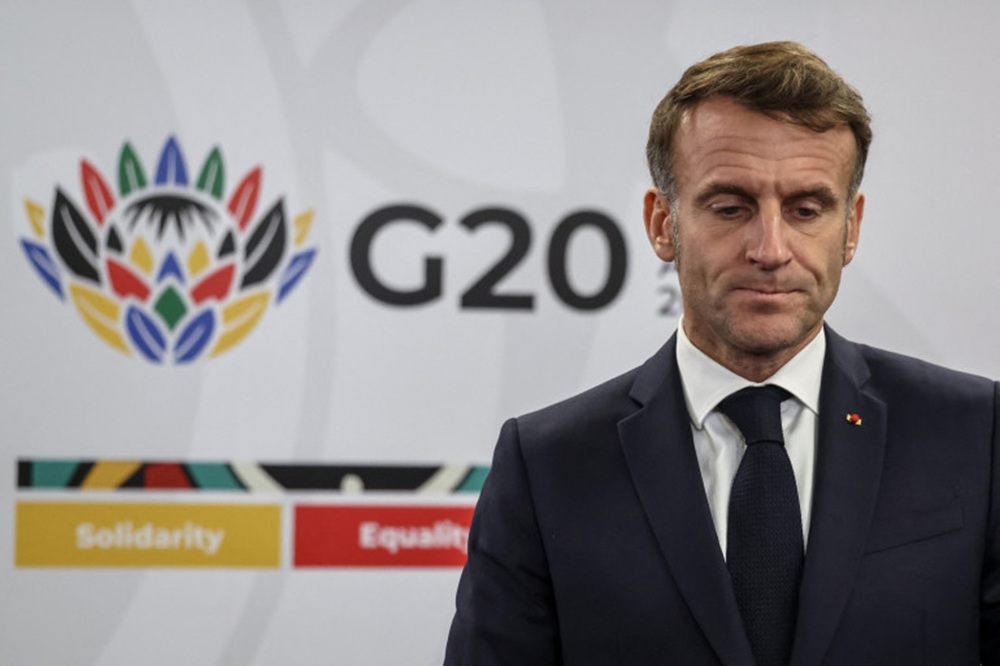
France’s Macron Accidentally Recreated the Chaos of the Fourth Republic
In just over a year, France has gone through three prime ministers. A journalist recently asked me why French politics has become so unstable. The short answer is easy to give, but the full story is about how a system built to avoid chaos has slipped into it.
How Macron Set Off the Current Crisis
The current political mess began with President Emmanuel Macron’s choice in June last year to dissolve the National Assembly and call early elections. He made this move right after the European Parliament elections, hoping a snap election would strengthen his hand.
The bet failed. Instead of gaining ground, he lost his already fragile majority in parliament.
A Presidential System, But Only Under Certain Conditions
France is often seen as a textbook example of a presidential system. The Fifth Republic, created in 1958, was designed to give strong powers to the president and avoid the constant turmoil that marked the Fourth Republic.
This model works smoothly when the president and the parliamentary majority come from the same political camp. In that case, which is how the system was broadly imagined, the prime minister acts as the president’s chief operator, pushing through the presidential agenda.
Things change when the majority in the National Assembly belongs to a different camp. Power then shifts away from the Élysée Palace and towards parliament. The president still matters, especially on foreign policy and defence, but the prime minister becomes the key player on domestic issues.
The French call this cohabitation, and it has happened several times.
Cohabitation in the Past
Socialist President François Mitterrand had to govern with prime ministers from the right, first Jacques Chirac, then Édouard Balladur. When Chirac became president, he faced the same situation from the other side. After calling a snap election that also went wrong, he had to work for several years with Socialist Prime Minister Lionel Jospin.
Those periods were tense and often quarrelsome, but they did not break the system. There was always a stable majority in parliament, even if it was not on the president’s side.
Why This Crisis Is Different
The current crisis is different for a simple reason: there is no majority in parliament. The problem is not cohabitation this time; it is fragmentation.
After last year’s snap election, no political bloc controls enough seats to govern alone. Macron’s centrists do not have a majority, and neither do the traditional right, the far right, or the left. The left-wing alliance of Socialists, Greens, and the far left won the largest share of seats, but still fell short of an outright majority.
Since then, Macron has focused on blocking a left-wing government from taking power. He has planned to build a centrist and centre-right coalition, topped up with enough Socialist MPs to get over the line.
The numbers simply do not work.
- If you give the Socialists what they demand, such as higher taxes on the wealthy or rolling back the pension reform, the right refuses to back the government.
- If you give the Socialists what they want, they pull out and can team up with the rest of the left and even parts of the far right to bring the government down.
Sébastien Lecornu, and before him Michel Barnier and François Bayrou, have all come up against the same dead end.
All this is happening while France’s public deficit keeps growing. Many voters now feel that the political class is unable to govern properly and that the system no longer functions. That mood is feeding support for populist parties both on the right and on the left.
Possible Ways Forward
If I had Macron’s ear, I would suggest a government of national unity, something similar to Switzerland’s model, where all major parties share power. Instead of being held hostage by each group, the president could pass responsibility back to them and make them share the burden of governing.
Another option would be a technocratic government, along the lines of what Italy has used during severe political standstills. In that setup, non-partisan experts run key ministries, and parties support them from parliament.
Both ideas sit uneasily with French political habits. They would require a big step into territory that France has rarely tried. That makes them unlikely in practice. A fresh snap election, sooner rather than later, seems the most probable outcome.
Back to the Fourth Republic?
There is an almost ironic twist to all of this. Today’s situation looks strikingly similar to the old Fourth Republic, a period marked by splintered parties, constant bargaining, and fragile coalitions that fell one after another. The Fifth Republic was designed precisely to break with that pattern.
Yet France now appears to be sliding back into the same kind of parliamentary chaos that the founders of the Fifth Republic wanted to leave behind.
Related News:
Macrons Sue Candace Owens Over Her Claims Brigitte Has a Penis
European Union
The Dayton Peace Agreement Continues to Hold After 30 Years
The Dayton Peace Agreement, signed in 1995, marked a historic turning point at the end of the twentieth century. It kept Bosnia and Herzegovina intact as a state and stopped a war that had lasted three and a half years.
The major global powers agreed on an international deal that protected the country’s statehood, borders, and status in international law.
Acting through the Contact Group, members of the UN Security Council (the United States, the United Kingdom, France, the Russian Federation, and the Federal Republic of Germany) set up the basic framework for long-term peace in Bosnia and Herzegovina.
Ending the war and the limits on building a functional state
Most authors agree that the Dayton Peace Agreement played a key role in ending the war in Bosnia and Herzegovina. At the same time, critics, especially of Annex IV,[3] argue that the ethnic-based constitutional and territorial set-up has held back the development of an effective and functional state.
Unlike many other peace agreements, the Dayton arrangement gives clear powers to international bodies to oversee and support its implementation.
The main actors in this process are:
- Peacekeeping forces, led by NATO, under a UN Security Council decision of December 1995
- The Office of the High Representative (OHR), with the High Representative serving as the top civilian authority for implementing the non-military parts of the agreement and supporting peacebuilding
- The European Union Special Representative, who backs reforms linked to Bosnia and Herzegovina’s path towards EU membership
- The Peace Implementation Council (PIC)
In the first post-war decade (1995 to 2005), international institutions helped to improve security and restore freedom of movement for people across the whole of Bosnia and Herzegovina. In the early years after the war, the Presidency of Bosnia and Herzegovina held its sessions in the National Museum because the Serb member of the Presidency at that time refused to use the official Presidency building in Sarajevo as the seat of state institutions.
Within the first five years, the High Representative, working with civil society organisations, designed and imposed a new coat of arms, flag, and anthem. The ruling parliamentary parties were unable to agree on these basic state symbols.
Parliamentary elections held in 1996, 1998, and 2000, with two-year mandates for state and entity parliaments, were meant to speed up democratic consolidation and support multi-ethnic civic parties. In practice, ethnic parties continued to dominate most election results.
Because ethnic parties could not agree on peacebuilding and state-building, the Peace Implementation Council (PIC) gave the High Representative the so-called Bonn Powers in 1998. Using these powers, the High Representative imposed 145 laws that formally belonged under the authority of the Parliamentary Assembly of Bosnia and Herzegovina.
These laws allowed reforms that supported peace consolidation and the creation of core state institutions. As part of these changes, the State Border Service (later the Border Police) and the Indirect Taxation Authority were created.
The Council of Ministers of Bosnia and Herzegovina grew from three to nine ministries, adding portfolios such as security, justice, human rights and refugees, transport and communications, the treasury and finance, and defence. This expansion gave the state a stronger executive capacity to carry out reforms and to support Bosnia and Herzegovina’s European Union integration process.
Joint Armed Forces of Bosnia and Herzegovina as a key post-Dayton reform
The unification of the separate entity armies into a single Armed Forces of Bosnia and Herzegovina is seen as one of the most important reforms after Dayton. This step brought full integration of entity forces and defence institutions at the state level. The development of the Armed Forces in line with NATO standards opened the way for gradual integration into the NATO alliance, as outlined in the Law on Defence of Bosnia and Herzegovina.
Major reforms also took place in the justice and security fields. The Court of Bosnia and Herzegovina and the Prosecutor’s Office of Bosnia and Herzegovina were established, along with the High Judicial and Prosecutorial Council (HJPC). The Intelligence-Security Agency (OSA) and the State Investigation and Protection Agency (SIPA) created the basic structure for a functioning state security system.
The full implementation of the Dayton Peace Agreement is now closely linked to Bosnia and Herzegovina’s integration into the European Union and NATO. Progress has been slow, largely because of a lack of agreement among ruling parties in the Parliamentary Assembly of Bosnia and Herzegovina. Since 2015, the High Representative has gradually reduced the use of the Bonn Powers.
Geopolitical changes near the end of the third decade of the Dayton period, especially the aggression of the Russian Federation against Ukraine in 2022, threatened peace in Europe but also sped up European integration processes. In this context, the Council of the European Union granted Bosnia and Herzegovina candidate status for EU membership, and negotiations are expected to start at the end of 2025.
Blockades of state institutions in Bosnia and Herzegovina and the obstructive actions of the National Assembly of the Republika Srpska slowed legislative work and reform. However, in 2025, rulings by the Court of Bosnia and Herzegovina helped break these blockades. The removal of Milorad Dodik (SNSD) from the post of President of the Republika Srpska marked a turning point in strengthening state institutions and pushing forward the country’s European integration path.
Political instability and the ongoing role of the OHR
As long as political life in Bosnia and Herzegovina remains unstable, with frequent crises of different intensity, the presence and engagement of the Office of the High Representative (OHR) will be necessary.
Its role is especially important in:
- Stopping actions that undermine the Dayton Peace Agreement
- Helping build the level of agreement needed to pass legislation in the Parliamentary Assembly of Bosnia and Herzegovina, which is essential for progress towards the European Union
Over the past thirty years, the OHR has used the Bonn Powers whenever ruling parties could not reach an agreement in the Parliamentary Assembly. This function is likely to remain important until Bosnia and Herzegovina becomes a full member of the European Union. The length of the OHR’s mandate in the coming years is closely linked to progress in EU and NATO integration and to the need to prevent new security risks and threats.
Recommendations for speeding up Bosnia and Herzegovina’s European integration
Key steps that could support faster EU integration include:
- Joint work by the OHR and the European Union Special Representative on putting the reform agenda into practice
- Turning the reform agenda into a joint document of the OHR and the EU Special Representative, prepared in cooperation with the Parliamentary Assembly of Bosnia and Herzegovina.
A major priority for the OHR is to support the adoption of a European clause in the Constitution of Bosnia and Herzegovina. This would make it easier and quicker to bring domestic law into line with the EU acquis communautaire.
The OHR should also increase pressure on parliamentary parties to form a broad coalition in support of a European, democratic, and law-governed Bosnia and Herzegovina after the 2026 elections. Such a coalition would give the winning parties a clear mandate and responsibility to push forward the EU integration agenda.
The OHR also has an important role in helping create international and regional conditions for constitutional reforms that are needed to speed up EU integration. Strengthening the democratic capacity of state institutions is linked to changes in the structure of the Parliamentary Assembly of Bosnia and Herzegovina.
Under these ideas, the House of Representatives would grow from 42 to 97 members, and electoral territorial units would cross entity borders rather than follow them. A larger number of representatives would allow for more thorough legislative work in committees and commissions.
It would also open space for professional associations and civil society organisations to engage more actively in public policy. At the same time, both the structure and the powers of the House of Peoples of the Parliamentary Assembly would be revised.
For the Council of Ministers of Bosnia and Herzegovina, proposals include the creation of two new ministries: a Ministry of Science and Technological Development and a Ministry of Agriculture and Ecology.
These ministries would respond to long-term needs in research, innovation, food production, and environmental protection, and they would support Bosnia and Herzegovina’s progress towards full European Union membership.
Related News:
Bosnia and Herzegovina Mark 30 Years Since the Dayton Peace Agreement
European Union
Bosnia and Herzegovina Mark 30 Years Since the Dayton Peace Agreement
Bosnia and Herzegovina will mark thirty years since the Dayton Peace Agreement on 21 November 2025, just two days before early elections for the President of Republika Srpska (RS), planned for 23 November.
The early elections were triggered by a final ruling of the Court of Bosnia and Herzegovina. The court sentenced Milorad Dodik (SNSD), former President of RS, to one year in prison, later turned into a financial penalty, and banned him from political activity for six years. Under the law, this decision automatically ended his presidential mandate.
The verdict has deepened institutional conflict. Authorities in RS and the SNSD at first refused to accept the ruling and continued to treat Dodik as an active political figure. They have now formally recognised the court’s decision, but state institutions and international actors still demand full and unconditional respect for judicial rulings.
This has created a clear paradox. On paper, Dodik has been removed from political life. In practice, he still controls the SNSD and large parts of the RS institutional system. This gap between formal restriction and real influence sits at the heart of the “Manchurian candidate” model, expressed through the candidacy of Siniša Karan (SNSD) as Dodik’s stand-in.
Candidates, real choice or political proxy?
The Central Election Commission of Bosnia and Herzegovina (CEC) has confirmed six candidates:
- Branko Blanuša (SDS), the joint candidate of the opposition bloc and the main challenger to the ruling camp.
- Siniša Karan (SNSD), the nominee backed by Milorad Dodik and the ruling structure, is widely viewed as Dodik’s political substitute, or, in effect, a “Manchurian candidate”.
The other candidates are Dragan Đokanović (Alliance for a New Policy), Nikola Lazarević (Environmental Party of RS), Igor Gašević (independent), and Slavko Dragičević (independent).
These candidates give the ballot a broader look, but their real impact on the final result is expected to be small. Their main influence is likely to be the possible division of the opposition vote.
How Dodik still shapes the campaign and why the SNSD has not been suspended
Although the Court of Bosnia and Herzegovina imposed a six-year ban on political activity on Milorad Dodik, practice inside the RS tells another story. The ruling says Dodik cannot hold public office or take part in any activity considered political. Yet the real balance of power has barely shifted.
Dodik still controls the key levers within the SNSD. He commands the party structure, an extensive network of loyal officials, and access to public money and institutions. In this setting, he can direct every major process from the background, from the choice of candidates and campaign strategy to party messaging and policy. In effect, he continues to operate as a political leader, even though this type of activity is formally banned.
This gap stems from a long-running clash between RS authorities and state-level institutions in Bosnia and Herzegovina. Tools for enforcing court decisions are weak in areas where state institutions do not have full operational control. This creates a legal and political grey zone where it is very hard to apply the ban.
For this reason, the Central Election Commission of BiH did not suspend the candidacy of Siniša Karan. The CEC is tightly bound by the law and can act only on proven facts that concern the candidate personally. There is no court or administrative ruling against Karan that would make him legally unfit to stand. The SNSD has officially nominated Karan, not Dodik, so the CEC has no legal ground to act, even if many see Karan as Dodik’s proxy.
In short, the election administration follows legal form and procedure. At the same time, political reality plays out in a space where formal rules and real power no longer fully match.
Rhetoric, hate speech, and Dodik’s impact on the campaign
During the campaign, Milorad Dodik and his supporters used sharp and divisive language, often including hate speech directed at Bosniaks and Muslims. This was very visible at rallies, including those in East Sarajevo. SNSD candidate Siniša Karan presented himself as a more “polished” version of Dodik’s message. He copied much of the hate speech and kept a combative attitude towards state institutions, only in slightly milder and more polite wording. Karan did not distance himself from this narrative, which raised doubts about why the BiH Central Election Commission did not question his candidacy.
International organisations reacted to this style of campaigning. The UN Alliance of Civilizations (UNAOC) and the United Nations Special Envoy for Combating Islamophobia, Miguel Ángel Moratinos, sharply criticised the hate speech. They stated that such language against Bosniaks is incompatible with UN principles and values and goes against the core mission of UNAOC, which is to promote mutual respect, constructive dialogue, and peaceful coexistence among people of different cultures and faiths.
The Central Election Commission fined the SNSD 30,000 KM (around 15,000 EUR) for its divisive rhetoric and hate speech. The fine is a formal response, but the ruling structure continues to use inflammatory language. This discourse strengthens the loyalty of SNSD supporters and, at the same time, drives the opposition and international observers to keep a closer watch on the fairness and security of the elections. It is particularly worrying that the competent Prosecutor’s Office has not reacted seriously to these public provocations and open cases of hate speech.
Lifting of OFAC sanctions, what happened and what it means
At the end of October 2025, OFAC (U.S. Treasury / Office of Foreign Assets Control) changed its sanctions list and removed Milorad Dodik on 29 October 2025. This move carries important diplomatic and financial meaning, since it ends some earlier restrictions on his property and financial dealings.
However, removal from the OFAC list does not mean that all other sanctions fall away. The EU, the United Kingdom, Germany, Poland, and Slovenia, among others, apply their own measures. Each state or organisation decides independently whether to keep or lift sanctions.
The end of U.S. sanctions on Dodik and his allies strengthens his position inside Bosnia and Herzegovina and makes his lobbying abroad easier. It does not, however, amount to full political rehabilitation. International actors still view Dodik’s policy line as a source of instability and a channel for Russian influence.
Dodik’s long-term strategy is based on building structures focused on the entity and pushing de facto separatism. Many compare this model to “South Ossetia” in the Balkans, with the possible arrival of Russian military bases. This approach poses serious problems for the EU, NATO, and the United States and continues to shape security and politics in the wider region.
After the lifting of OFAC sanctions, the growing insistence of the Serb member of the BiH Presidency, Željka Cvijanović (SNSD), on cooperation with the United States has shed more light on the background of the arrangement with Washington. In this context, the discussion covers not only Bosnia and Herzegovina’s possible path towards NATO, but also the option of building a U.S. military base on the territory of the RS. The seemingly constructive tone that Dodik’s regime has adopted in contacts with Washington can be read as preparation for such moves.
Will the 2022 Trivić vs Dodik scenario repeat?
Analyses and records from polling stations show that Jelena Trivić likely received more votes than Milorad Dodik in the 2022 RS presidential election. Despite this, the Central Election Commission (CEC), under strong international pressure, declared Dodik the winner.
There is a real concern that something similar could happen in 2025. The answer is that it is possible, but not in the same way. OSCE/ODIHR now has greater monitoring authority, external scrutiny is far stronger, and the legal environment around the elections and pressure on the CEC have changed compared with 2022.
Even with closer monitoring, the risk of manipulation remains high. The SNSD still has a dense network of political and institutional influence over public administration and party resources. This gives the ruling camp ample room for pressure, abuse of power, and various irregularities.
The role of the mayors of Banja Luka and Bijeljina (especially Draško Stanivuković)
Local leaders, above all Draško Stanivuković (Banja Luka, PDP) and Ljubiša Petrović (Bijeljina, SDS), will have a major logistical and political role in the upcoming elections. Their power lies in their influence over polling boards and polling stations, supervision of local administration, prevention of obstruction, and the mobilisation of opposition voters.
If Stanivuković chooses a passive, calculating, ng, or even blocking approach, the opposition will face a serious handicap. If he offers full and active support, the opposition could enter the race with a realistic chance of success. In that case, coordination at the local level would grow stronger, and the opposition bloc would gain more credibility in the eyes of voters.
Is the status of RS under attack, or is RS the one threatening Bosnia and Herzegovina?
Milorad Dodik and the SNSD often claim that Republika Srpska is “under attack” from Sarajevo, foreign courts, and international bodies. However, assessments by international institutions and independent experts present a different view. According to them, Dodik’s policy undermines the constitutional order of Bosnia and Herzegovina, stirs ethnic tensions, increases security risks for the country and the region, and damages RS itself in economic, political, and diplomatic terms.
Put simply, RS as an entity is not under constant attack. It is Dodik’s regime that places Bosnia and Herzegovina at risk and, in doing so, indirectly threatens the stability and future of RS as well.
What would a Karan win mean, and what would a Blanuša win mean?
Political observers and international analysts often describe Siniša Karan as a “Manchurian candidate”, a figure who formally holds office but in reality follows Dodik’s orders. Karan has no strong political profile of his own. He fully carries out Dodik’s instructions and serves as the tool through which Dodik keeps control despite the court ban. In this sense, he acts as a legal façade for the regime. A Karan victory would, in practice, be Dodik’s victory, not Karan’s.
If Karan (SNSD) wins, a continuation of Dodik’s current policy line can be expected. This would likely mean more confrontation with state institutions, the possible creation of parallel structures, higher internal tensions within RS, deeper Russian influence, further economic stagnation and isolation of the entity, and additional instability for Bosnia and Herzegovina.
A win for Branko Blanuša (SDS) would open room for institutional calming and stabilisation. Relations with state-level institutions could become less confrontational. Support from the international community would likely grow. Space would open for political dialogue and reforms and for stronger democratic processes inside the RS. A Blanuša victory would also create an opportunity to start tackling crime and corruption in a more serious way and to gradually weaken Dodik’s hold on power.
The role of the international community and neighbouring states (Serbia and Croatia)
The international community, including the EU, the United States, OSCE/ODIHR, and the UN, is watching the elections in the RS very closely. Their main focus is on respect for court decisions, the fairness and transparency of the election process, and the prevention of hate speech. They use political pressure, sanctions, observation missions, a nd diplomatic activity to influence the situation.
Serbia officially keeps its distance from the elections and says it wants to avoid instability. At the same time, it maintains strong ties with Dodik’s regime. Croatia, for its part, indirectly supports the continuation of SNSD policies because of its own strategic interests in Bosnia and Herzegovina, while also trying not to contribute to wider international tensions.
International actors, including the EU, the US, the UN, and the OSCE, repeatedly stress the need for peaceful and transparent elections. They monitor hate speech, react publicly to threats, and remain ready to act if there are serious irregularities, to protect the credibility and stability of the election process.
Conclusion and short IFIMES assessment
The early presidential election in the RS is taking place in a very tense institutional and political environment. The criminal case against Milorad Dodik has created both a legal precedent and a vacuum of power. The SNSD is trying to fill this gap through its “Manchurian candidate”, Siniša Karan, who serves as Dodik’s proxy.
A win for Karan would mean a continuation of policy based on destabilisation and conflict with state institutions and the international community. In contrast, a victory for Branko Blanuša would open the way for changes in the functioning of institutions, a reduction in tensions, and stronger confidence in state mechanisms in both the RS and Bosnia and Herzegovina. It would also signal a serious attempt to respond to crime and corruption.
The role of the international community remains central. Observation of the election process, resistance to manipulation, action against hate speech, and support for security and constitutional order are all key elements of its engagement.
The final result will largely depend on the ability of the opposition to mobilise supporters and on joint action by local leaders, especially in Banja Luka and Bijeljina. Their active participation could greatly affect both the fairness of the process and the public perception of its legitimacy.
Trending News:
Europe’s Energy Crisis: Solutions and Long-Term Strategy for a Stable Future
-
News2 months agoPeace Prize Awared to Venezuela’s María Corina Machado
-
Politics2 months agoFar Left Socialist Democrats Have Taken Control of the Entire Party
-
Politics2 months agoHistorian Victor Davis Hanson Talks on Trump’s Vision for a Safer America
-
News3 months agoSouth Africa’s Audacious Bid to Teach America a Lesson
-
Politics2 months agoThe Democratic Party’s Leadership Vacuum Fuels Chaos and Exodus
-
Politics2 months agoDemocrats Fascist and Nazi Rhetoric Just Isn’t Resognating With Voters
-
News2 months agoThe Radical Left’s Courtship of Islam is a Road to Self-Defeat
-
Politics2 months agoChicago’s Mayor Puts Partisan Poison Over People’s Safety as Trump Troops Roll In