Politics
Articles of Impeachment Filed Against Tim Walz Over Massive Fraud
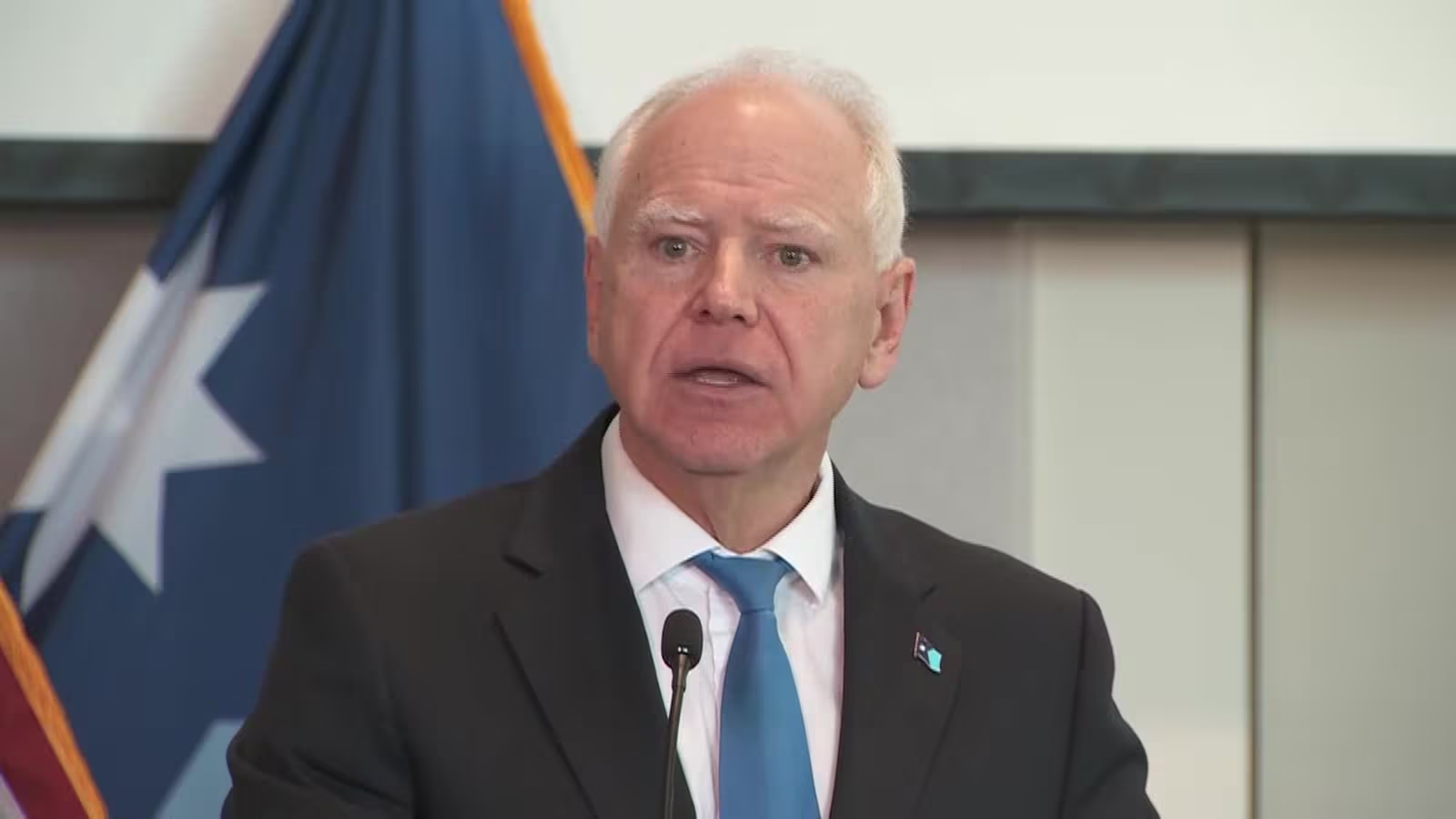
ST. PAUL, Minnesota – Republican lawmakers in the Minnesota House have introduced articles of impeachment against Democratic-Farmer-Labor (DFL) Gov. Tim Walz. The move targets the two-term governor shortly after he said he won’t run for re-election in 2026.
The resolution is dated January 12, 2026, and is led by State Rep. Mike Wiener (R-Long Prairie). It accuses Walz of “corrupt conduct in office” and claims he broke his constitutional oath by failing to faithfully enforce state laws.
At the center of the push are claims of major fraud inside state-run programs. The resolution argues the fraud could involve billions of taxpayer dollars and says Walz did not act fast enough to stop it.
The filing comes as federal investigators continue to look into large fraud schemes tied to programs such as child care assistance and Medicaid. Those probes have drawn wider attention after whistleblower reports and law enforcement raids.
Tim Walz, who has served as governor since 2019 and was the 2024 Democratic vice-presidential nominee, has rejected any claim of wrongdoing. He and his allies have described the impeachment effort as political “retribution.”
The Articles of Impeachment Against Walz, Explained
The resolution lists four articles that accuse Walz of serious failures in office:
- Article I: Concealment or Allowing Widespread Fraud
The first article claims Walz knew about broad, ongoing fraud in state programs and either helped hide it or allowed others to do so. It points to warnings from audits, reports, and other public signs of abuse. The resolution also references statements from prosecutors and whistleblowers who say the governor was briefed about large losses but did not take strong action, letting the activity continue. - Article II: Blocking Oversight and Investigations
The second article accuses Walz of getting in the way of proper oversight. It says he did not direct executive agencies to fully cooperate with audits and investigations, allowed resistance to legislative review, and failed to discipline officials tied to program oversight. - Article III: Putting Politics Ahead of Accountability (based on the resolution’s descriptions)
The third article suggests Walz focused more on political messaging than open and transparent management. It argues this approach may have weakened safeguards meant to prevent fraud. - Article IV: Failure to Protect Public Funds
The fourth article claims Walz did not fulfill his duty to enforce laws that protect public money. It accuses him of letting safeguards go unenforced, not putting stronger anti-fraud steps in place, and allowing losses to pile up across several programs.
Supporters of the resolution include Reps. Pam Altendorf, Ben Davis, Krista Knudsen, and others. They say at least 10 GOP lawmakers back the effort and cite estimates that potential losses could reach as high as $9 billion. They argue the impeachment push is about answering public demands for accountability.
Political Backdrop and Legislative Roadblocks
As of early 2026, the Minnesota House is split 67 to 67 between Republicans and Democrats. That balance makes impeachment hard to pass without some bipartisan votes. If the House approves the articles, the matter would move to a trial in the Minnesota Senate. Conviction and removal would require a two-thirds vote, at least 45 of 67 senators.
Because of the close split and the high vote threshold, some observers have called the effort more symbolic than practical.
Minnesota’s 2026 legislative session begins February 17, when the House could take up the resolution. Under the Minnesota Constitution (Article VIII, Section 3), adoption of the articles would temporarily prevent Walz from carrying out his duties until the case is resolved or he is acquitted.
Walz’s office has brushed off the effort as an attempt to ride the momentum of federal actions and political grudges. A spokesperson said: “These legislators are apparently trying to capitalize on the president’s vow for ‘retribution’ against the state.
Wider Fallout and Reactions
Respected career attorneys have resigned over the DOJ’s behavior. The federal government is attempting to pull billions from its constituents. It is shameful that this is how they’re choosing to spend their time, and we urge them to get serious.”
Walz has said his focus remains on protecting Minnesotans from fraud and responding to critics. In early January, he announced he won’t seek a third term as the controversy continues.
The impeachment filing has sparked a heated fight at the Capitol. Republicans frame it as a needed response to misconduct and inaction by the governor’s office. Democrats and Walz supporters call it a distraction and say it reflects growing national political tension spilling into state government.
The dispute has also put a spotlight on weak points in Minnesota’s public assistance programs and raised sharper questions about oversight under Walz’s administration. Analysts note that even if the articles reflect real public concern about fraud, removing a sitting governor remains a steep climb in a divided Legislature.
With the session set to begin, attention will stay on whether any Democrats break ranks or whether the effort stalls and becomes another round of political theater. For now, the articles mark the strongest formal challenge to Walz’s tenure since he took office.
Related News:
New Voter ID Laws 2026: How Will They Affect the 2026 Midterms
Who Is Leading the Democratic Party in 2026?
Politics
Trump Threatens Minnesota With Insurrection Act Over ICE Protests
WASHINGTON, D.C. – Tensions in Minnesota have spiked after President Donald Trump warned he may use the Insurrection Act to send U.S. military forces in response to protests tied to federal immigration enforcement.
The warning comes as Minneapolis sees clashes between demonstrators and Immigration and Customs Enforcement (ICE) agents after two widely reported shootings. At the same time, federal investigators say they are still uncovering large-scale fraud in state-run programs.
Republicans argue Democrats are pushing the ICE story to pull attention from the fraud cases, while state leaders such as Governor Tim Walz say the federal response is fueling fear and disorder. The White House, meanwhile, says local officials are letting unrest grow.
Rising Tensions in Minneapolis
The latest unrest grew after an ICE agent fatally shot 37-year-old Renee Nicole Good, a U.S. citizen and mother of three, during an immigration enforcement action in Minneapolis. Her death set off protests across the area, with critics accusing federal agents of using excessive force and overstepping their role during Trump’s immigration crackdown.
A second ICE-related shooting followed on January 14. A federal officer shot a man in the leg during an attempted arrest in north Minneapolis. The Department of Homeland Security (DHS) said the officer was attacked. Witnesses and local officials disputed that account and described the event as part of a wider pattern of aggressive enforcement.
Since then, protests have escalated into confrontations, including outside federal buildings such as the Bishop Henry Whipple Federal Building. Streets have been blocked, arrests have been reported, and some accounts describe agents using force against protesters, including smashing car windows and detaining bystanders.
Minnesota officials estimate 2,000 to 3,000 armed federal agents are now in the Twin Cities, a presence they say exceeds local police staffing. Walz called the surge a “federal invasion,” urged residents to document ICE actions for possible future legal cases, and asked people to keep protests peaceful.
White House Press Secretary Karoline Leavitt defended the operations, saying ICE is targeting “heinous criminals,” including child abusers and drug traffickers. She accused Democratic leaders, including Walz and Minneapolis Mayor Jacob Frey, of using public statements in ways that encourage violence toward federal officers. DHS officials also reported rising threats against agents, including alleged ambush attempts and interference during arrests.
Trump’s Insurrection Act Warning
On January 15, Trump posted on Truth Social that he would invoke the Insurrection Act if Minnesota’s “corrupt politicians” did not stop what he called “professional agitators and insurrectionists” from attacking ICE agents.
The Insurrection Act, passed in 1807, gives a president authority to deploy military forces inside the United States to suppress uprisings or enforce federal law when local authorities cannot or will not do so. Trump pointed to earlier uses of the law by other presidents and said federal agents are “only trying to do their job.”
Trump has raised the Insurrection Act before. He weighed it during the 2020 protests after George Floyd’s death, also in Minneapolis. Legal experts say the law has been used around 30 times in U.S. history, but using it in a modern major city could trigger major legal fights over federal power and civil rights.
Walz responded by urging Trump to lower the tension and stop what he called a “campaign of retribution.” Minnesota has also sued the Trump administration to block the federal agent surge, arguing it is creating chaos and spreading fear across communities.
Fraud Investigations Expand
While the ICE protests dominate headlines, federal investigators have kept pushing forward on fraud cases tied to Minnesota social services programs. Prosecutors estimate up to $9 billion may be fraudulent out of roughly $18 billion spent since 2018 across programs such as child care assistance, Medicaid-funded housing, and pandemic relief.
The investigations began surfacing in 2021 and include allegations that providers billed for services that never happened. Many cases have been linked to the state’s Somali community. So far, 98 defendants have been charged and 64 have been convicted, with investigators also looking into possible links to elected officials and terrorist financing.
The Trump administration has frozen $10 billion in child care funding for Minnesota and four other Democratic-led states (California, Colorado, Illinois, and New York), citing “extensive and systematic fraud.”
A viral video from influencer Nick Shirley, which accused Somali-run day cares of fraud, added fuel to the issue, though some of its claims have been debunked. Republicans in Congress have also held hearings, with House Oversight Committee Chairman James Comer calling for stronger accountability.
Under rising pressure, Walz announced on January 5 that he will not run for re-election, saying he needs to focus on the scandal instead of campaigning. He has admitted his administration had a “culture of being a little too trusting” and says new anti-fraud steps are now in place. Republicans argue that those changes came too late and claim the problem was allowed to grow for political reasons.
Distraction Claims Deepen
Republicans say Democrats, major news outlets, and Walz are giving the ICE protests outsized attention to draw focus away from the fraud findings. Rep. Greg Steube tied attacks on ICE agents to what he called Democratic “demonizing” of federal officers.
Vice President JD Vance praised Shirley’s video and suggested it provided stronger reporting than much of the protest coverage. The White House has also highlighted Minnesota fraud efforts in official messaging, implying that Democratic-led states share blame, and administration officials have pointed to immigrants as drivers of the schemes without offering evidence.
Democrats respond that the fraud investigations are serious but started well before the current ICE surge. They say the protests are driven by real anger over federal use of force. Walz has challenged the $9 billion estimate and says his administration helped spot problems early.
Major outlets, including The New York Times and CNN, have reported on both the protests and the fraud investigations, with live protest updates appearing alongside coverage of fraud hearings. Advocates say ICE actions have intensified under Trump and point to data showing more shootings involving immigration agents.
Both issues now sit at the center of a sharp political fight. Republicans frame the fraud as proof of Democratic failures in blue states. Democrats argue the ICE surge is meant to punish political opponents.
As investigations continue, Minnesota residents are demanding answers on both fronts, including independent reviews of ICE actions and stronger controls to prevent fraud. Another Insurrection Act move could push tensions even higher and test the limits of federal authority.
Minnesota may also preview Trump’s approach in other Democratic strongholds. The administration has already broadened fraud probes and funding freezes to states such as California and New York. Supporters say the pressure is needed to stop waste and abuse. Critics warn the strategy may weaken trust in public aid programs.
With Walz stepping aside, the 2026 governor’s race is now wide open, and the state’s political future looks less predictable. Community leaders continue to call for calm, with Walz warning against violence that could be used to justify more federal action. As national attention stays fixed on Minnesota, the state’s overlapping crises show how immigration policy, public spending, and political messaging can collide fast in Trump’s second term.
Politics
Democrats Push Back on Sen. Marsha Blackburn’s Fraud Accountability Act
WASHINGTON, D.C. – The first weeks of the 119th Congress are Democrats bringing a new fight, this time over immigration enforcement and how the federal government protects taxpayer dollars. Sen. Marsha Blackburn (R-Tenn.), joined by several Republican senators, has introduced the Fraud Accountability Act, a bicameral proposal that would tighten immigration penalties tied to fraud in federal programs.
The bill would treat fraud convictions as clearly deportable offenses under the Immigration and Nationality Act (INA). It would also allow the federal government to revoke naturalized citizenship for people convicted of fraud or other deportable crimes.
The push comes as federal investigators continue to unravel an alleged fraud network in Minnesota. Prosecutors say the losses could top $9 billion, tied to operations that presented themselves as child care centers, food programs, and health clinics. Reports have also pointed to involvement from parts of Minnesota’s Somali community, which has added fuel to Republican claims that oversight has been weak for years.
What the Fraud Accountability Act Would Do, and Why Republicans Say It’s Needed
Blackburn introduced the bill in early January 2026 with Sens. John Cornyn (R-Texas), Tom Cotton (R-Ark.), and Ted Budd (R-N.C.). The Fraud Accountability Act would update the long-standing INA by adding fraud, including fraud aimed at government programs, private people, or businesses, to the list of deportable offenses.
Supporters say the goal is simple: deter abuse, protect taxpayer funds, and make clear that immigration benefits come with obligations. Blackburn has framed the issue in blunt terms. In a press release, she said people who come to the United States and steal from taxpayers through fraud should be deported.
She has also linked the bill directly to the Minnesota fraud scandal, pointing to Trump administration actions tied to ongoing investigations. That includes freezing over $10 billion in federal grants to states under fraud review, including Minnesota, California, Colorado, Illinois, and New York.
Republicans also argue the bill responds to policy choices that they believe opened the door to abuse. They often cite a 2024 move to drop attendance verification requirements tied to child care funding. Blackburn has described the Minnesota case as a betrayal of taxpayers, pointing to allegations that empty or barely operating sites still collected millions in federal dollars.
In the House, a matching bill is led by Rep. Earl “Buddy” Carter (R-Ga.). The effort has also drawn backing from immigration enforcement groups, including NumbersUSA.
Democrats’ Response, and Why They Say the Bill Goes Too Far
Democrats have moved quickly to criticize the proposal. They describe it as too harsh, vulnerable to misuse, and aimed more at politics than policy. No major Democratic replacement bill has been introduced yet. Still, party leaders and progressive groups have pushed back on the idea of making deportation and denaturalization a central tool for dealing with fraud.
A common Democratic argument is that fraud should be punished, but the solution should focus on stronger safeguards across federal programs, no matter who commits the crime. They say the bill puts a heavy focus on immigration consequences while skipping broader steps that could prevent fraud in the first place.
Some Democrats also warn that the messaging around the Minnesota case has been reckless. They point to public references that use phrases like “Somali scammers,” and say that kind of language can stir anti-immigrant anger and paint entire communities with a broad brush.
They argue Minnesota’s alleged fraud points to deeper problems in how programs are managed and monitored, and they blame years of weak controls from both parties. They also say oversight offices have not had enough funding or staff to keep up.
Blackburn, for her part, has accused Democrats of ignoring fraud concerns for years, including during the Biden era. A Fox News segment highlighted “pushback from Democrats” against the bill and suggested it may face steep resistance in a closely divided Senate.
Immigration reform advocates aligned with Democrats have called for a more balanced approach, one that improves program integrity without widening the grounds for deportation or opening the door to more citizenship revocations, which they view as extreme.
The fight fits a familiar pattern in the early Trump administration era. Even when both parties agree fraud is a problem, they clash over whether immigration penalties should be central to the solution.
What This Could Mean in 2026
The Fraud Accountability Act is now waiting for committee action, and its path forward is unclear. Immigration votes are still tough, and bipartisan deals remain rare. Supporters may try to attach the bill to a larger must-pass package. Opponents are signaling they’re ready for a long debate.
The proposal has sparked a wider discussion about how Washington handles federal spending fraud, whether white-collar crimes should trigger stronger immigration penalties, and how enforcement debates intersect with national origin and community trust.
With the Minnesota investigation still unfolding, and with probes underway in other states, the Fraud Accountability Act may become a major test of how this Congress plans to talk about taxpayer protection and border security at the same time.
Related News:
Mainstream Media and Democrats Pivot on Portland Shooting Amid DHS Revelations
Politics
U.S. Attorney Jeanine Pirro Exposes Federal Reserve Cost Overruns
WASHINGTON, D.C. – U.S. Attorney for the District of Columbia Jeanine Pirro spent the week defending her office’s criminal investigation into Federal Reserve Chair Jerome Powell and the Fed’s headquarters renovation project.
The inquiry has rattled financial markets and sparked a fight on Capitol Hill. It focuses on reported cost overruns topping $1 billion and whether Powell misled Congress in sworn testimony.
Pirro, a former Fox News host and a long-time ally of President Donald Trump, said the case is standard oversight, not payback. She was confirmed as U.S. attorney in August 2025 after an interim appointment in May. In an appearance on Fox News’ Hannity on January 14, she said her office tried several times to contact the Federal Reserve over the winter holidays and got no response.
In a post on X late January 13, Pirro wrote that the U.S. Attorney’s Office reached out “on multiple occasions” to discuss cost overruns and Powell’s congressional testimony, then moved to legal process after being ignored.
She added that the legal process “is not a threat.” In interviews, she repeated the same point and said the situation could have been avoided if the Fed had responded to outreach.
The investigation received approval in November 2025. It escalated on January 9, when prosecutors issued grand jury subpoenas seeking documents and testimony tied to Powell’s June 2025 appearance before the Senate Banking Committee.
The renovation of the Federal Reserve’s historic headquarters buildings on the National Mall reportedly rose from about $1.9 billion to $2.5 billion, raising concerns about management decisions and the accuracy of public disclosures.
How the Investigation Started: Missed Replies and Spending Concerns
Pirro has described the probe as a basic push for accountability around taxpayer dollars. In media appearances, she stressed the scale of the overspending, saying it was not “a million” or “ten million” but “a billion dollars” in overruns. She said a gap that large can point to serious problems, including possible fraud or embezzlement, and she pressed for answers on where the money went.
People familiar with the outreach said the U.S. Attorney’s Office sent two emails during the December holidays. Those messages did not include a stated deadline or clearly signal a criminal investigation. After no reply, prosecutors quickly moved to subpoenas.
Pirro has said the steps her office took were based on the facts, and she rejected claims that the probe is tied to the Trump administration’s long-running complaints about Powell and interest rate policy.
Powell Pushes Back, Warns About Fed Independence
Powell responded on January 11 with an unusual video statement, calling the subpoenas “unprecedented” and describing them as an attempt to intimidate the central bank. He linked the investigation to pressure from the White House over monetary policy, saying the threat of criminal charges followed the Fed’s choice to set rates based on its best judgment rather than presidential preference.
Powell said he respects the rule of law and agreed with the idea that no one is above it, including the Fed chair. He also said the Federal Reserve kept Congress fully informed about the renovation project.
Capitol Hill Reaction and Wider Blowback
The investigation has drawn criticism from both parties. Republican senators on the Senate Banking Committee, including Lisa Murkowski and Thom Tillis, have condemned the probe and described it as an effort to push the Fed.
Murkowski called for a congressional review of the Department of Justice. Former Fed Chairs Alan Greenspan, Ben Bernanke, and Janet Yellen, along with other economists, issued a joint statement warning that the case could weaken the central bank’s independence.
Reports have also pointed to frustration inside the Trump administration, with some officials said to be surprised by the subpoenas and upset about a lack of coordination. President Trump has publicly distanced himself, telling NBC News he did not know about the action in advance and that his main concern remains high interest rates.
Pirro has not backed down. On Hannity, she said her office is not attacking the Fed’s independence; it is doing its job. She also pushed back on critics, including some Republicans, arguing that no public official should be treated as off limits to investigators.
What It Could Mean for the Federal Reserve and Economic Policy
The dispute highlights the strain between the executive branch and the Federal Reserve, an agency designed to operate with independence so that monetary policy remains credible. Legal experts have noted that charges such as perjury generally require strong proof that a false statement was intentional, which can be difficult to establish.
As the investigation continues, attention remains on whether the Federal Reserve cooperates in ways that prevent further escalation. Pirro has said she expects Powell’s full cooperation, and she has returned often to her central message: no one is above the law.
The story is moving quickly, with potential effects on financial markets, Fed governance, and the ongoing debate over political influence on economic policy. Lawmakers and market watchers are now waiting to see whether Congress schedules hearings or the Justice Department takes additional steps in the weeks ahead.
Related News:
DOJ Issues Grand Jury Subpoena to Federal Reserve Over $2.5 Billion Renovation Overruns
-
Crime3 weeks agoYouTuber Nick Shirley Exposes BILLIONS of Somali Fraud, Video Goes VIRAL
-
Politics1 month agoIlhan Omar’s Ties to Convicted Somali Fraudsters Raises Questions
-
News1 month agoWalz Tried to Dodges Blame Over $8 Billion Somali Fraud Scandal
-
Asia2 months agoAsian Development Bank (ADB) Gets Failing Mark on Transparancy
-
News3 months agoThe Democrats’ Great Betrayal, Champions of the Working Man to Handmaids of the Elite
-
Politics3 months agoThe Democratic Party’s Reckoning: From People’s Champion to Elite Enclave
-
Politics3 months agoThe Democrats Now the Party of White Voters with College Degrees
-
Politics2 months agoSouth Asian Regional Significance of Indian PM Modi’s Bhutan Visit